The Machine Age · 16 August 1858
Lightning Under the Sea
The queen wires the president, and the wire dies famous three weeks later
look closer
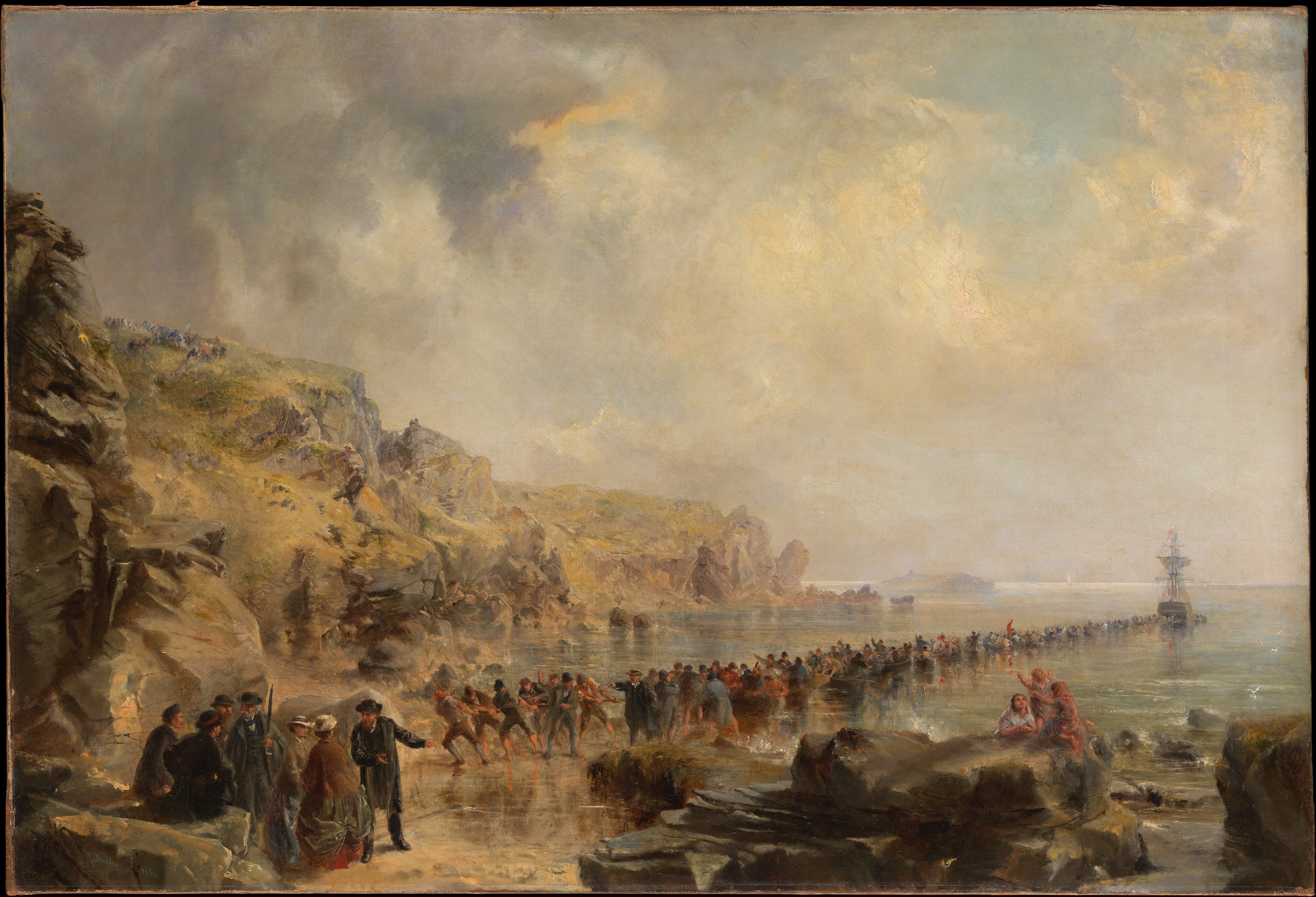
Sailors and islanders stand hip-deep in the surf at Foilhommerum Bay. They haul the shore end of the cable up the beach by hand. The wire that would carry words across the ocean came in at the speed of men pulling rope.
On 16 August 1858, Queen Victoria sends President Buchanan 98 words of congratulation, and the 98 words take 16 hours to cross. Nobody minds. Until this month, news crossed the Atlantic at the speed of the fastest ship, 10 days when the weather cooperated; a sentence in 16 hours is a miracle with room to improve. New York loses its composure: a hundred-gun salute at dawn, another at noon, torchlight parades, and a fireworks display so enthusiastic it sets the roof of City Hall on fire. The cable's promoter was Cyrus Field, a paper merchant. He had spent four years and four failed expeditions getting a wire laid across 2,000 miles of ocean floor. Now he is toasted as the man who married the continents. Three weeks later the line goes silent. The company's chief electrician, a surgeon by training named Whitehouse, had been driving signals through the exhausted cable with induction coils at brutal voltage, and the insulation cooked. The silence was so complete, and the celebrations had been so loud, that respectable voices declared the whole thing a hoax and the queen's message an invention. Field spent the next eight years, through a civil war and a dozen boardrooms, arguing a simple point: it had worked. It had carried 732 messages, and physics does not un-ring that bell. The failure had a villain and a vindicated man, and the company had chosen wrong between them. William Thomson of Glasgow, the physics professor on the project's board, had argued from theory that a wire 2,000 miles long must be whispered through. He built a mirror galvanometer to read a signal too faint to feel, a spot of lamplight trembling on a scale. Whitehouse distrusted whispers and applied his coils, up to 2,000 volts, until the deep-sea insulation failed. The inquiry that followed took the rare step of naming the physics correct and the surgeon wrong. When the 1866 cable went through, it was worked from the first day on Thomson's trembling spot of light. The crown knighted him for it, and he finished life as Lord Kelvin. The absolute temperature scale is named for the man the cable proved right. The return match needed the biggest object afloat. Only the Great Eastern, Brunel's beautiful white elephant, could carry 2,600 miles of improved cable in one belly. In 1865 she paid out 1,200 miles and lost the end in two and a half miles of water. In July 1866 she ran the line clean through, from Ireland to Heart's Content, Newfoundland. It was a fishing village of a few dozen houses that woke up as the doorstep of the instant world. Robert Dudley, the expedition's artist, had painted the start of that run. On 7 July the shore end came in under the cliffs of Foilhommerum Bay on Valentia Island. Sailors and islanders stood hip-deep in the surf, hauling the future up the beach by hand like a seine net. Ladies watched from the rocks in Sunday dresses, and the ship that carried the cable lay offshore dressed with flags. Then the Great Eastern went back out, fished the lost 1865 cable off the abyssal floor with a grapnel, spliced it, and by September there were two working wires under the Atlantic. A word cost a fortune at first, and the traffic came anyway: markets, treaties, obituaries, cotton prices. Distance stopped being a fact about information. The village telegraph office at Heart's Content clicked around the clock for the next century, relaying other people's news through a room by the sea. The failed cable of 1858 lies out there still, the first draft, dead in the dark, famous for the three weeks in which it worked.