The Age of Sail · 7 July 1770
Painted From Life
The admiral blows up a real frigate so the painter gets it right
look closer
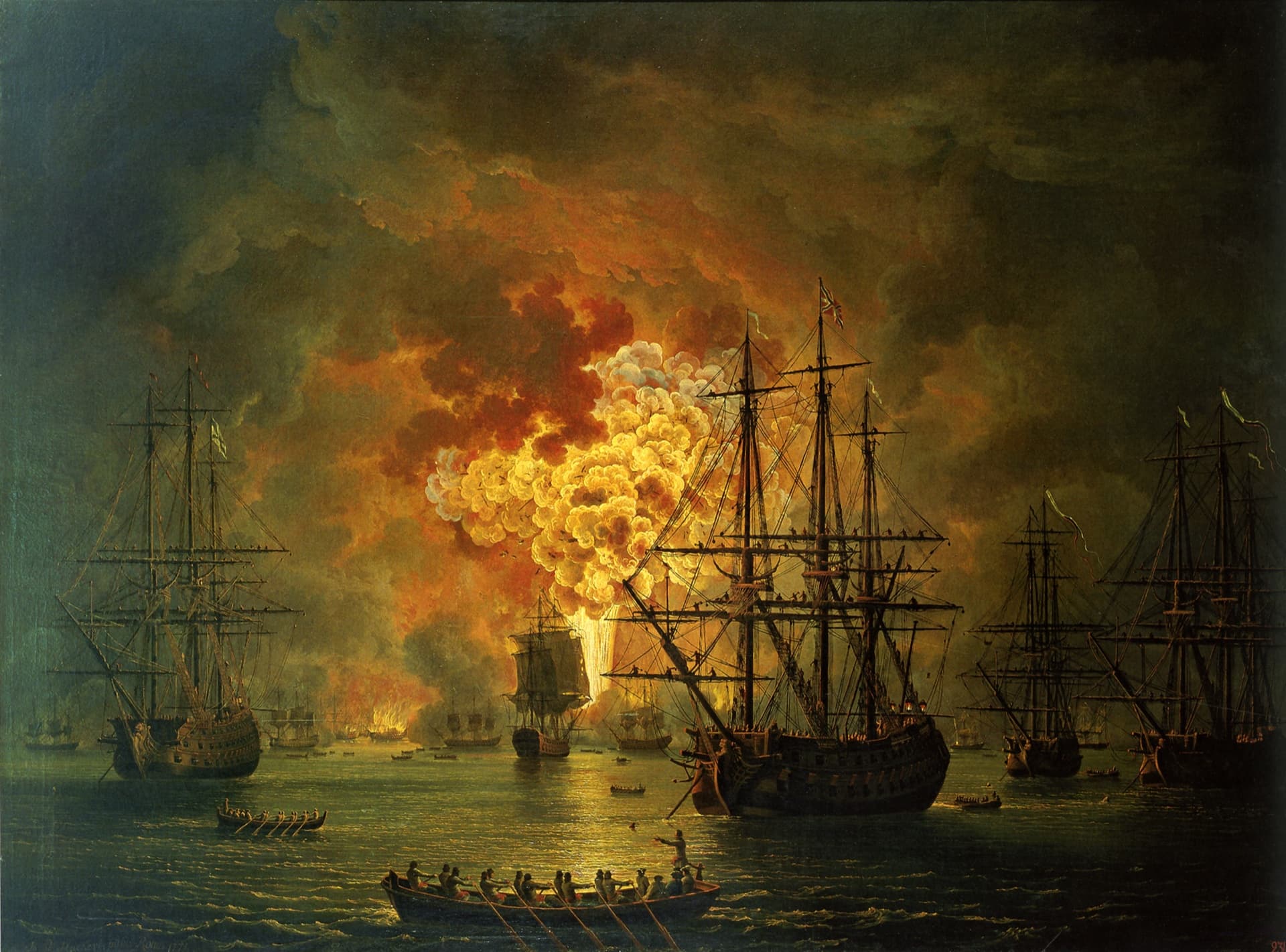
This is the fireball Hackert could not invent. He had never seen a warship blow up, so Orlov bought him one. A Russian frigate was packed with powder and fired off Livorno while Hackert sketched from the shore.
Catherine the Great had no Mediterranean fleet, so she sent her Baltic one, around the whole of Europe, to find the Ottoman navy and end it. The squadrons that arrived off Anatolia in the summer of 1770 were leaking, scurvy-worn, and commanded by her favorite's brother, Alexei Orlov, a man with no naval training and a bottomless appetite for results. On 5 July the fleets met off Chios, and the two flagships burned each other to the waterline at pistol range. The shaken Ottoman fleet, still much the larger, withdrew into the bay of Chesme and anchored in tight rows under shore batteries, which its admirals believed made it safe. On the night of the 6th the Russians sent in four fireships behind a bombardment. One of them, laid alongside by a lieutenant named Ilyin, set a ship of the line burning, and the fire went down the anchored rows like a fuse. By morning the Ottoman Mediterranean fleet was gone: some 70 vessels burned or taken, perhaps 11,000 men dead in a single night, against Russian losses in the hundreds. Catherine struck a medal for the sailors with the burning fleet on it and one Russian word, BYL, which means it was. Then came the problem of the painting, which produced the story the art world has kept ever since. Orlov commissioned a German painter in Rome, Jacob Philipp Hackert, to make a grand series of the victory for the empress. Hackert delivered handsome ships and correct rigging, and Orlov made a professional objection: the explosion was wrong, and Hackert, having never seen a warship blow up, could hardly deny it. So Orlov arranged a reference. In 1771, in the roadstead of Livorno, with the Tuscan authorities' permission and half the town watching from the shore, a Russian frigate was packed with powder and detonated for the painter's benefit. Hackert sketched the real thing: the column of fire, the lifting deck, the smoke ring, the rain of spars. The result went into the series now hanging in the Chesme Hall at Peterhof, and the fireball in this canvas is, in the most literal sense in the history of battle painting, painted from life. It is also the most expensive piece of studio reference ever commissioned, a working warship spent on a detail. Nobody in the Russian court considered this excessive, which tells you what the victory was worth to them. Catherine built a church and a palace named for the bay, and Europe recalculated: Russia now reached the Mediterranean. Hackert kept painting for princes for 40 years, and presumably never again had to ask a client to blow something up. Once had been enough, and it shows.