The Revolutionary Age · 5 March 1770
The Bloody Massacre
A snowball fight ends with 5 men dead, and Revere has his print of it selling in 3 weeks
look closer
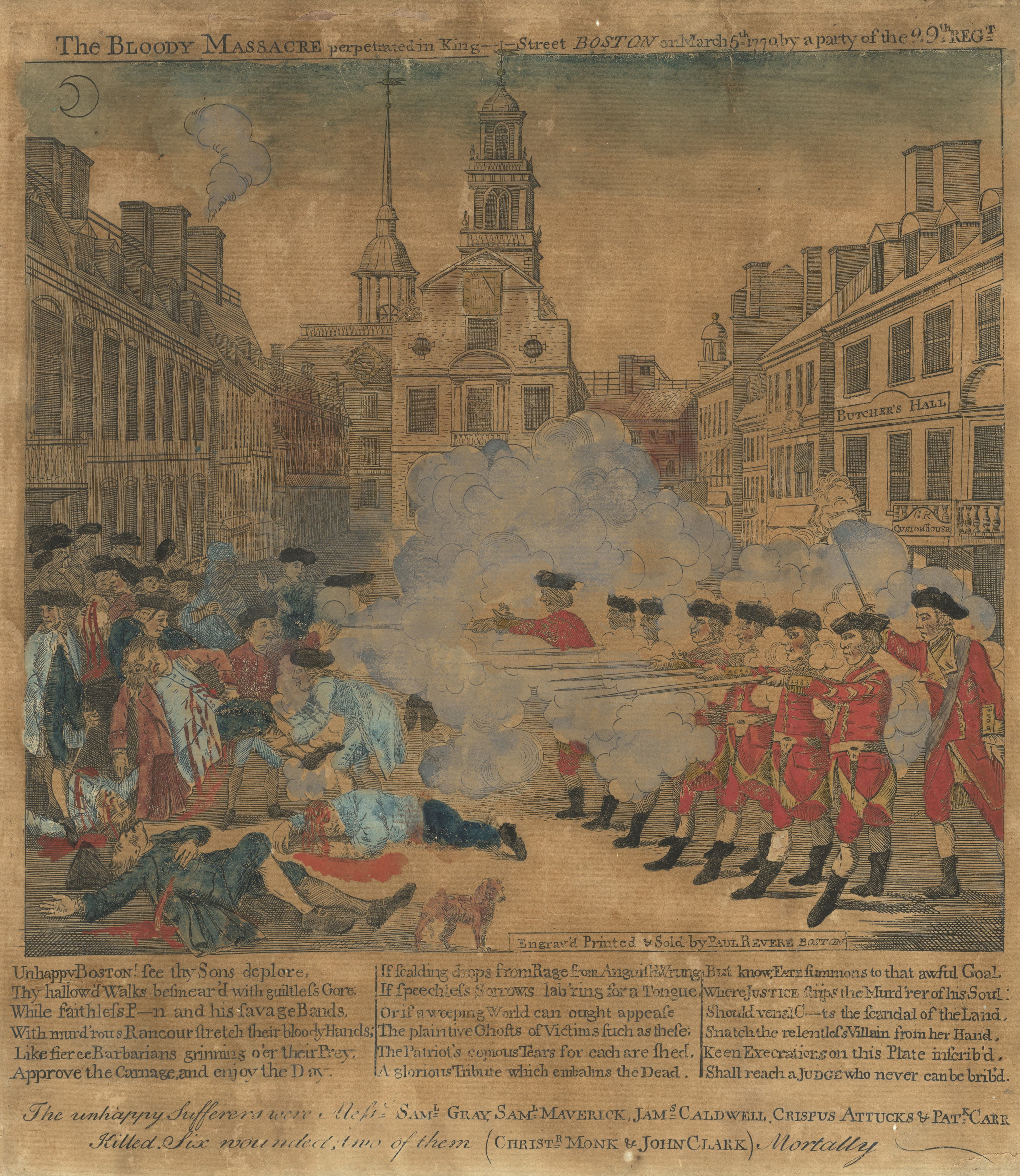
Revere drew a drilled line of soldiers firing on command. An officer stands behind them with his sword up. The night was closer to a panicked scuffle on the ice.
It began with a boy insulting an officer over an unpaid wig-maker’s bill. By nine on the cold night of the fifth of March, 1770, a lone British sentry named Hugh White stood outside the Custom House on King Street. A crowd was growing around him, and the boys were throwing snowballs packed hard with ice. White struck one of them with his musket. The crowd thickened, church bells rang as if for a fire, and Captain Thomas Preston marched down a relief of seven soldiers of the 29th Regiment to rescue the sentry. They fixed bayonets and could not get back out. Someone swung a club and knocked Private Hugh Montgomery flat on the ice. He came up firing, and the rest of the line fired after him, ragged, without an order anyone could later prove. Five men in the crowd died. Crispus Attucks, a dockworker of African and Wampanoag descent who had escaped slavery 20 years before, took two balls in the chest and fell first. Samuel Gray, a rope-maker who had brawled with soldiers days earlier, and James Caldwell, a sailor, died on the spot. Samuel Maverick was 17 and lived until morning; Patrick Carr, an Irish leather-worker, lasted nine days and told his doctor he forgave the men who shot him. It was not a battle. Eight nervous soldiers had fired into an unarmed mob at point-blank range, and the town had its martyrs before the bodies were cold. Paul Revere, a Boston silversmith, put the scene on a copper plate within the month. The trouble is he stole it. A young painter named Henry Pelham had drawn the same view first and lent it around; Revere copied the composition, engraved it, and had prints selling before Pelham’s own could appear. Pelham wrote him a furious letter comparing the theft to a highway robbery, and there is no record that Revere ever answered. The picture is a lie in the honest sense of propaganda. Revere drew the soldiers as a disciplined firing line loosing a volley on command, an officer’s sword up behind them, when the truth was closer to a panicked scuffle. He labeled the Custom House “Butcher’s Hall.” He drew a musket firing out of an upper window of it. Blood runs in neat lines toward the gutter. Under the image he printed a verse: “Unhappy Boston! see thy Sons deplore / Thy hallowed Walks besmear’d with guiltless Gore.” The prints went up in taverns and parlors across the colonies and did exactly what they were made to do. At the trial that autumn, a lawyer named John Adams took the soldiers’ defense. He argued that the crowd had been a rabble of “saucy boys, negroes and mulattoes, Irish teagues and outlandish jack tars,” and got Preston and six of the men acquitted. Two were convicted of manslaughter and branded on the right thumb with a hot iron, an M, in open court, and walked free. In the foreground of Revere’s print, between the dead and the boots of the soldiers, a small brown dog stands in the road. It faces out of the picture, the one witness there that takes no side.