The Age of Sail · 14 May 1829
The Brig That Said No
A brig of 18 guns declines the invitation of 184
look closer
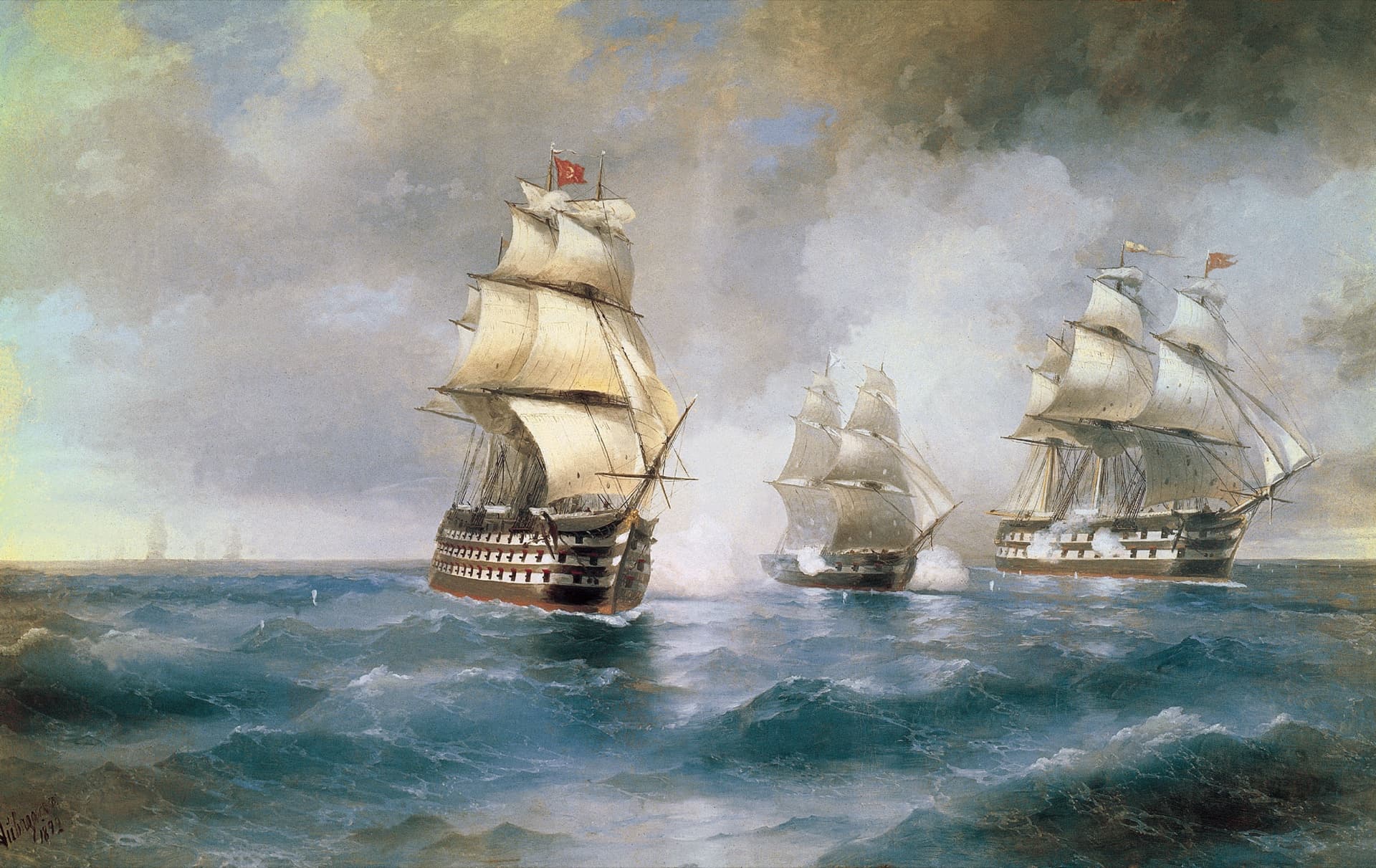
The Mercury is the small ship in the middle, with her flag still flying at the masthead. A much bigger warship stands on either side of her. A brig cannot sink a warship with 3 gun decks, so her gunners shot at its masts and rigging instead.
On 14 May 1829 Russia and Turkey were at war over the Black Sea. The 18-gun brig Mercury was caught alone by the two fastest ships of the line in the Ottoman fleet. The Selimiye carried 110 guns and the Real Bey 74. The arithmetic was 184 guns to 18, and the wind was light, which favored the big ships. Custom offered a clean exit; a small vessel overhauled by force of that order could strike her colors with her honor intact, and the Turkish admirals, by every account, expected exactly that. Her captain, Alexander Kazarsky, 31 years old, called his officers to council, and the council voted for the other tradition. The colors were nailed up, and a loaded pistol was laid on the capstan beside the powder magazine. The last officer alive was to fire it into the powder rather than let the ship be taken. Then the Mercury fought a running battle of over three hours against two floating fortresses, her sweeps out in the calms. Her gunners had orders to aim high, at spars and rigging rather than hulls. A brig cannot sink a three-decker, but she can undress one. A chain-shot cut the Selimiye's rigging and forced her out of the chase; the Real Bey pressed on, took a wrecked topmast of her own, and gave it up. The Mercury came home to Sevastopol with 22 holes in her hull, some 300 hits counted in her masts and rigging, four men dead, and the pistol on the capstan unfired. An officer of the Real Bey, writing home, produced the tribute the Russians have quoted ever since. If there are miracles in history, this was one, and the name of the little brig deserved to be written in gold. Sevastopol raised a monument to Kazarsky in 1839, the first public monument in the city's history, inscribed with four words: an example to posterity. The example was needed sooner than the marble. Kazarsky himself was dead by 1833, at 36, poisoned, it was widely believed, while investigating dockyard corruption for the tsar. His courage was no armor in that war. Aivazovsky, who was born on that coast and painted its water for 60 years, returned to the Mercury late in life. In the 1892 canvas the brig is small, white-sailed, and precisely between her two executioners, the sea running easy and enormous underneath all three. He signed it in the corner 8 years before he died, one more picture in the 6,000 or so of his life, and the only one where the smallest ship in sight is winning.