Feudal Japan · c. 1565
The Capital in Gold
A young painter shows Kyoto thriving while the real city smoulders
look closer
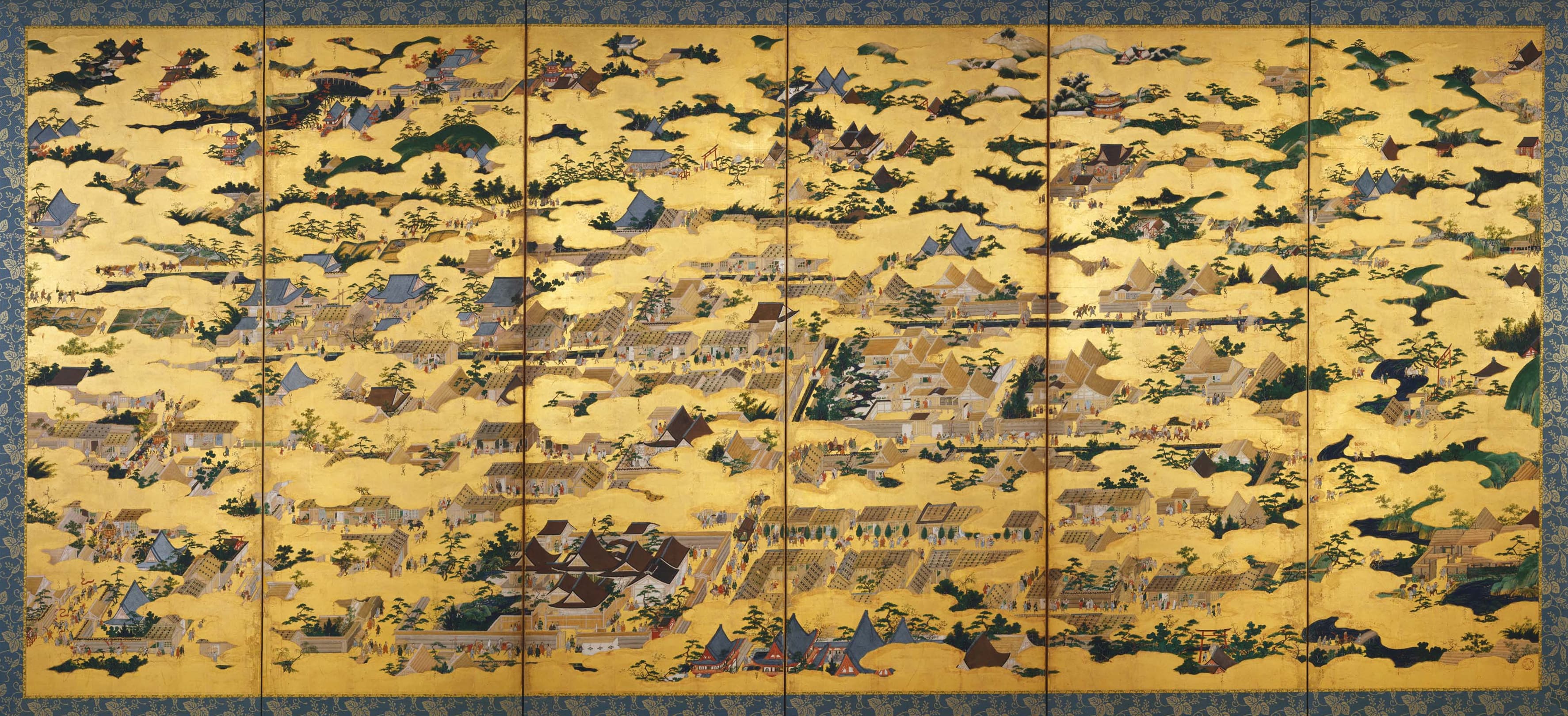
Brown shingled halls stand inside a wall, with a bright red gallery at the lower corner. Small figures cross the yards between them. Gold cloud is banked against the compound on every side, so it sits in the capital like an island.
Someone in the 1560s hands a screen painter the whole of Kyoto to fit onto folding panels, and the painter, most likely Kanō Eitoku, is barely into his twenties. What he produces is a bird’s eye view of the capital from above the rooftops: streets and bridges and mansions and the imperial palace, temples with their pagodas. The Gion festival floats are being hauled through the crowds, and the shops have their goods laid out. Around 2,500 human figures are scattered across the pair of screens, each a few centimeters tall, each doing something. Bands of gold cloud lie across the city like fog, hiding the parts the painter chooses to skip and letting him jump from one district to the next. The strange thing is what the picture leaves out. The Kyoto of these years was not thriving. The Ōnin War had burned much of it to the ground a lifetime earlier, in the 1470s, and the wars that followed kept it poor and dangerous. Whole streets stood empty, the shogun’s authority was a fiction, and armies passed through as they pleased. Eitoku paints none of that. He gives the warlords and the court the capital they wanted to believe in, orderly and rich and busy, a city worth ruling. This is a screen doing a job, and the job is partly flattery. Eitoku belonged to the Kanō workshop, a family business that painted for whoever held power, and he became its greatest name. He would go on to cover the walls of Nobunaga’s tower at Azuchi and Hideyoshi’s palaces in gold and giant trees and hawks. That work was tied so closely to those two men that when their castles burned almost all of it burned with them. Very little survives. That is why a screen like this one is treasured: it is one of the few places you can still stand in front of Eitoku’s actual hand. This particular pair has a paper trail. Oda Nobunaga owned it, and in 1574 he sent it north as a gift to Uesugi Kenshin, the same Kenshin who a decade earlier had ridden into Takeda Shingen’s camp at Kawanakajima. It has stayed with the Uesugi family ever since. The image here is the left screen of the two. The gold is not sky but a curtain. Everywhere it lies, Eitoku has left out whatever the city was really doing underneath.