Ancient Rome · AD 476
The Course of Empire
The empire ends with a signature, a pension, and a villa by the sea
look closer
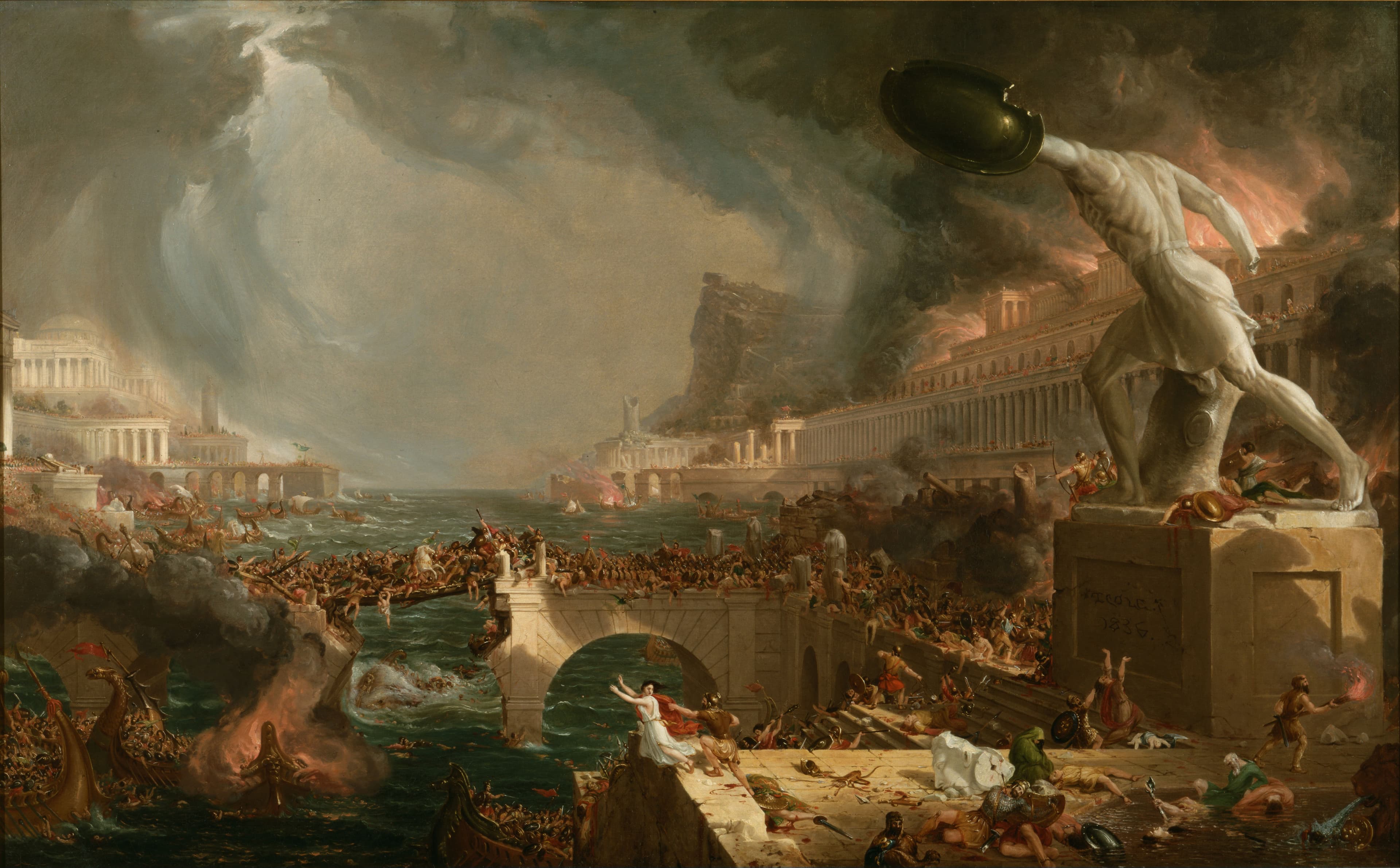
The giant marble soldier strides on with his shield up and his head broken off. Cole copied the pose from an ancient statue called the Borghese Gladiator, which still has its head.
The emperor of the West is about 15 years old, and on the fourth of September, 476, he signs away the empire. His name is a bad joke history could not have improved: Romulus, after the founder, Augustus, after the first emperor, and behind his back Romulus Augustulus, the little Augustus. He had been emperor for 10 months, and only because his father Orestes needed a Roman face on his regime. Orestes was a soldier who had once been secretary to Attila the Hun, and he had taken Ravenna by force. The face was the boy's. The power was the army's, and the army was no longer particularly Roman: Germanic soldiers who had been promised land in Italy and not been given it. Their officer Odoacer made the obvious offer, land for loyalty, and when Orestes refused, the mutiny took a few weeks. Orestes was caught and executed at Piacenza. At Ravenna, Odoacer found the boy emperor and did something almost unheard of in the fifth century: nothing. He took pity, the sources say, on the boy's youth and his good looks. He granted him a pension of 6,000 gold pieces a year and sent him to live with his relatives on the Bay of Naples. The house was a fortified villa that had once belonged to Lucullus, the republic's most famous gourmet. Then Odoacer mailed the imperial regalia to Constantinople with a message of studied modesty: one emperor was enough for the world, and he would govern Italy merely as king. No new Caesar was appointed in the West. Nobody thought to announce that anything had ended, because on the ground almost nothing had. The Senate still met and the taxes still moved. Odoacer ruled the way the last several strongmen had, only without the puppet. The fall of Rome, as a date and a headline, was invented afterward. It took a Byzantine chronicler two generations later to point at 476 and say there, that is where the Western empire died, and historians have been arguing with him ever since. As for the boy, the record simply loses him. A letter from the next king's officials, 30 years later, seems to show him still alive at the villa and still drawing the money. The last emperor of the West grew old by the sea, on a pension from the world that had replaced him. Thomas Cole finished Destruction in 1836, the fourth of the five canvases in his Course of Empire. He made the ending everything the paperwork was not. Ships burn in the harbor and the crowd fights across a broken bridge on a wooden beam. Above all of it a colossal marble warrior strides on, his head already gone. Cole was watching his own young republic swell with money and confidence, and hung the series in a merchant's parlor as a forecast. The five canvases run a single harbor city from wilderness to wilderness: hunters in skins, then shepherds, then a marble capital at glittering noon, then this, then silence, one broken column with a heron's nest. Cole put the same landmark in all five pictures, a crag with a boulder balanced on top. It sits at the edge of every scene. The place never changes, only the people. His patron Luman Reed, a self-made grocery millionaire, died before the series was finished. New York exhibited it to crowds in 1836 anyway. Audiences were meant to leave asking where on the arc their own republic stood, and Cole, watching the boom years around him, had a private answer he mostly kept out of the catalog. The empire in the painting dies the way memory insists Rome must have. The real one ended with a signature and a change of address.