Classical Greece · 399 BC
The Cup He Chose
The escape is paid for; he chooses the hemlock and one more argument
look closer
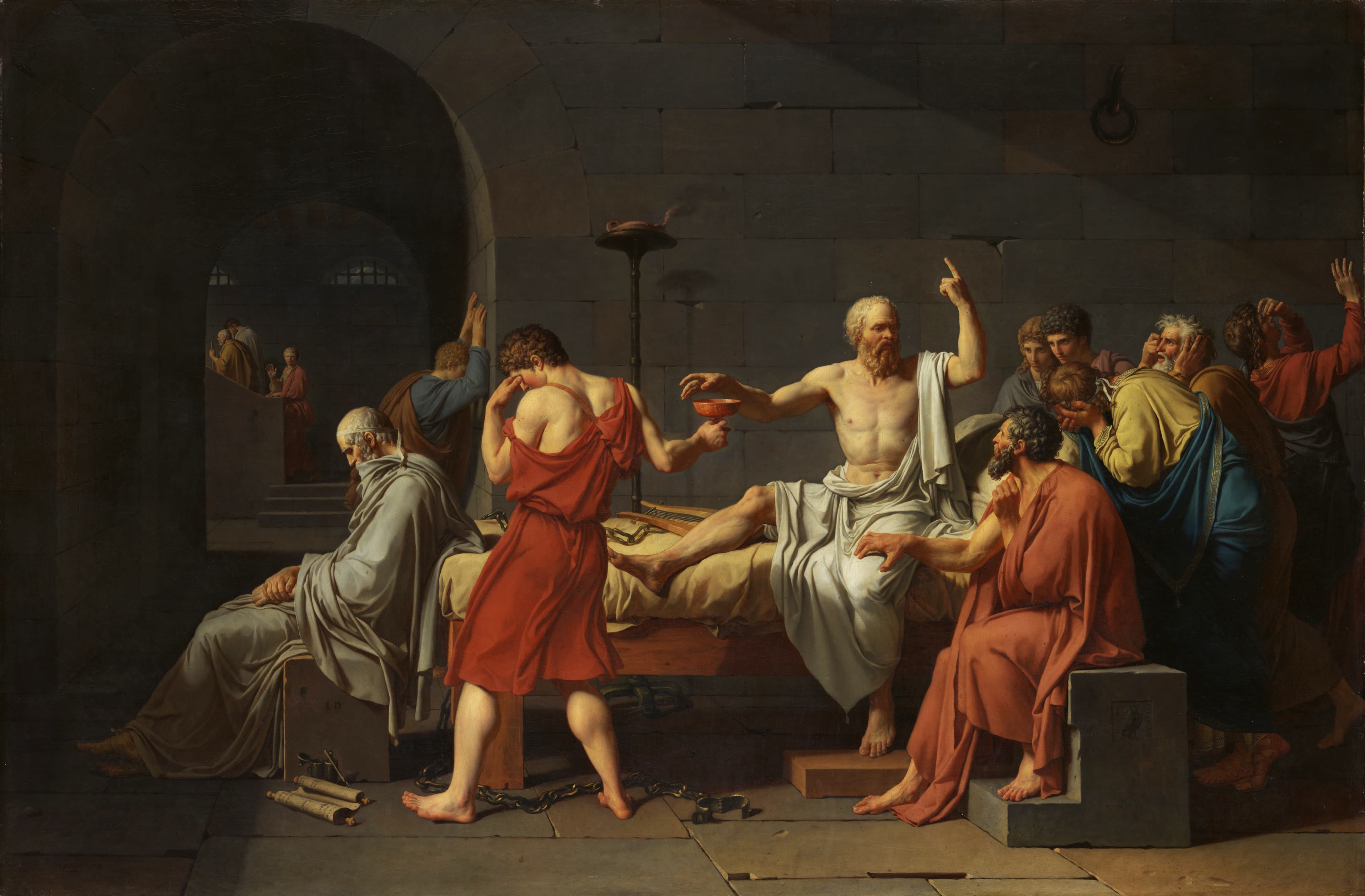
Socrates reaches for the cup without looking at it, still talking. The jailer who brought it has turned his face into his own arm.
The ship from Delos has been sighted, and that settles it. Athens sends a sacred galley to the island every year, and while it is at sea the city keeps itself ritually clean: no executions. The voyage bought Socrates a month in chains. His friends spent the month arranging a bribe and a fast exit to Thessaly, and on the last morning Crito arrives with everything ready and one job left, which is to convince the prisoner. The prisoner declines. He is 70 years old, he has spent his life arguing that the examined life obeys its city's laws, and he is not going to refute himself on the way out the door. Running, he tells Crito, would only prove the jury right. The jury had been 501 citizens. The vote was close, roughly 280 to 220, on charges that he disbelieved the city's gods and corrupted its young men. What convicted him was less the evidence than the tone. Asked to propose his own penalty, as Athenian law allowed, he suggested free dinners for life in the town hall, the honor given to Olympic champions. The second vote, on death, was wider than the first. He was a stonemason's son who had stood his ground as a soldier at Potidaea and Delium. He was a famously ugly man with a snub nose who owned one cloak and wrote nothing in his life. He spent 40 years in the market asking people to define the words they used. Athens laughed at him, listened to him, and at last, five years after losing an empire and a war, ran out of patience. The machinery of the verdict was as ordinary as a market day. Jurors chosen by lot drew three obols for the sitting; speeches timed by a water clock; the votes cast with bronze disks into urns and counted by hand. Athens tried its philosopher under the same procedures it used for tax fraud. That was, in his telling, rather the point of staying for the sentence. The laws that killed him were the laws he had lived under for 70 years, argued under, soldiered under. A man does not get to obey them only when they flatter him. Plato reconstructed the speeches, and Xenophon gathered accounts from those present. Neither of them ever quite got over the tone of the defendant, which was that of a man conducting a seminar on trial procedure from inside the dock. The last day fills with visitors. Xanthippe, his wife, is sent home when she cannot stop crying. The friends nearly cannot start the conversation, and he needles them into one more argument, a long one, about whether the soul survives the body. It is his answer to the question nobody will ask out loud. Toward sunset the jailer brings the cup, apologizing as he does it; hemlock was the humane machinery of the age, and the man who ground it knew his trade. Socrates asks the practical question, how one does this, the way a man asks about any tool. Drink, walk until the legs are heavy, lie down. The cold comes up from the feet. His friends break; he tells them a man should die in silence worth keeping. Then, with his face covered: Crito, we owe a rooster to Asclepius. Pay it, don't forget. Asclepius healed the sick. Nobody has ever settled what the debt was for. Jacques-Louis David painted the scene in 1787 and moved history's furniture where drama needed it. Plato sits at the foot of the bed, though Plato tells us himself he was sick at home that day. David paints him old, dreaming the room he would spend his life writing down. The reaching hand does not look at the cup. The other hand is still up, one finger raised, holding the point he has not finished making. Paris had two years left before it started holding trials of its own.