The Revolutionary Age · 27 April 1848
The Decree Read Aloud
Martinique will not wait for the ship carrying its freedom
look closer
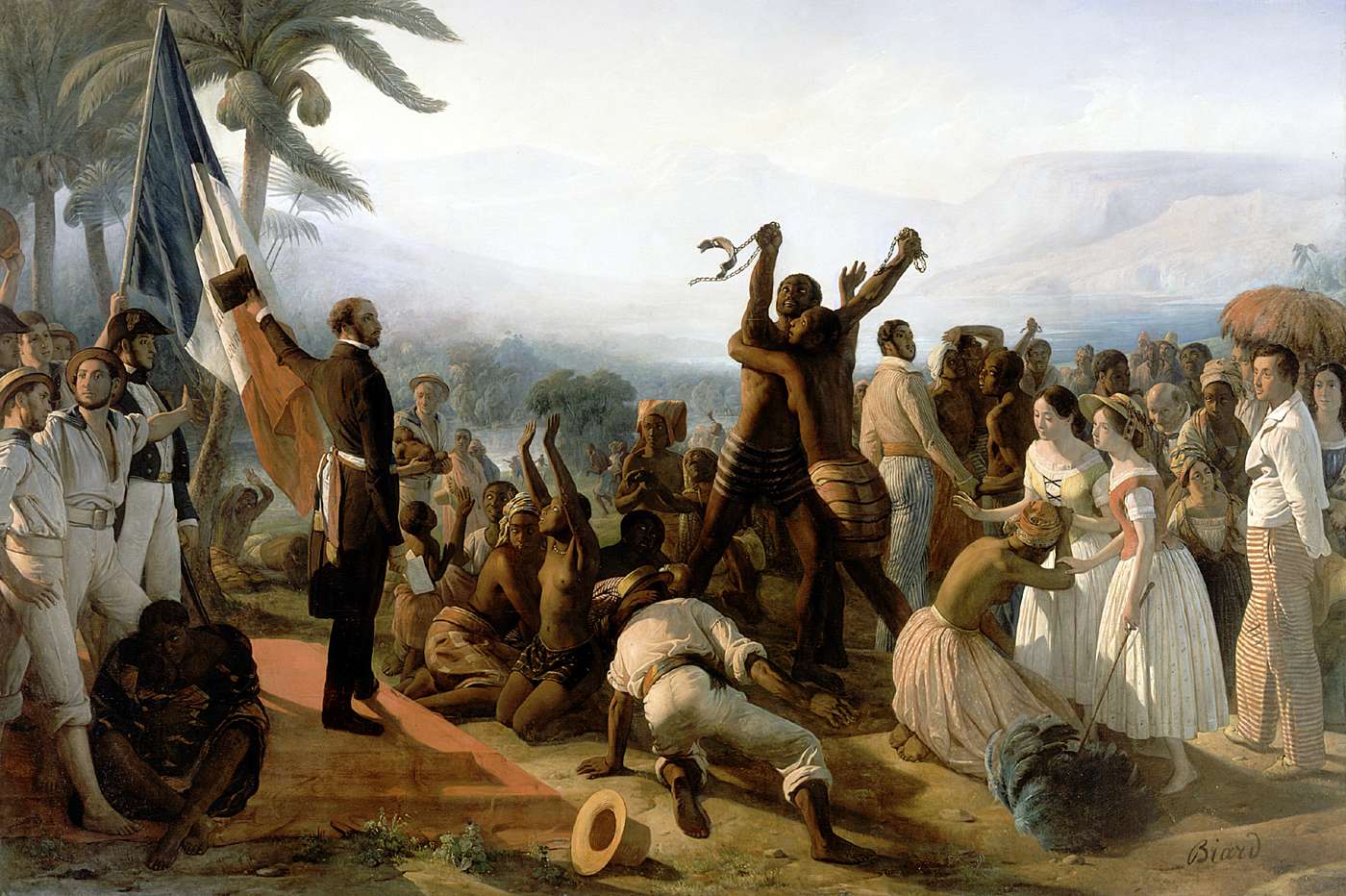
A man lifts both arms with the broken irons still hanging off his wrists, and a woman holds on to him. Biard took this couple straight out of his own painting of 1846, The Right of Search.
The paper being read out is the decree of 27 April 1848. The Second Republic was two months old, and it spent some of its first energy on the oldest debt in the empire: slavery in the French colonies, ended at once and for good. The push came above all from Victor Schoelcher, the son of a Paris porcelain maker. He had seen the plantations of Cuba and the American South in his twenties, and spent the rest of his life working against them. As undersecretary for the colonies he drafted the decree, pushed past the delays the planters wanted, and got the signatures. About a quarter of a million people in Martinique, Guadeloupe, Réunion and Guyane were, on paper, free. On paper, and across an ocean. The decree had to sail, and while it sailed the plantations kept working. In Martinique the enslaved refused to wait. An enslaved man named Romain was arrested on 21 May, the island rose the next day, and the governor proclaimed emancipation on the 23rd with the official text still at sea. Freedom in the French Caribbean has two birthdays: the one Paris signed and the one Saint-Pierre took. The proclamations that followed island by island through May and June looked, at their best moments, something like Biard's canvas. A delegate reads the decree out under the tricolor. Broken chains go up over the crowd. People hold each other across a line that had been law the day before. Biard showed the painting at the Salon of 1849, and the state bought it that June for 2,400 francs. It hangs at Versailles now, and it has to be read the way official memory is always read. This is the emancipation Paris wished to see: thanks aimed at the flag, the freed on their knees at the feet of the freers. The rising that jumped the schedule is nowhere in the frame. Biard did leave one thing in that the official version did not need. The pair at the center hold each other and their broken irons in the same movement, and neither of them is looking at the man with the decree. Schoelcher spent the rest of a long life defending the decree's promise, died a senator, and lies in the Panthéon. The islands keep the May dates as the true anniversaries. The painting keeps the April one, which is also true, and says nothing about who forced the pace.