The Renaissance · c. 1426
The Friar’s Porch
A friar above Florence paints the oldest story under the newest building in town
look closer
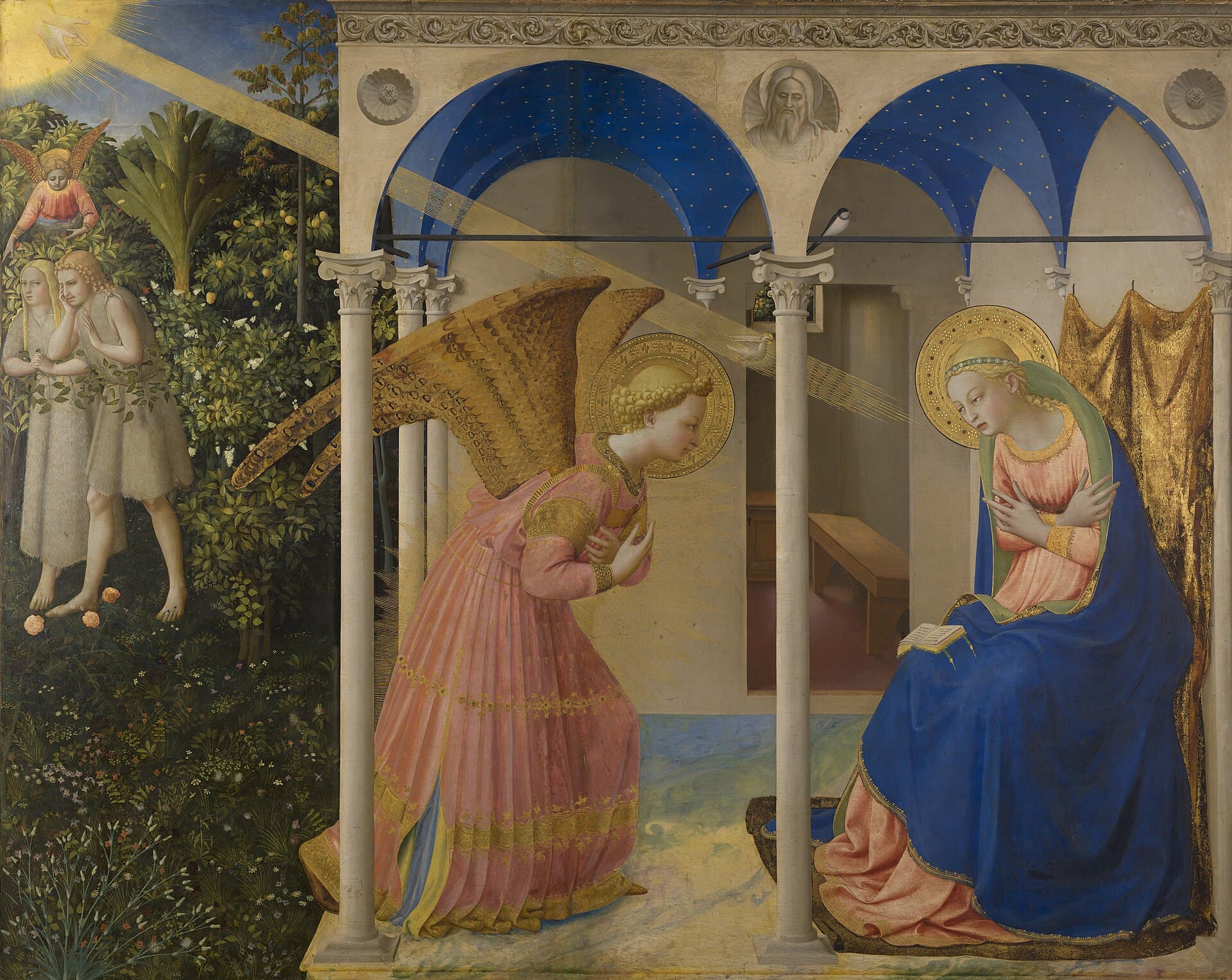
An angel in red pushes Adam and Eve out through the flowers. Eve holds her hands together and Adam covers his face. They leave the garden on the same panel where Mary says yes.
Around 1426 a Dominican friar in the hills above Florence painted the moment a girl learns she is going to have a child. Guido di Pietro, called Fra Giovanni by his brothers, was about 30. He lived at the convent of San Domenico in Fiesole and painted for it. The scene is the Annunciation, told in Luke: an angel, a young woman, a few words. Painters had shown it for 1,000 years. He put it on a porch. The porch is the new thing. Slim columns, round arches, a vault painted blue and dusted with gold stars. Florence had just seen its first building like this. Brunelleschi began the arcade of the foundling hospital in 1419, and its row of arches on thin columns changed what a Florentine street looked like. Fra Angelico took the arches and made them the front of Mary’s house. The angel kneels under one arch and Mary sits under the next. The room behind her is a plain cell with a bench and a small window. Heaven arrives at an ordinary house, and the house is the newest thing in town. Everything else is the old craft at its best. The angel’s wings are gilded feather by feather. The light in the top left corner is gold leaf too, a beam that runs from the hands of God across the garden to a dove hanging in the air before Mary. Her robe is ultramarine, ground from lapis lazuli carried from the mines of Afghanistan, a pigment that cost about as much as the gold beside it. A convent paid for this. On the left, outside the porch, an angel in red drives Adam and Eve out of a garden thick with flowers. Their exit and her yes hang in the same picture, and the beam of light crosses both. A swallow sits on the iron rod that ties the arches together, the kind of rod every real arcade needed. Vasari, writing a century later, said the friar prayed before he picked up a brush and never changed a stroke once it was down, believing that was how God wanted it. He wept, Vasari says, when he painted the Crucifixion. Whether or not any of that is true, the Church took it seriously. In 1982 John Paul II beatified him, and the man his brothers knew as Fra Giovanni became the Blessed Angelico, patron of artists. Masaccio was working across the valley in the same years, and the porch in this panel obeys the same rules of depth he was inventing. The friar simply kept the gold. The panel stood in Fiesole for nearly 200 years. In 1611 the convent sold it, with the 5 small scenes from Mary’s life along its base, to the Duke of Lerma, the most powerful man at the Spanish court. He gave it to the convent of the Descalzas Reales in Madrid, and in 1861 it moved across the city to the Prado. In 2019 the museum cleaned it. Centuries of yellowed varnish came off, and the blue of the vault and the pink of the angel’s robe came back to what the friar had mixed. The swallow was still on its rod.