Ancient Rome · 7 December, 43 BC
The Golden Pins
The finest voice in Rome ends up in a lady's lap
look closer
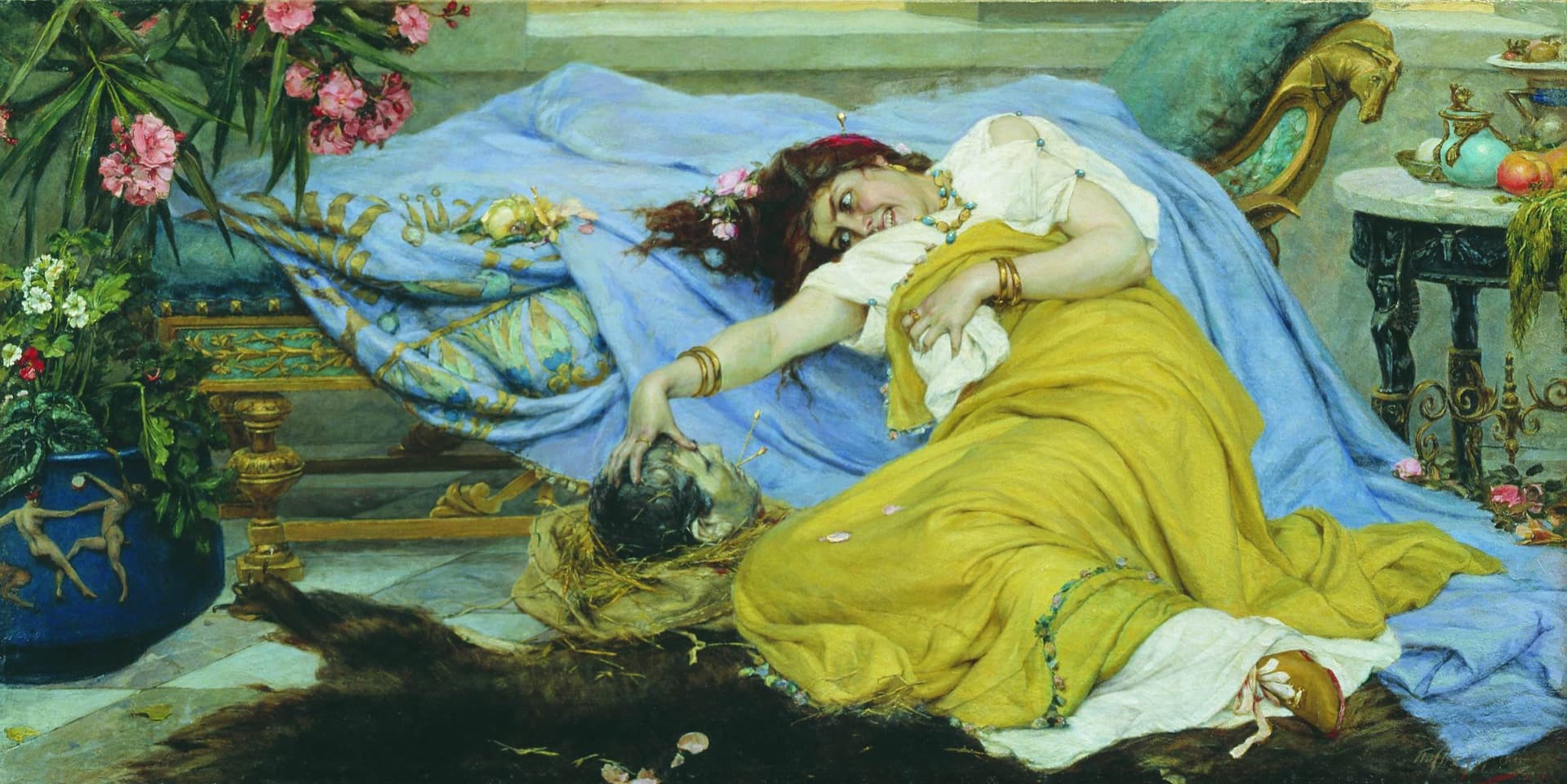
A gold pin still stands in her hair with roses tucked in beside it, and she is grinning with her cheek on her arm. Cassius Dio is the only ancient writer who tells this story at all.
The three men met on a river island near Bononia, in guarded privacy, and spent two days trading the names of people who had to die. Octavian was 19. Antony and Lepidus were the other two thirds of the new arrangement. What came out of the meeting was the proscription list, a public register of citizens any man could kill for a share of the estate. Plutarch says Octavian spent the first day defending one name and surrendered it on the second. The name was Cicero, the old consul who had promoted him, and who privately called him a boy to be praised, honored, and pushed aside. Antony wanted Cicero more than he wanted anyone. Cicero had spent the autumn of 44 writing 14 speeches against him, the Philippics, and reading them aloud to Rome. The killers caught up with him on 7 December near his villa at Formiae. He was in a litter, carried toward the sea, where a ship was waiting that he had twice boarded and twice abandoned. The squad was led by a centurion named Herennius and a tribune named Popillius, whom Cicero had once successfully defended in court. He heard them coming, told the bearers to set the litter down, and put his head out, stretching his neck for the blade. He was 63. On Antony's instructions they took the head, and the hand that had written the Philippics. What happened before the trophies reached the Forum is in Cassius Dio. Fulvia, Antony's wife, had her own account to settle. Her first husband was Clodius, the street politician who had been Cicero's enemy until he was murdered on a road. Cicero had defended the murderer with pleasure. She took the head on her knees, spat on it, and drew out the tongue that had made the jokes, and pushed her hairpins through it, adding, Dio says, jokes of her own. Then the head went where Antony ordered: nailed to the Rostra, the speaker's platform, above the spot where the voice had done its work. Romans came to look and could hardly bear it; Plutarch says what they saw there was not Cicero's face but the image of Antony's soul. The arithmetic of the aftermath took 50 years to finish. Fulvia was dead within 3 years, Antony within 13, both badly. Octavian outlived the list he had signed, became Augustus, and one day caught a grandson hiding a scroll of Cicero under his cloak. He took the book, stood reading for a long time, and handed it back with the sentence Plutarch preserved: a learned man, child, a learned man and a lover of his country. Svedomsky, a Russian with a studio in Rome, painted Fulvia at her ease in about 1898. The trophy lies on a straw mat beside the couch with the pins already placed, and the rest of the room is arranged for an ordinary comfortable afternoon.