Medieval Europe · 29 May 1453
The Last Tuesday of Rome
After 11 centuries, the walls of Theodosius meet gunpowder
look closer
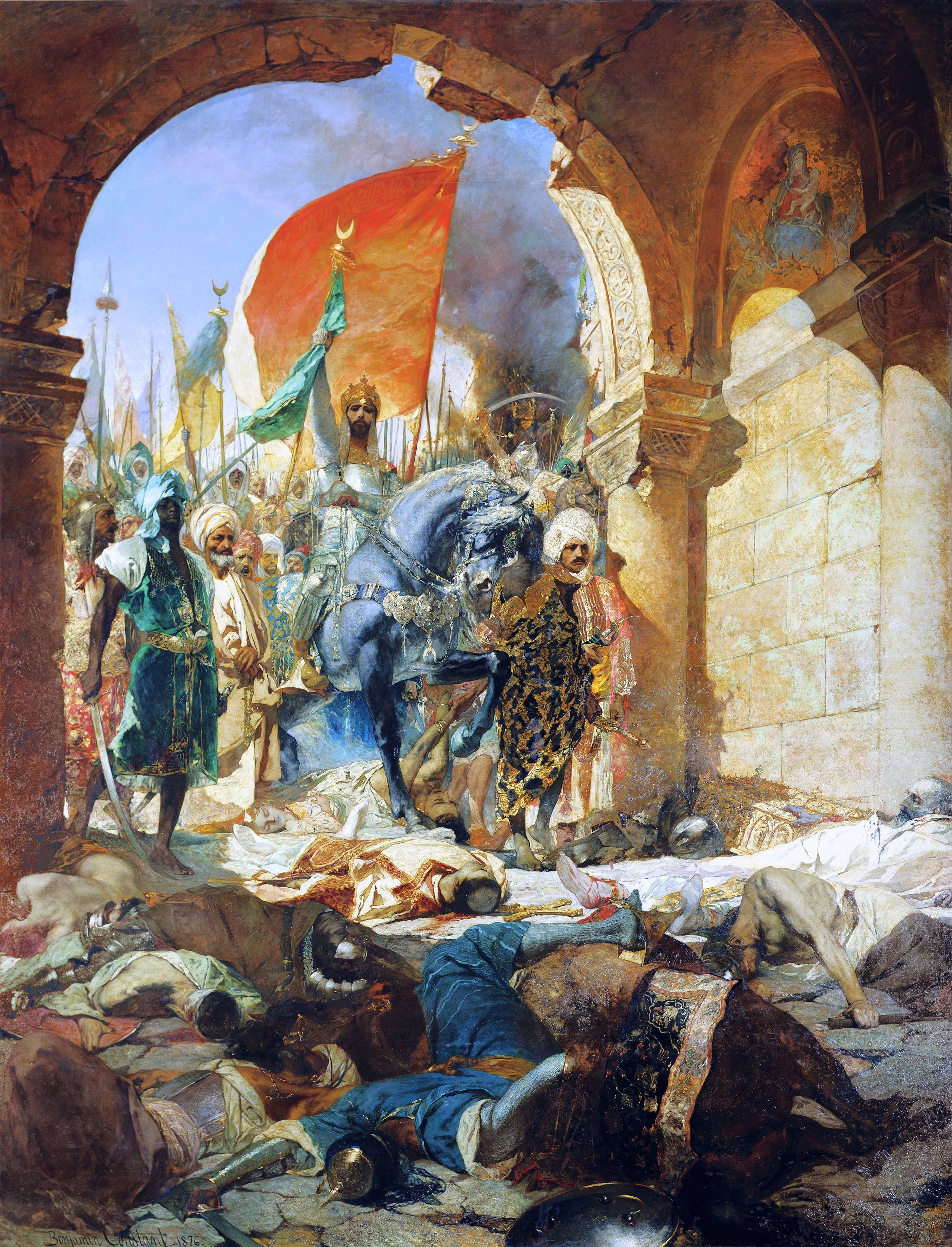
Mehmed was 21. Benjamin-Constant paints him in a jewelled turban and silver mail. He is under a red standard, and its staff ends in a crescent.
The walls have never failed. For a thousand years, everything that hated Constantinople broke against these three rings of stone: Huns, Avars, Arabs, Bulgars. The city behind them is 1,123 years old this month, counting from the day Constantine the Great dedicated it. It is mostly memory now: perhaps 50,000 people living in villages scattered inside ramparts built for a million, growing vegetables between the palaces. What remains intact is the name. This is still, in law and in its own mind, the Roman Empire. The tired man commanding its defense is Constantine, eleventh of that name, the last of a line of emperors that runs back to Augustus. The army outside has something new. A Hungarian engineer named Orban came to the Byzantines first and offered to build them the largest gun on earth; they could not pay him. The sultan could. The barrel that resulted is 27 feet long and fires a stone ball half a ton in weight. It took 60 oxen to drag it from the foundry at Edirne. It can be loaded and cooled only seven times a day, and seven times a day for seven weeks it has been chewing the land walls. Mehmed, 21 years old and two years on the throne, has an engineer’s patience and no hurry. When the great chain across the Golden Horn kept his fleet out of the harbor, he had 70 ships hauled overland on greased timbers, over a 200-foot ridge, in a single night. The defenders woke to find an enemy navy floating inside their moat. On the evening of the twenty-eighth of May, everyone in the city who can walk crowds into the Hagia Sophia. Greeks and Latins have refused to share a liturgy for 400 years; tonight, with the guns finally silent outside, they sing it together. A few hours later the assault comes in waves out of the dark: first the irregulars, spent like water, then the Anatolian regiments, then the Janissaries. The defense holds until its hinge snaps. Giustiniani, the Genoese captain who has commanded the land walls all siege, takes a wound and is carried to his ship, and the men who watched him go stop believing. Someone finds the Kerkoporta, a small sally gate, left unbarred. By dawn the banners on the inner wall are Ottoman. The emperor throws off his purple and dies fighting in the press, unrecognized; no body is ever certainly found. In the afternoon Mehmed rides slowly to the Hagia Sophia, dismounts at the door, and pours a handful of earth over his own head before entering. Walking the ruined Great Palace that week, witnesses say, he recited a Persian couplet: the spider keeps watch in the halls of the Caesars. He was claiming Rome, not erasing it; he would sign himself Kayser-i Rum, Caesar of Rome, for the rest of his life. Among Greeks, Tuesday is an unlucky day still, five and a half centuries on. And of the young sultan at the church door, earth falling through his fingers onto his turban: grief, or triumph, no one can say.