Feudal Japan · 12 June 1560
The Storm That Hid an Army
A summer downpour hides 3,000 men closing on an army of 25,000
look closer
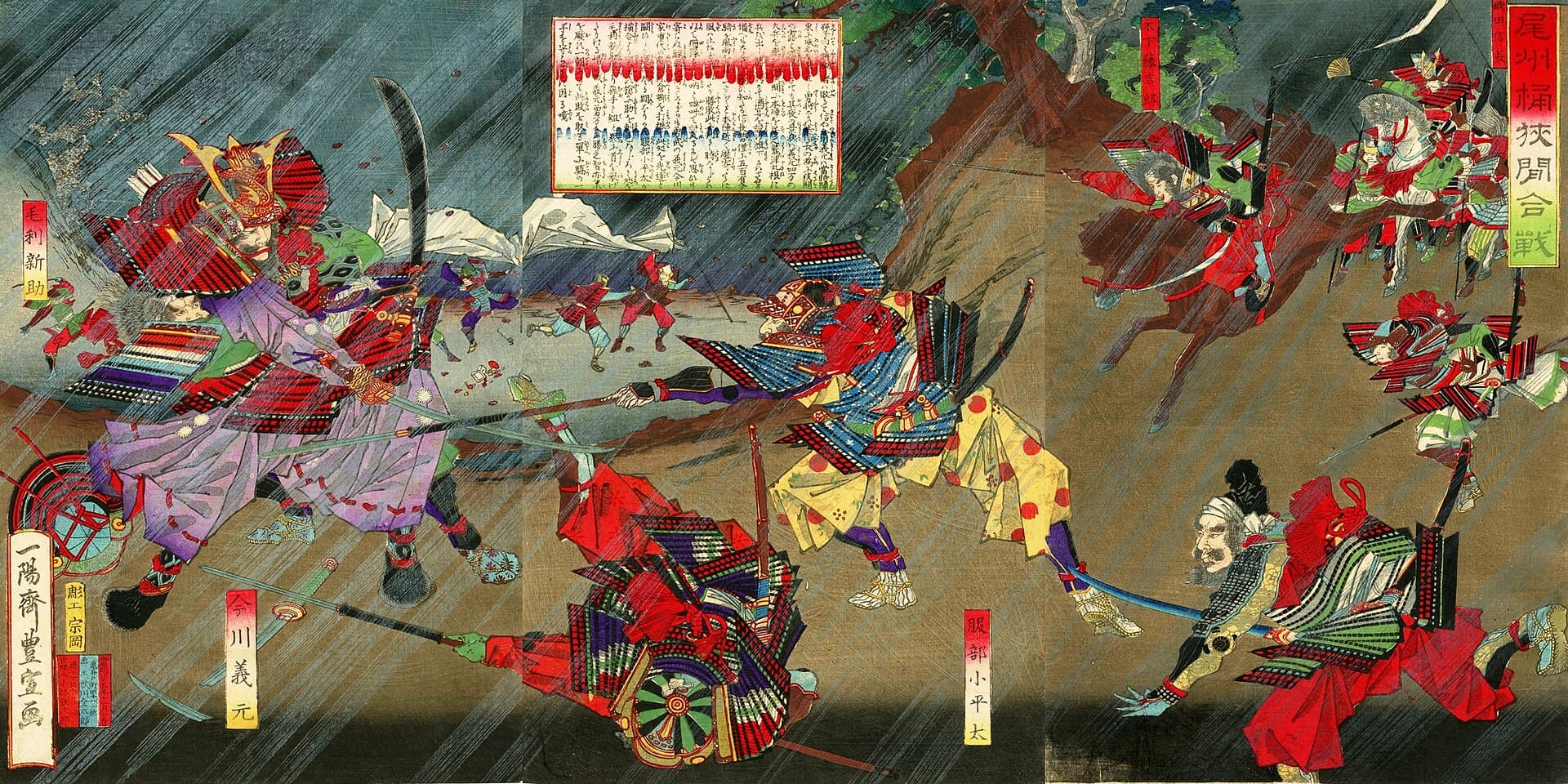
Imagawa Yoshimoto lies face up with his mouth open, in the violet robe he wore over his armor. Mōri Shinsuke is on top of him. The name slip at the left of the frame is Mōri’s, and the rain has not let up.
Imagawa Yoshimoto has blackened teeth and painted eyebrows in the old court style, and in the summer of 1560 he is marching on the capital with an army that later chroniclers put near 25,000. He is one of the great lords of the eastern seaboard. In his path sits the small province of Owari and its reckless young ruler, Oda Nobunaga, who is 26. He can field perhaps 3,000 men, one for every ten of the enemy. The border forts fall one after another. At first light Nobunaga rises and dances a passage from Atsumori, one of the kōwaka dance-chants, with its line that the life of a man is 50 years. He puts on his armor standing, then rides out with a handful of guards while the rest scramble to catch up. Yoshimoto has stopped to rest in a wooded gorge called Dengaku-hazama, pleased with the morning’s captured forts, and the accounts say heads were being inspected and sake poured. Then the weather breaks. A violent thunderstorm rolls off the hills, rain so hard the accounts have the pines bending double, and under its cover Nobunaga brings his whole small force down onto the resting camp unseen. The Shinchō-kōki, the biography written by a man who served Nobunaga, says the storm passed and the Oda charged out of it into a camp that thought itself safe. Yoshimoto, hearing the noise, assumed a drunken brawl among his own men. By the time he understood, the enemy was inside the curtains. He fought. One story has him cutting through the shaft of the first spearman’s weapon before two Oda men, Mōri Shinsuke and Hattori Koheita, took him down and one of them took his head. The huge army, its commander dead and its camp overrun in minutes, simply came apart. A campaign meant to end a small province ended the largest reputation in eastern Japan. Nobunaga walked out of an afternoon he should not have survived. From there the road led, step by step, toward the near-unification of the country. The painting is a woodblock triptych by Utagawa Toyonobu, printed in the 1880s, three centuries after the fact, and it keeps the one thing that mattered: the rain. Slate-gray lines slash across the whole width of the sheet, samurai collide in lacquered armor of red and gold and blue, and small paper cartouches name the fighters the way a program names actors. It is a Meiji audience’s Okehazama, staged and gorgeous. What it gets exactly right is that the weather won half the battle.