Medieval Europe · 1348
The Triumph of Death
The plague empties Europe at the speed of a cart
look closer
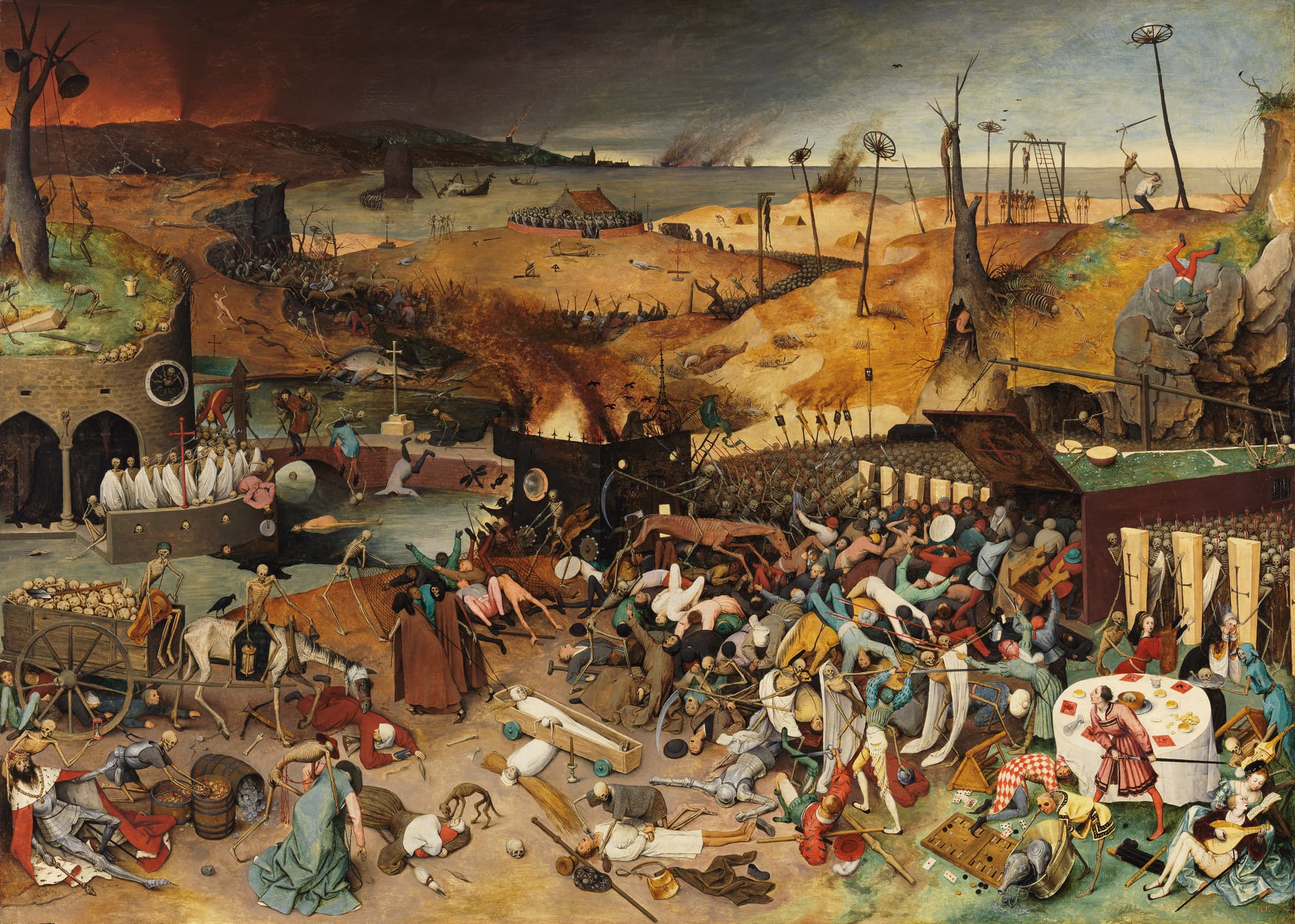
A skeleton holds an hourglass over the king's face. A second one in plate armor rakes his gold out of a tipped-over barrel. The silver is already spilled in the dirt.
It moved no faster than anything else moved: the pace of a loaded cart, a coasting ship, a mule train in the hills. In October 1347 a dozen Genoese galleys limped into Messina with dying men at the oars, and within five years the sickness they carried had been everywhere from Sicily to Norway. The Black Death killed by thirds and by halves. Serious estimates for Europe run from one death in three to one in two, tens of millions of people, and the records that survive read less like history than like testimony. In Siena the chronicler Agnolo di Tura wrote that he buried his five children with his own hands. In Florence, Boccaccio watched the dead stacked in trench graves layer upon layer, he wrote, the way a ship is loaded with cargo. Where it began, the story goes, was a siege. At Kaffa on the Black Sea, a Genoese trading post was surrounded by a Mongol army already dying of the sickness. The besiegers heaved their dead over the walls with catapults. A notary who told the tale, and may have improved it, has the Genoese fleeing home with the infection in their holds. However it truly boarded, it sailed the trade routes exactly, harbor by harbor, following the money. What it actually was, nobody living then would ever learn; the bacterium was not identified until 1894. In the meantime the ports improvised. Ragusa began holding inbound ships at anchor for 30 days, then 40; quaranta is Italian for 40, and the word quarantine is the plague's most durable gift to the world. Nobody knew what it was. The learned blamed the air, and the planets. Towns blamed strangers, and in the Rhineland the terror turned on the Jews, who were massacred in city after city on the invented charge of poisoning wells. Strasbourg burned its Jewish quarter in a single February day in 1349. Processions of flagellants whipped themselves from town to town, carrying the sickness with them as efficiently as the rats did. And then, having emptied the world, it receded, and the strangest part began: for the survivors, almost everything got better. Labor was suddenly scarce and land was suddenly cheap. Wages doubled; lords legislated frantically to freeze them at the old rates, and failed; serfdom in the West never fully recovered its grip. Siena, which had been enlarging its cathedral into the largest in Christendom, simply stopped. The unfinished nave still stands there, a wall of the world before. Pieter Bruegel painted The Triumph of Death two centuries later, in 1562, for a Europe where the plague still returned generation after generation. He painted it as the folk memory had processed it: not a sickness but a campaign. His death is an army with logistics. Skeletons cart skulls like a harvest, toll the bell, drive the living herd into a great box-trap marked with a cross, and advance in ranks behind coffin lids carried like a phalanx's shields. On the left a skeleton holds an hourglass over a dying king in ermine while a second, in a soldier’s plate armour, rakes the gold out of his barrels. The landscape behind them has already been processed: bare, smoking, hung with wheels and gallows, the sea full of burning ships. In the bottom corner of the panel, which has hung in the Prado since 1827, Bruegel put the one joke the picture allows, if it is a joke. Two lovers sit with a lute, singing, not yet looking up. Behind them a skeleton has joined in on a fiddle, keeping their time, waiting for the song to end.