The Age of Sail · 29 August 1782
Toll for the Brave
A 100-gun ship rolls over at anchor with families still aboard
look closer
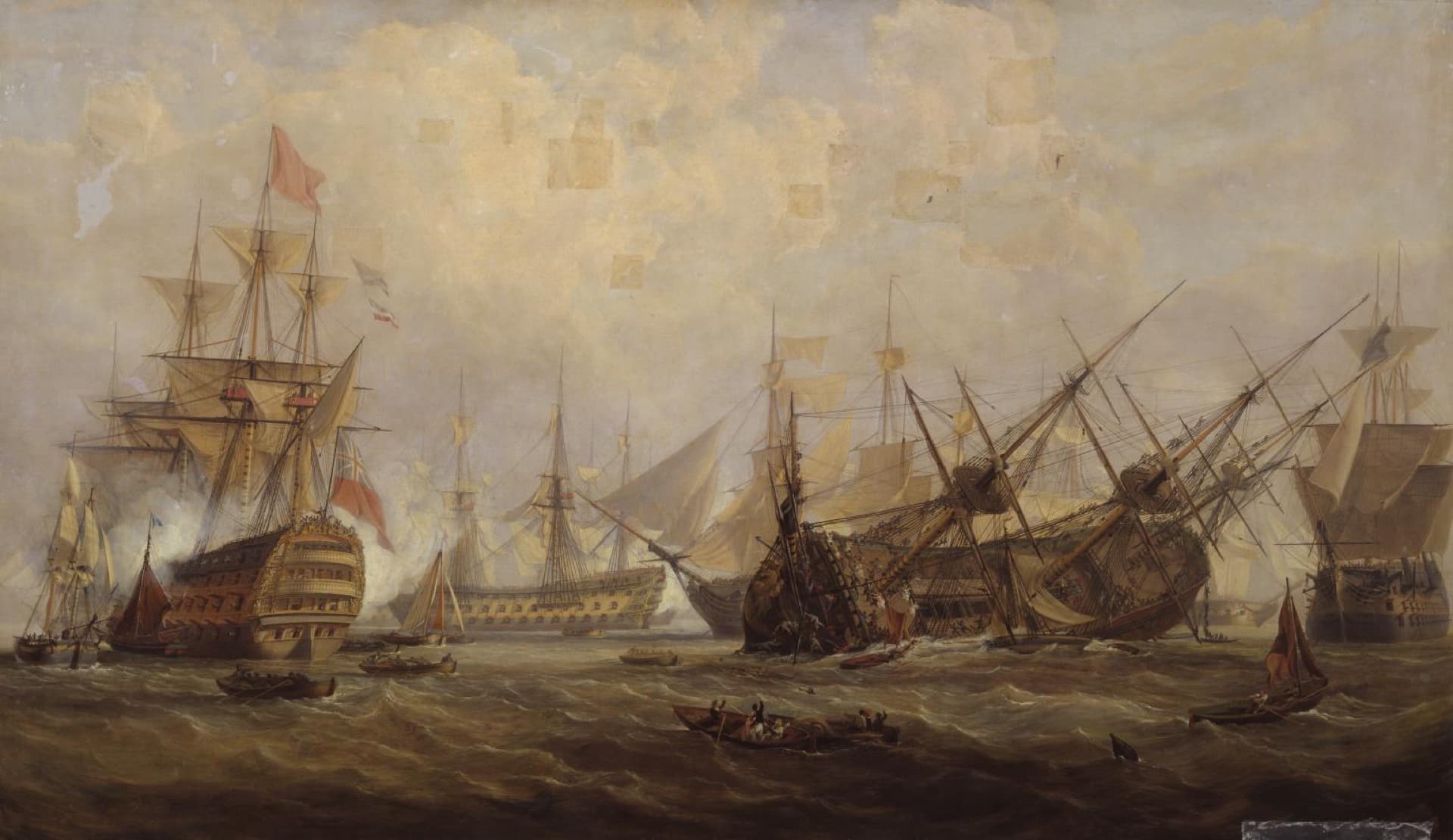
The Royal George on her beam ends, with people crawling along her exposed side and up the rigging. She had been tipped over on purpose, to reach a repair just below the waterline without going into dock.
The Royal George was the largest warship in the world when she was launched, and still one of the grandest in 1782. She carried 100 guns, she had been Hawke's flagship in the storm chase at Quiberon Bay, and she had 26 years of service in her timbers. On 29 August she lay at anchor at Spithead, among the fleet getting ready to relieve Gibraltar. She needed a small repair just below the waterline, and the war allowed no time in dock. So it was done the routine way: guns hauled over to one side to tip the ship far enough to bring the spot out of the water. It was so routine that the ship stayed open for business. Supply boats worked alongside. Sailors of the day were rarely let ashore, so the visitors came to them: wives and children saying goodbye, tradesmen, several hundred people by later estimates who did not belong to the crew. A lighter, a flat barge, tied up on the low side to load rum, putting weight exactly where there was none to spare. The tilt deepened until the sea stood at the lips of the open lower gunports. The carpenter saw it and twice asked the officer of the watch to right the ship. He was waved off twice. Then the water made the decision. It came through the ports in a sheet. The ship lurched, hung, and went down where she lay, in minutes, in full view of the anchored fleet. Perhaps 900 people drowned, among them some 300 women and children. Rear-Admiral Richard Kempenfelt died with them, writing at his desk when the tilt jammed his cabin doors shut. About 230 were pulled from the water. The court martial acquitted every surviving officer and blamed the general state of the ship's timbers, a verdict that spared the routine and satisfied almost nobody. Cowper wrote the poem whose first line became the disaster's name, Toll for the brave, and the nation took the strange comfort it takes in disasters with no villain. The wreck lay in the fleet's own anchorage for decades. In the 1830s the Deane brothers went down on her wearing a thing they had just invented, the diving helmet. The Royal George became the place where helmet diving was worked out. The Royal Engineers finished the wreck off with gunpowder. Some of her bronze guns were melted down for the base of Nelson's Column. John Christian Schetky was marine painter to three monarchs in a row, and he exhibited this sinking in 1840, while the salvage was still in the papers. He shows the hull on her beam ends, people crawling along her exposed side, and the small boats rowing hard toward a disaster that was over before anyone reached it.