Ancient Egypt · 41 BC
Venus Comes to Dinner
Summoned to answer charges, Cleopatra sails up the Cydnus dressed as a goddess
look closer
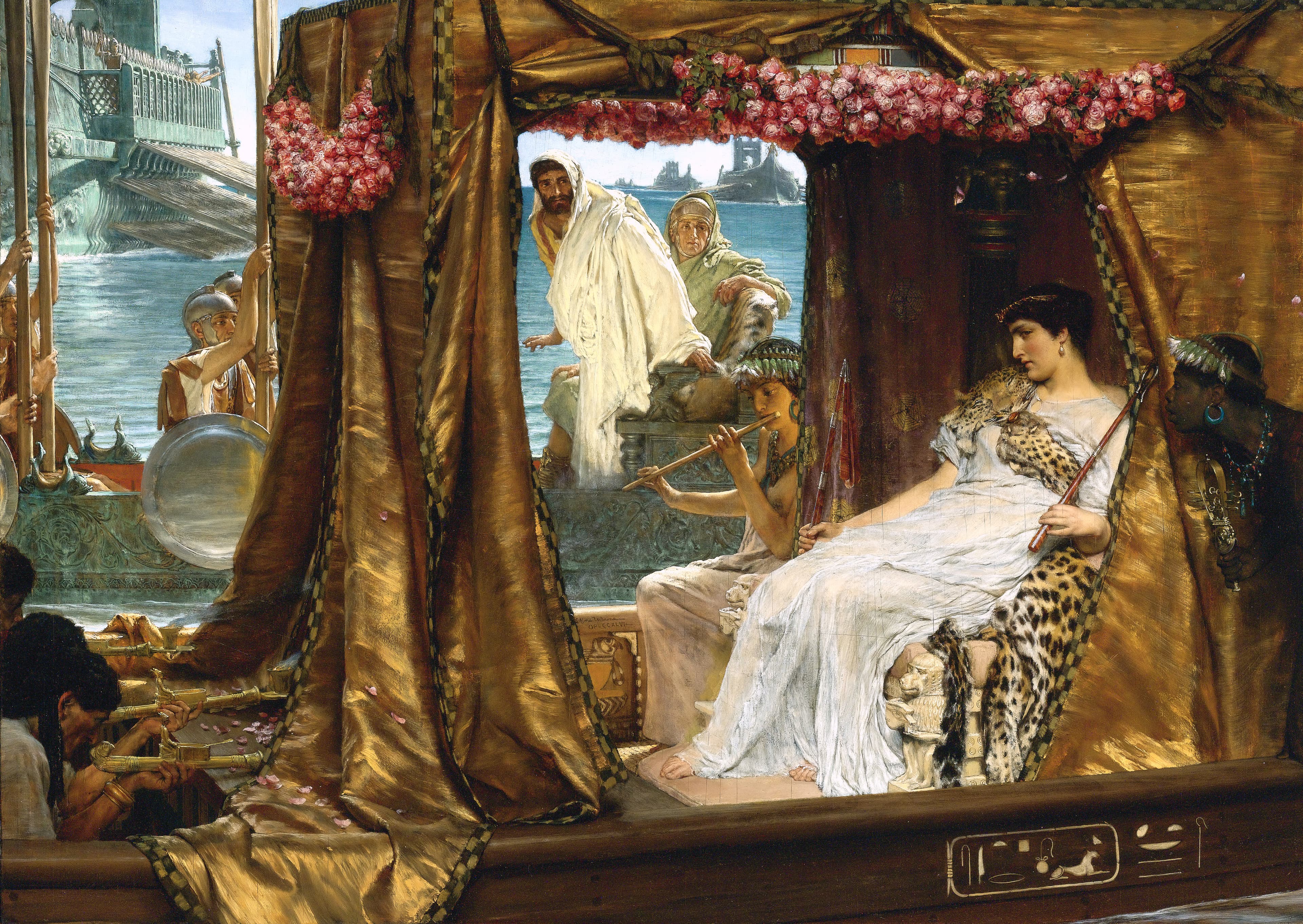
Cleopatra sits under the gold canopy with a leopard skin drawn over her shoulder. The head of the skin lies on her breast, and her eyes are turned down and away. Plutarch says she was dressed the way painters dress Venus, and Alma-Tadema took him at his word.
The summons was a legal formality: Cleopatra was to present herself at Tarsus and answer the charge that Egypt had helped Caesar’s assassins. Mark Antony, fresh from the victory at Philippi, was touring the East as its new master, taxing cities and auditioning kings. In 41 BC he held court in the market square of Tarsus, a river town a few miles up the Cydnus from the sea. Cleopatra let several summonses lie before she came, and she came by water. Plutarch describes what moved up the river, and for once history reads like stagecraft because it was: a barge with a gilded stern, purple sails, and silver oars beating time to flutes and pipes. The queen lay under a canopy spangled with gold, dressed, he says, the way painters dress Venus. Boys costumed as Cupids fanned her, and her maids worked the ropes and rudder as Nereids and Graces. Braziers of perfume burned on deck, so the scent reached the banks before the barge did. Tarsus emptied to line the river and look, until Antony, master of the Roman East, sat on his tribunal alone. Word went through the town that Aphrodite had come to revel with Dionysus for the good of Asia. He invited her to dinner. She declined and invited him instead, and Antony, curious, went, and found the barge rigged with lamps hung in squares and circles past counting; Plutarch calls the effect a sight scarcely equaled anywhere. The performance was built on research. She had met Antony before, first at 14, when he was a young cavalry officer in Alexandria helping restore her father. She had concluded that this Roman wanted splendor and jokes, not the statecraft she had rationed out for Caesar. She was 28. It worked at once and permanently. Antony followed her to Alexandria for the winter and joined the dining club she founded there, the Inimitable Livers. The first bill for Tarsus was paid across the Aegean. Her exiled sister Arsinoe was dragged from the sanctuary of Artemis at Ephesus, Josephus says, and killed on Antony’s order. Shakespeare found the barge in Thomas North’s 1579 English translation of Plutarch and barely changed it. North: the poop whereof was of gold, the sails of purple, and the oars of silver, which kept stroke after the sound of the music. Shakespeare, giving the speech to Enobarbus: the poop was beaten gold; purple the sails; the oars were silver, which to the tune of flutes kept stroke. It is less a paraphrase than a debt. Alma-Tadema painted the meeting in 1883 and sided with the queen’s staging. She fills the foreground under her canopy, eyes elsewhere, a leopard skin across her lap. Antony is the white-robed figure craning from a boat behind her, waiting to be noticed. In 2011 the canvas sold at auction in New York for 29 million dollars.