Feudal Japan · Spring, 1185
The Drifting Bow
A commander risks his life for a dropped bow he is ashamed of
look closer
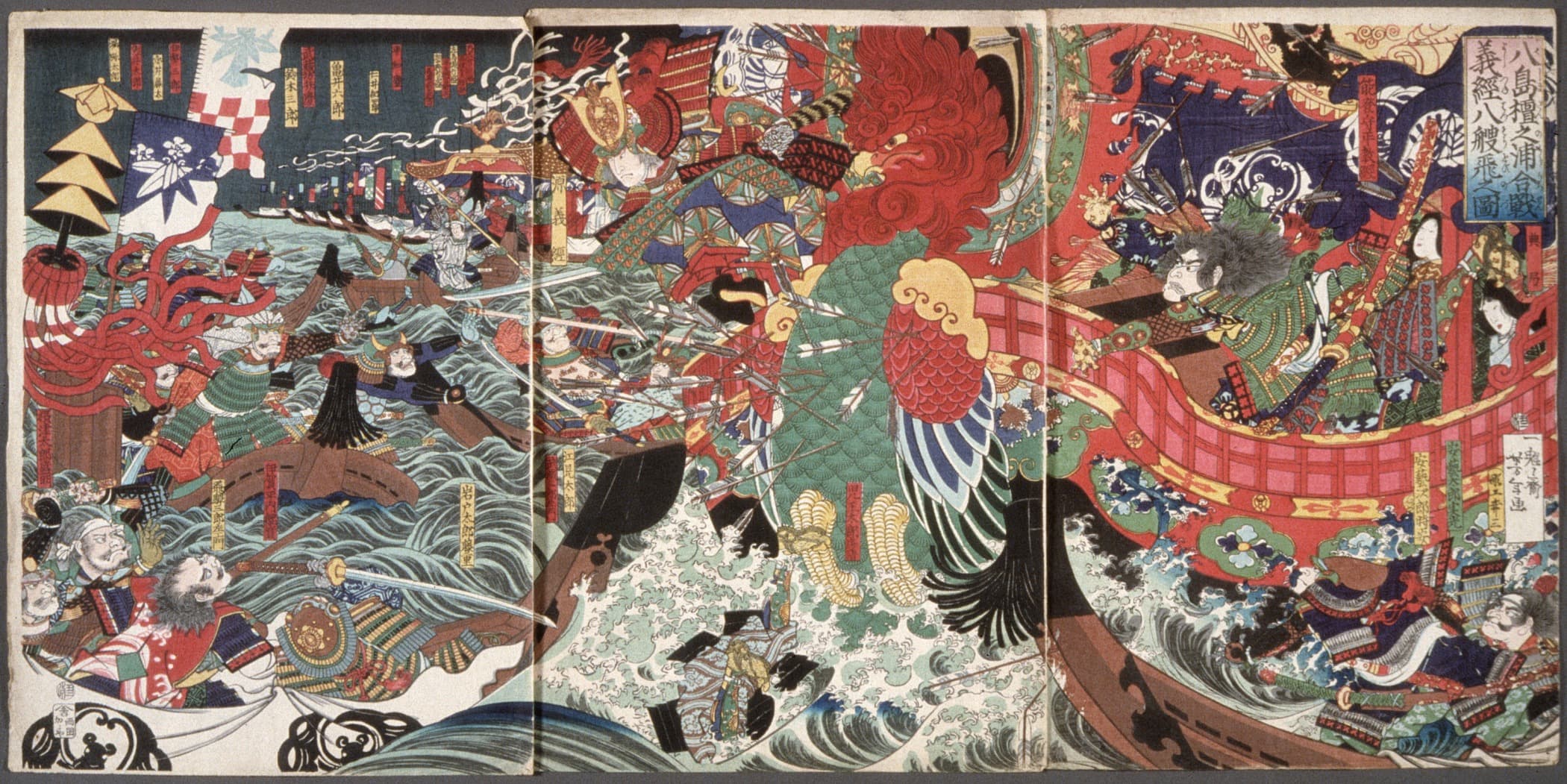
Minamoto no Yoshitsune wears red-laced armor under a gold horned crest. His name is printed in the yellow panel at his shoulder. He was 26 here and the best field commander in Japan, and four years later his own brother hunted him to death.
In the second month of 1185, on the shore at Yashima on the Inland Sea, the Taira are dug in with their backs to the water and the boy emperor aboard their ships. Minamoto no Yoshitsune has already surprised them once, firing their beach camp at dawn after riding through a storm most captains said no boat could cross. He is 26, small, and the best field commander of his generation, and he has spent the war doing the thing his enemies rule out. The Taira, unbalanced, pull back onto their boats. The fighting moves into the shallows. Two of the war’s most-told minutes happen here. First a Taira boat rows out with a fan fixed to a pole and a young woman standing beside it, a target and a taunt: knock it down if you can. Yoshitsune sends Nasu no Yoichi, barely out of boyhood, who rides his horse into the surf and splits the fan with a single arrow while both armies watch. Then Yoshitsune drops his own bow in the sea. He wades after it under enemy fire, hooking for it with his whip while his men shout at him to let it go, and he will not. Afterward they ask him why a bow was worth his life. Because it was a weak bow, he tells them, a small man’s bow, and if the enemy had fished it out and mocked it, the shame would have outlived him. The episode has its own name, yuminagashi, the drifting bow. The painting is Tsukioka Yoshitoshi’s, a three-sheet print from 1865. It stages the fight as pure motion. Warriors fight off boat rails in white water, arrows cross at every angle, and a carved bird’s head with a red mane rears over the whole middle sheet. Its own title cartouche runs two famous days together, calling the scene Yashima and Dan-no-ura at once and promising Yoshitsune’s leap across eight boats, which belongs to the second battle. Near the center a young man in a horned helmet fights with his name written beside him in a cartouche so the buyer knows exactly whose story this is. It is Yoshitsune, drawn seven centuries after the fact by an artist who never doubted he was the hero of it. He had reason to doubt what came next. Yoshitsune won the war for his elder half-brother Minamoto no Yoritomo, and Yoritomo, building the first shogunate at Kamakura, could not have a brother the whole country loved. Within months Yoshitsune was a fugitive, moving north in disguise, sheltered and then sold out. In 1189, cornered at the Koromo River with a handful of men, he killed himself while the warrior-monk Benkei held the doorway. The legend has Benkei dying on his feet, so stuck with arrows that his body stood guard after he was dead. Yoshitsune was 30. The commander who leaped into the sea for a bow he was ashamed of became the man Japan would rather have had win the peace.