Ancient Egypt · c. 450 BC
A Death in the House
When the house cat dies, the whole family shaves its eyebrows and calls the embalmer
look closer
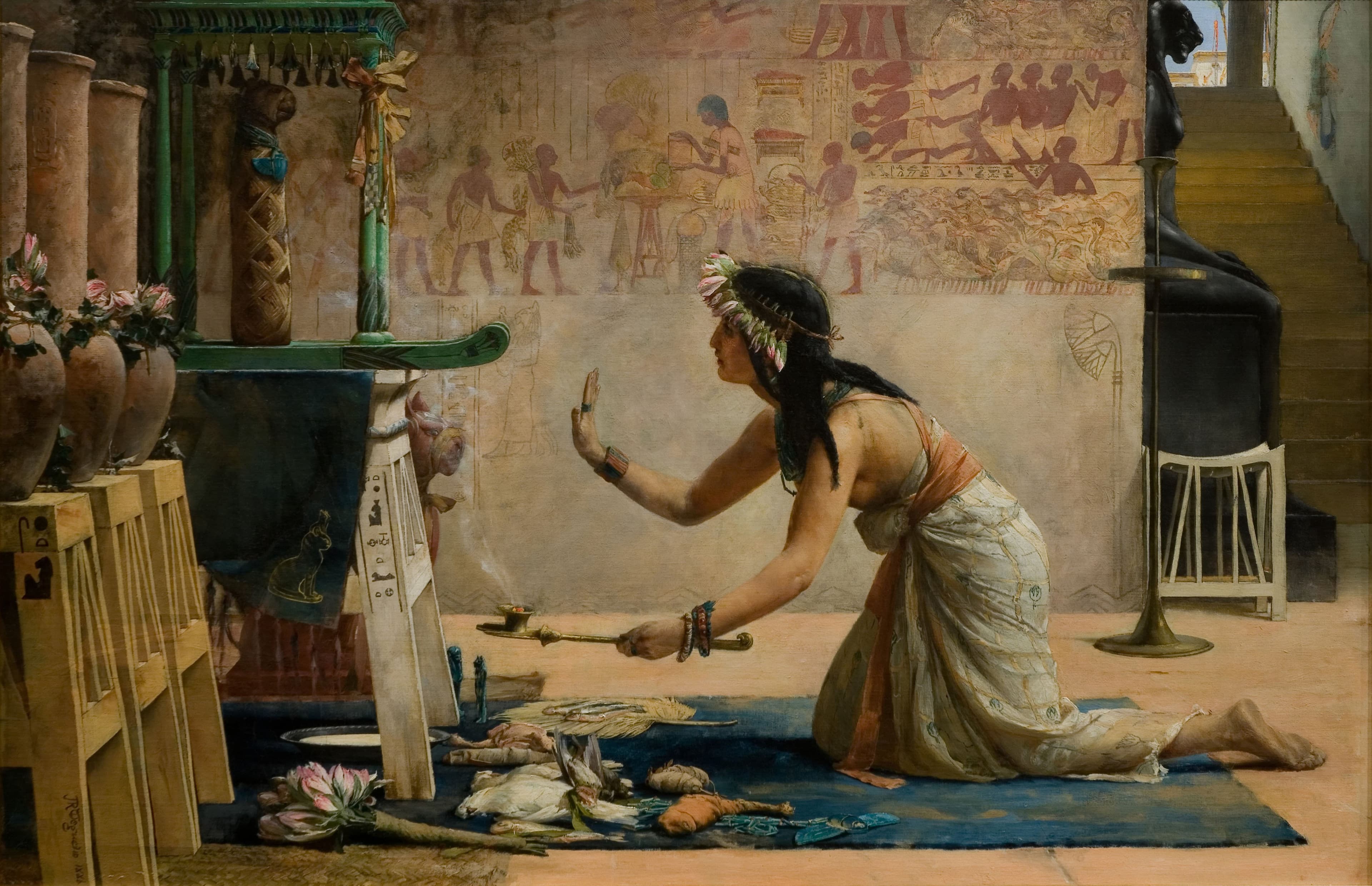
The priestess holds up an open palm with a wreath of pale petals bound in her hair. Behind her the wall is painted with a line of men carrying offerings. Herodotus says a household that lost a cat shaved its eyebrows and nothing else, and for a dog it shaved the whole body and the head.
The cat died of old age, and the whole household shaved off its eyebrows. Herodotus, who toured Egypt around 450 BC and asked about everything, reports the custom as plain fact: for a cat, the eyebrows; for a dog, the body and the head too. Mourning ran until the hair grew back. He also noted what fire meant in an Egyptian town. When a house burned, people stationed themselves in a line, minding the cats rather than the blaze, because a cat will bolt through a cordon into the flames, and that was counted the greater loss. The dead cat was not buried at home. It went to the embalmer, and then in its wrappings to Bubastis in the Delta. That was the city of Bastet, cat goddess of the household, and Herodotus calls her festival the biggest in Egypt. He counts 700,000 pilgrims arriving by barge with rattles and flutes going, and more wine drunk than in all the rest of the year. Piety at that scale became an industry, and archaeology later X-rayed what lay under it. Huge numbers of the offering mummies turn out to be kittens with broken necks, bred in temple catteries so pilgrims would have something to dedicate. Killing a cat privately stayed a capital matter all the same. Diodorus, visiting around 60 BC, swears he watched a mob lynch a Roman who had killed one by accident. The king’s own officials begged the crowd off, at the exact moment Egypt was desperate to stay friends with Rome. Polyaenus, writing 700 years after the fact, even claimed a Persian army once took the border fortress of Pelusium by herding cats and other sacred animals ahead of its line. Then no Egyptian archer would shoot. The tale is late gossip. Nobody has ever called it out of character. In 1888 a farmer digging near the village of Beni Hasan broke into a filled gallery: cat mummies in the tens of thousands, stacked like cordwood. Most of the find, about 19 tons, was shipped to Liverpool and auctioned off as fertilizer for English fields. The auctioneer, the papers said, knocked down the lots using a mummified cat for a hammer. John Reinhard Weguelin painted The Obsequies of an Egyptian Cat in 1886, two years before the find at Beni Hasan. His priestess kneels on a blue rug with a censer smoking in one hand and the other palm raised in offering. In front of her is a green shrine, where the wrapped animal stands upright above a cloth with a gold cat worked on it. Plucked ducks and lotus blossoms are laid out for the journey to Bubastis. Weguelin was an Englishman painting in the exacting archaeological manner of Alma-Tadema. The canvas hangs today in the Auckland Art Gallery in New Zealand, about as far from the Delta as a painting can be carried.