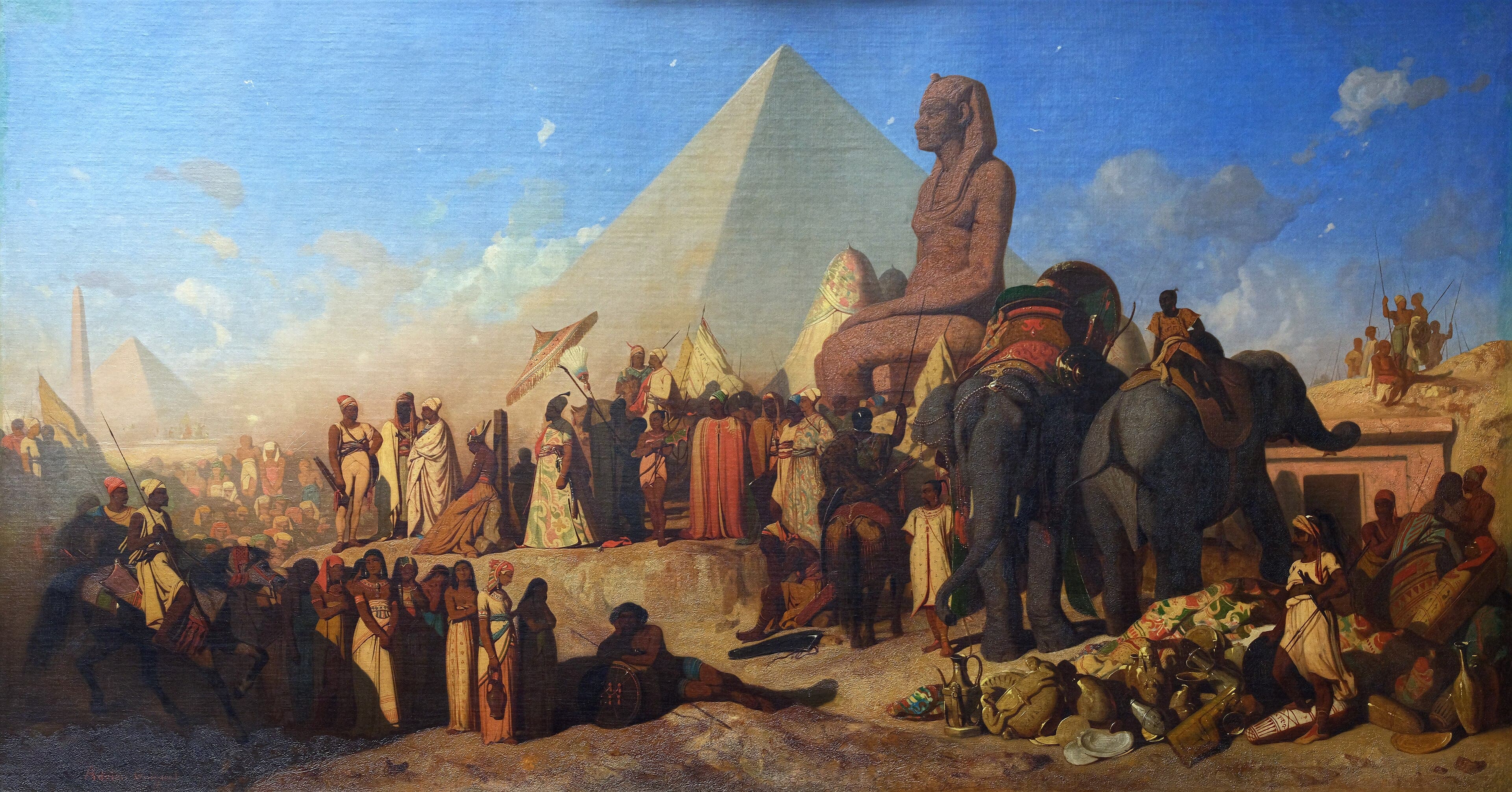
Ancient Egypt · 525 BC
The King Who Did Not Weep
Persia’s king parades a captive pharaoh’s family past him, watching for tears
look closer
A fringed parasol and a fan of ostrich feathers ride over the crowd on poles. Beyond them the white tents of the army stand in the haze. Both objects also appear behind the king in the carved reliefs at Persepolis.
On the tenth day after Memphis fell, Cambyses had the beaten pharaoh brought out and seated on the road at the edge of the city, with other Egyptian lords for company. He wanted to see what the man would do. Psamtik III had worn the double crown for six months. He was the last king of a dynasty from the Delta city of Sais, which had given Egypt its final century and a half of independence. He lost it all in one season: the Persian army across the desert, the pitched battle at Pelusium, the siege, the surrender. Herodotus, visiting the battlefield generations later, claims the bones still lay out in the sand, and that he went among them inspecting skulls. What Cambyses staged next was an experiment on a man. First the king’s daughter came past in slave’s clothing, a pitcher on her shoulder, sent with the daughters of the nobles to fetch water. The fathers around Psamtik cried out at the sight, and he alone lowered his eyes to the ground. Then his son passed with a bridle in his mouth and a rope on his neck, one of 2,000 young men being marched to execution. Cambyses had set the price at 10 Egyptians for every man of the herald’s crew, 200 of them, torn apart by the city when the ship came in to demand surrender. Psamtik said nothing. Then a ruined old man came past, one nobody had planned for, begging from the soldiers. The king recognized a friend he used to drink with and burst into tears, striking his head and calling him by name. Cambyses sent a messenger to ask the obvious question. The answer Herodotus records: my own house’s griefs were too great for weeping, but a friend fallen from plenty to beggary on the doorstep of old age, that could be wept for. The conqueror, the story goes, was moved, and a runner went to spare the son; he found him already cut down, the first of the 2,000. Psamtik was kept at court afterward, honorably, until he was caught raising Egypt in revolt and drank bull’s blood, which the Greeks held to be certain poison, and died. The Egyptian record tells it flatter. A naval officer named Udjahorresnet, who had changed sides early, left an account on his statue, now in the Vatican. He composed Cambyses’ royal titles himself, he says, and the new king put the temple of Sais back in order, the way a lawful pharaoh would. Adrien Guignet painted the tears test in 1842, in his twenties, and it hangs in the Louvre. He gave the parade a backdrop of pyramid and colossus, which Memphis could nearly justify, and a train of war elephants, which nothing could: Persia would not field elephants for almost two more centuries. His captive king sits apart on the ground, a shield leaning beside him, watching the patterned dresses go by.