Ancient Egypt · c. 1250 BC
A People Named in Stone
Egypt records no plague and no exodus, but one granite slab writes down a name
look closer
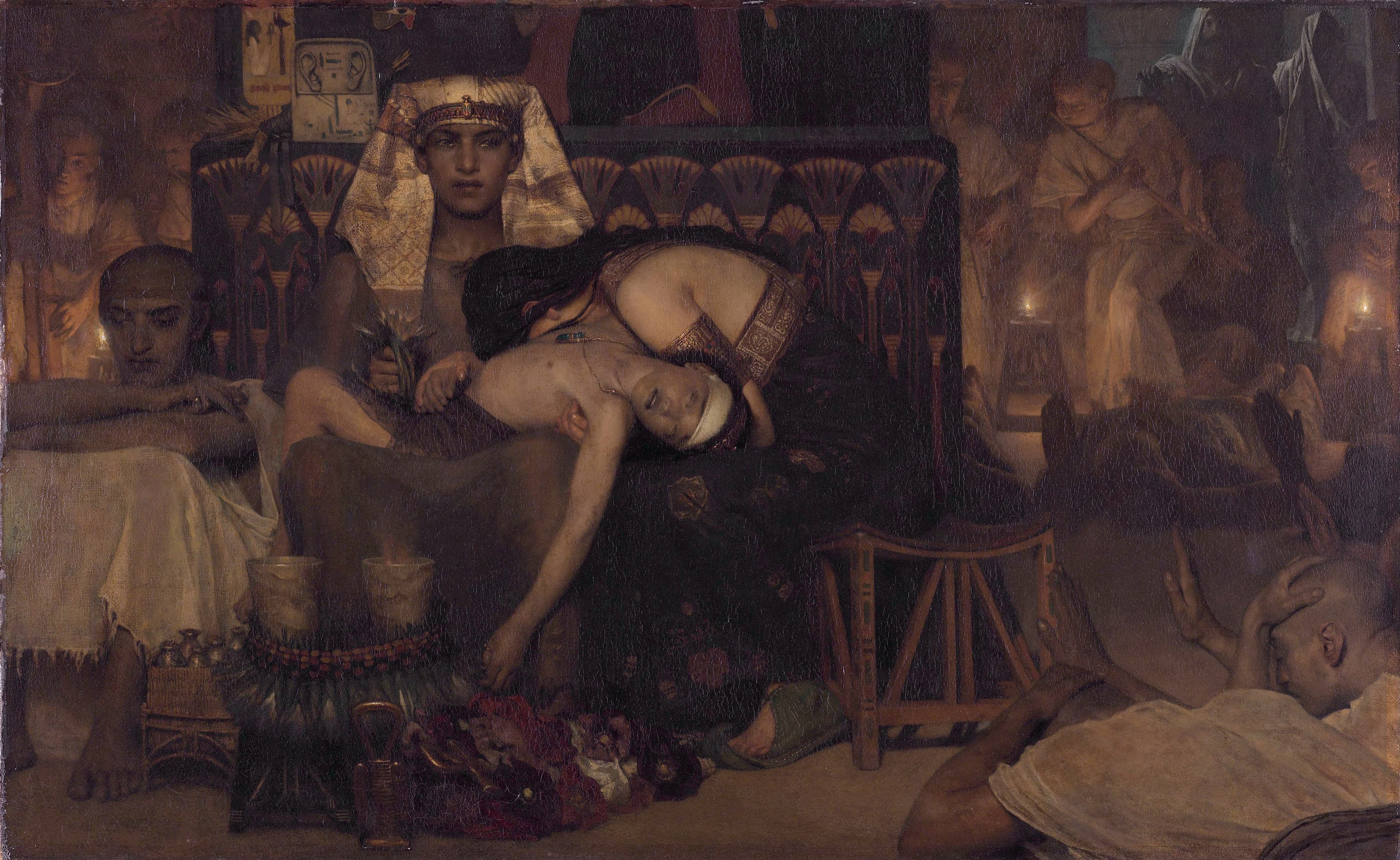
The pharaoh sits in a striped headcloth and a gold band with a lotus still in his fist. The boy lies across his lap, and the mother’s dark head goes down on him. No Egyptian record mentions a plague of the firstborn, and the night survives only in Exodus.
A firstborn son lies dead across the pharaoh’s knees, and the king cannot understand why. In the Book of Exodus this is the tenth and last plague. The God of the Hebrews passed through Egypt in the night and killed the eldest child in every house that was not marked with blood, from the throne to the mill. Pharaoh finally let the slaves go. It is one of the most retold nights in the world. It is also, in the Egyptian record, a night that never happened. No inscription, no papyrus, no temple wall from ancient Egypt mentions a plague of the firstborn, or Moses, or a mass departure of Hebrew slaves. Egyptian scribes wrote down a great deal, including their defeats. What survives is stranger and thinner than the story: a single line on a single stone. In 1896 the archaeologist Flinders Petrie was digging in the ruins of a mortuary temple at Thebes. His workers turned up a slab of black granite over 10 feet tall, carved for the pharaoh Merneptah around 1208 BC. Most of it celebrates a war in Libya. The last few lines list towns crushed in a campaign through Canaan, and among them, once, appears the word Israel. It is the oldest mention of Israel found anywhere on earth, and Petrie is said to have known at once that it would make his name better than any tomb. The grammar is the whole point. Egyptian writing tagged each name with a small silent sign telling the reader what kind of thing it was. Ashkelon and Gezer on the same stone carry the sign for a walled town. Israel alone carries the sign for a people: a seated man and woman over three strokes, the marker Egyptians used for a wandering group with no fixed city. So the one hard fact under the whole Exodus story is not a plague or a sea or a law. It is a scribe in the thirteenth century BC, listing off a victory, pausing to mark Israel as a people rather than a place. Israel is laid waste, the line runs, its seed is no more, which is the earliest thing any record says about Israel, and it is an obituary. Lawrence Alma-Tadema painted the dead firstborn in 1872, working the way he always did, from archaeology and props, staging the grief inside a hall of lotus columns. The pharaoh sits stunned with the pale boy across his lap, and the mother has collapsed forward over the body. Back in the shadows two robed men stand beside a single burning lamp, the nearer one leaning on a staff. They are Moses and Aaron, come to say the child is only the beginning. The painter kept the room dark on purpose. He was 36 when he made it, and he never let the canvas go: his heirs gave it to the Rijksmuseum in 1913.