The Machine Age · 1875
Before They Washed Their Hands
Surgery in a frock coat, painted with the blood left in
look closer
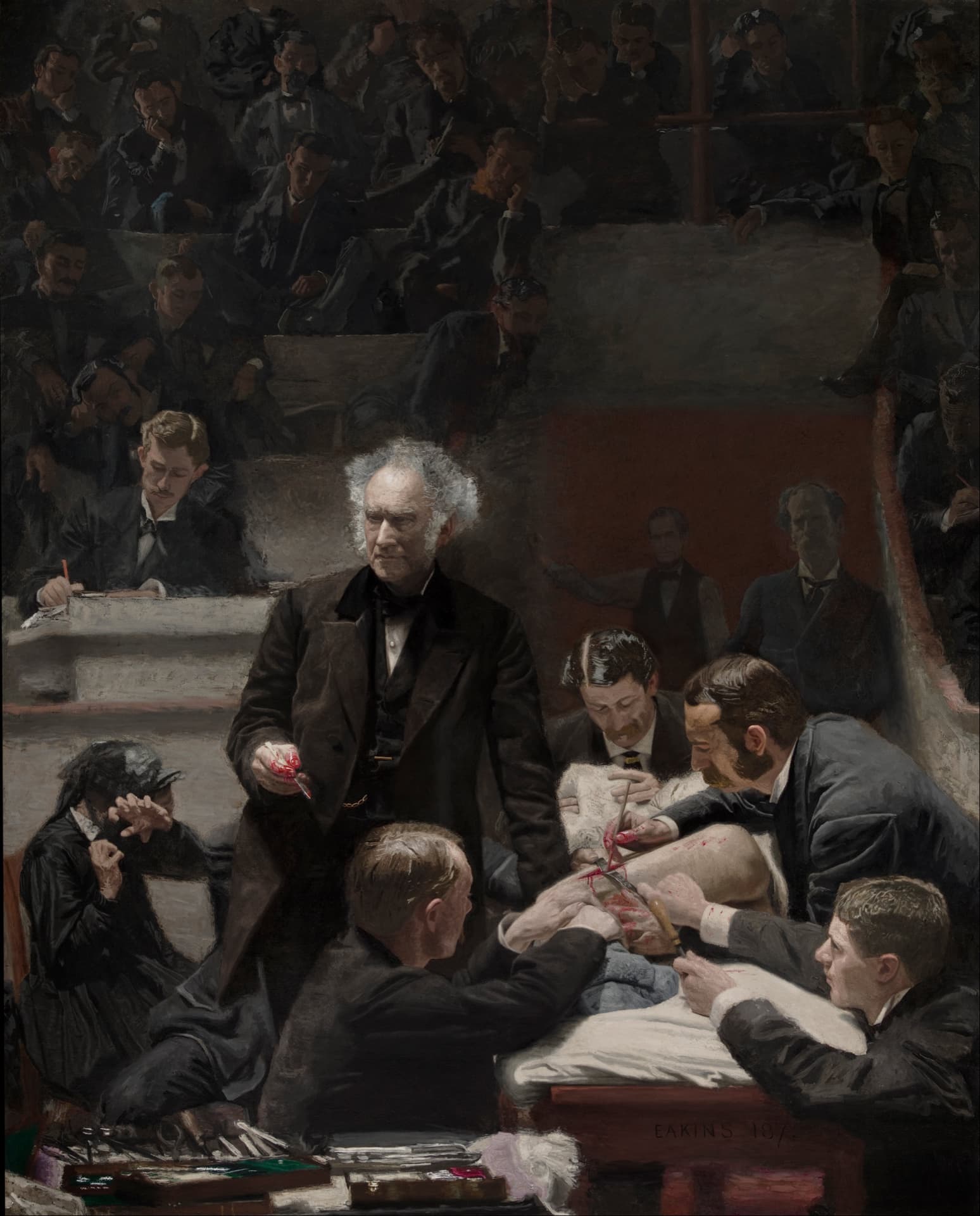
Bare fingers, a scalpel, blood, and the frock coat Gross wore in from the street. Joseph Lister had published on antisepsis 8 years before this canvas, and Philadelphia had not taken it up.
Dr Samuel Gross was 70 and the most famous surgeon in America. The operation Eakins painted him doing was a merciful one: cutting dead bone out of a young man's thigh instead of taking the leg off. That is what the generation before him would have done. The patient is under ether, which is the single modern thing in the room. Everything else in the picture is why the nineteenth century killed so many of the people it was trying to save. Gross is wearing his street clothes. So is every man cutting. There are no gloves, no masks, no gowns. The instruments lie in a velvet-lined case. The surgeons' bare fingers are in the wound. Gross has stepped back with a scalpel in his hand and blood on his fingers, explaining to a hall full of students what he is doing. Joseph Lister had published on antisepsis in 1867, eight years before this canvas, and Philadelphia had not adopted it. Eakins painted the same subject again 14 years later. In that picture the surgeons wear white and the room is clean. The gap between the two is the best record anyone has of how long a good idea took to cross an ocean. The woman recoiling in black at the left, hands clawed over her eyes, is understood to be the patient's mother, present because the rules for charity cases required a relative to attend. Eakins put himself in too, seated at the right of the entrance tunnel with a pencil. He submitted the picture to the art section of the Centennial Exhibition in 1876 and the committee turned it down. It ended up among the medical exhibits in an army hospital pavilion. One reviewer wrote that people would come away sick. Jefferson Medical College bought it for 200 dollars. In 2006 the college agreed to sell it for 68 million dollars, to the National Gallery and a new museum in Arkansas. Philadelphia was given 45 days to match the offer, and matched it. It now belongs jointly to two of the city's museums, and the argument about whether it is beautiful has been over for a century. Gross's face is lit like a portrait. The thing that draws every eye first is the hand holding the knife.