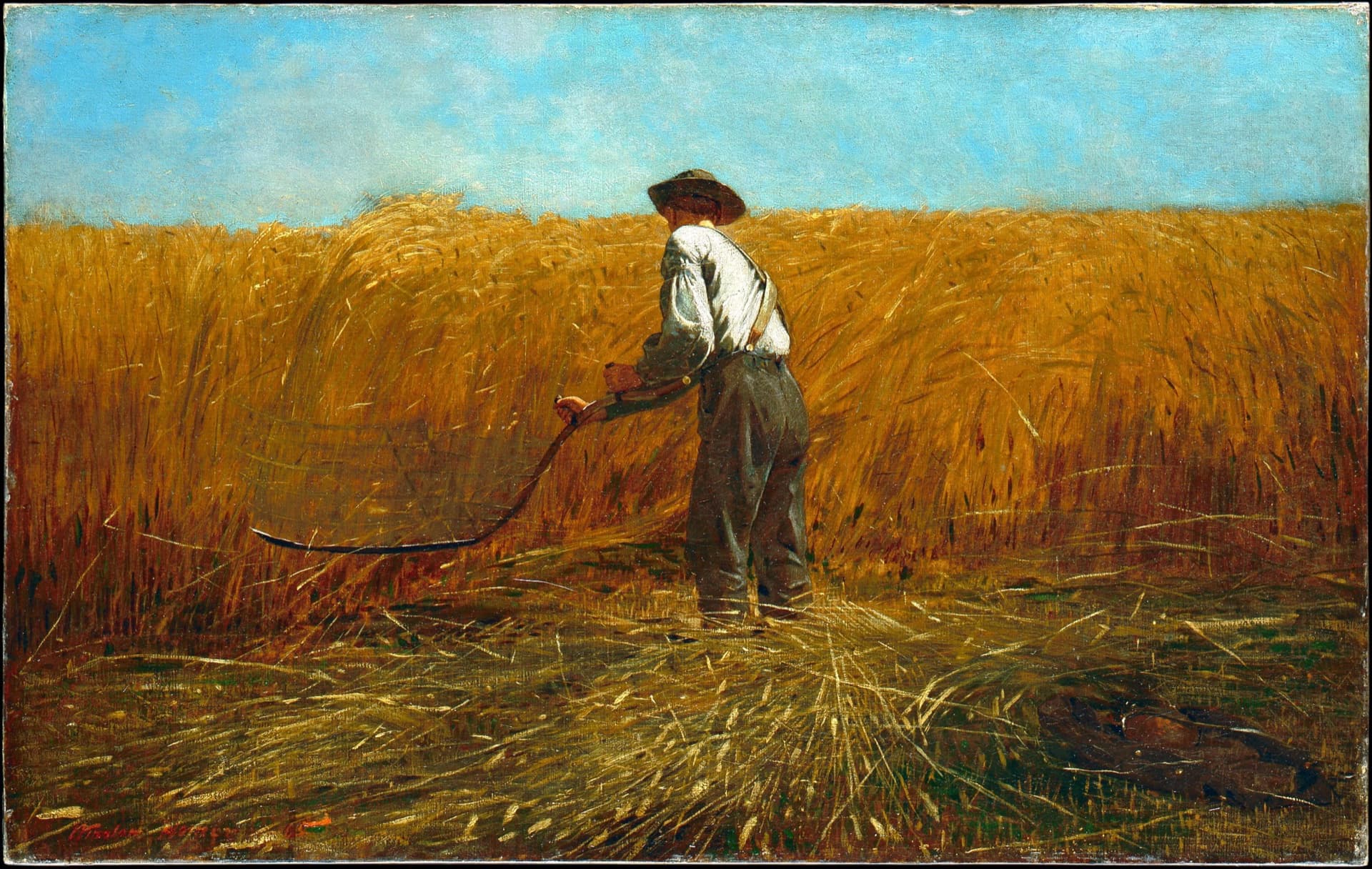
The Machine Age · 1865
The Veteran in the Wheat
The war ends and a man goes back to cutting things down
look closer
Homer first painted a bigger, more elaborate scythe here, then simplified it to this bare blade. The covering paint has gone transparent with age, so the ghost of the first tool shows through above it.
Winslow Homer had spent the war as an artist-correspondent for Harper's Weekly, embedded with the Army of the Potomac, drawing sharpshooters and picket lines and men waiting. In the autumn of 1865, months after Appomattox and Lincoln's funeral train, he painted a single figure with his back turned in a field of ripe wheat. The country had just finished counting: something near three quarters of a million dead, out of a population of 31 million. The harvest of 1865 was enormous, and the men who came home to cut it had spent four years at other work. Homer left the evidence in the lower right corner, where most viewers never look: a dark heap that is the man's army jacket and canteen, dropped in the stubble. That is the whole plot. The uniform is on the ground and the shirt is white and the work is farming again, which is what the title means by a new field. The Northern press was full of that argument in 1865, the citizen soldier laying down the rifle and picking up the tool, and Homer painted the argument without a word of encouragement in it. Then there is the scythe, and the scythe is why the painting is disturbing rather than pastoral. Homer first painted the tool an American farmer would really have used in 1865, a bigger scythe with a rack of wooden fingers to catch the grain. Then he painted it out and put a plain long single blade in its place, the old kind, the kind Death carries in every woodcut in Europe. The paint he covered the first one with has gone transparent over the years, so it is showing through again. He made the picture less accurate on purpose. A lone figure swinging that blade through standing ranks of wheat had one meaning for anyone who had read four years of casualty lists. The wheat is cut down in exactly the swath a man makes walking forward. Homer was 29 and had barely begun. He went on to the sea pictures that made him America's great painter of weather and solitude. This one hangs in New York with the jacket still in the corner. The man's face is never shown.