The Machine Age · 1908
The Gold Ground Returns
A goldsmith’s son puts Byzantium on a Vienna cliff edge
look closer
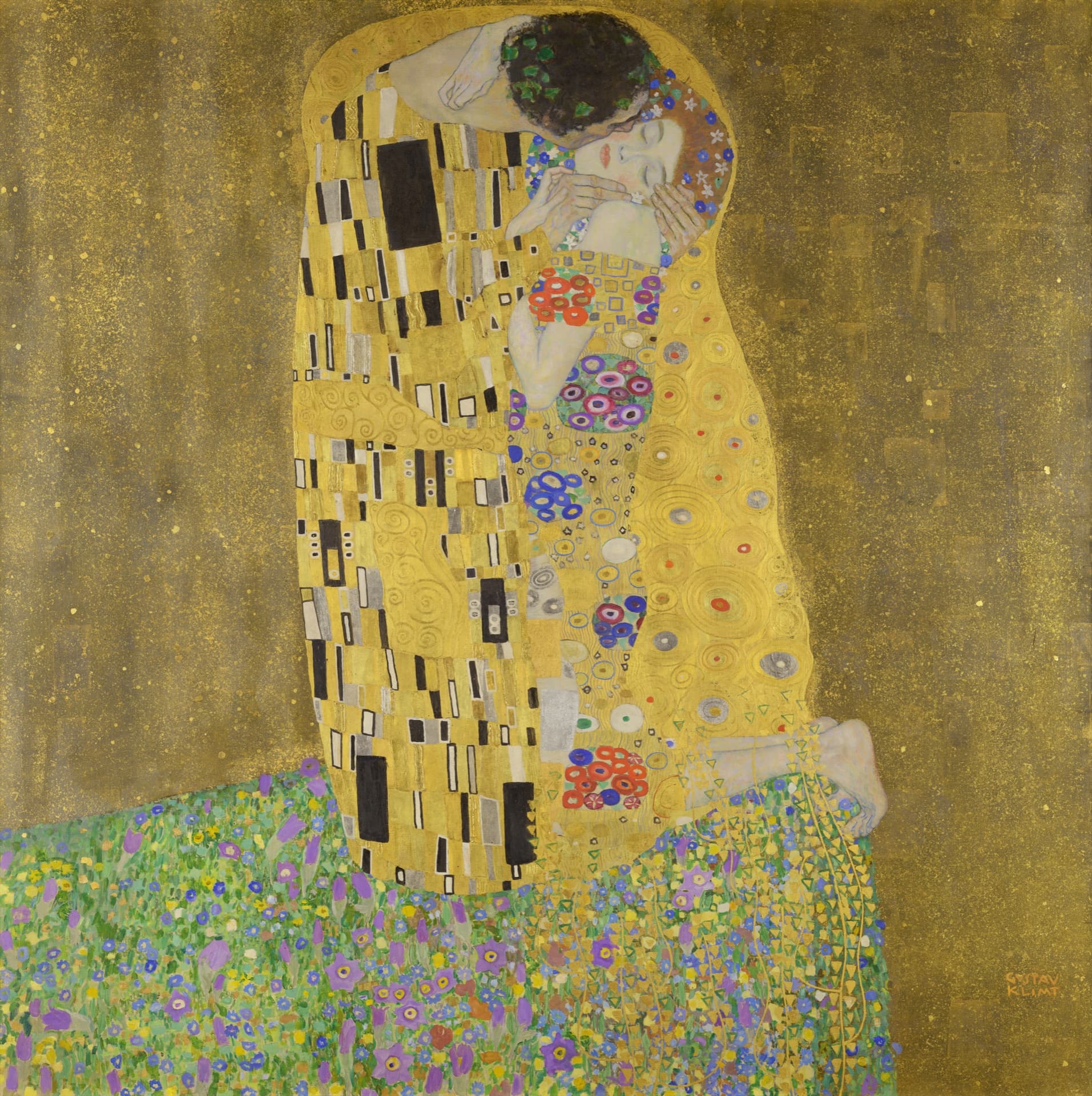
His hands hold her head and turn it. Her hand closes over his with the knuckles up. Her eyes are shut, and Klimt never shows the man's face.
Klimt's father was a gold engraver who died poor, and the son spent the middle of his career putting the material back to work. He had gone to Ravenna in 1903 and stood in front of the sixth-century mosaics, gold ground behind flat glittering emperors, and came home to make what art history now calls his golden phase. The Kiss is the end of it: oil and gold leaf on a canvas 180 centimeters square, begun in 1907. A couple kneel on a bed of flowers, and the world behind them dissolves into metal. Everything below the necks is pattern, and the pattern is doing the arguing. His robe is black and white rectangles, hard-edged; hers is circles and flowers, and the two designs meet without merging where the bodies press together. Very little skin appears, and his face is not part of it: her face, his neck, the hands, her feet. Every one of them is doing something. His hands hold her head and turn it. Her hand closes over his with the knuckles up. Her toes curl over the edge of the flower bank, because the meadow simply stops, and beyond it is nothing at all. Her eyes are closed and her face is angled away from the kiss, which lands on her cheek. Viewers have read rapture there for a century, and other viewers have read a woman at a cliff edge being held very firmly, and the painting has never adjudicated. Vienna in 1908 was the city of Freud's consulting room, Mahler's opera house and Klimt's public scandals. His ceiling paintings for the university had been called pornographic and rejected. He returned the fee and stopped taking state commissions. Then this canvas appeared at the Kunstschau, unfinished, and the state that had refused his ceilings bought it on the spot for 25,000 crowns, a record price for an Austrian painting. It has never left the country and has hung in the Belvedere ever since. Klimt died in 1918, at 55, of a stroke followed by the influenza that was going around the world that year. He left no letters explaining any of it. He had said once that whoever wants to know something about him should look attentively at his pictures, which in this case means looking at the hands.