The Revolutionary Age · 19 October 1781
Between Two Armies
The general who lost the war sends a deputy, and the surrender is handed down a rank
look closer
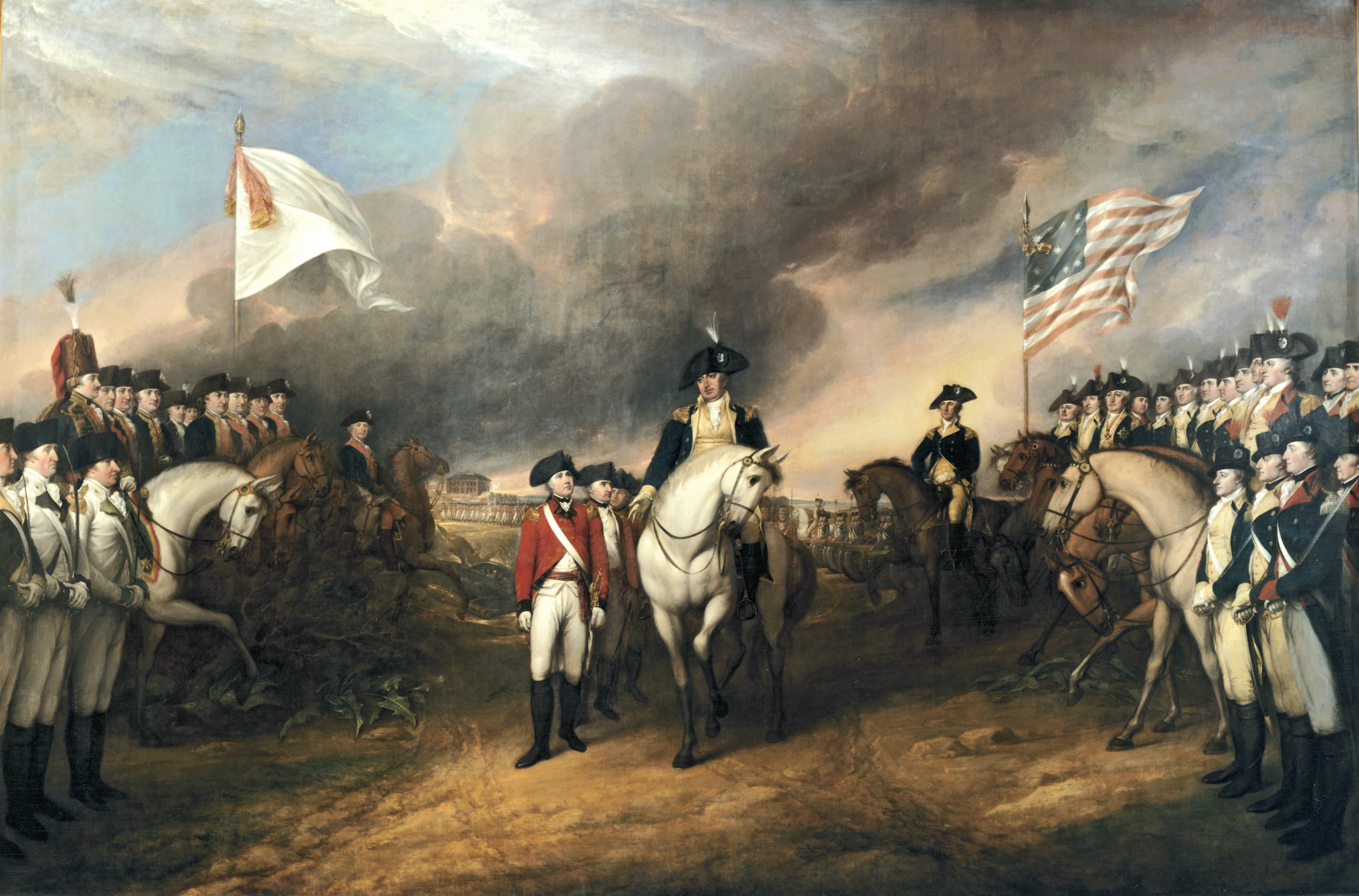
The man on the white horse is Benjamin Lincoln, one gloved hand held out. The British officer standing in front of him is Charles O’Hara, sent out because Cornwallis said he was too ill to come.
By the middle of October, 1781, Lord Cornwallis had run out of everything but excuses. His army of some 8,000 was pinned against the York River in Virginia, dug into a town called Yorktown, and everything that could go wrong for him had. A French fleet under de Grasse had beaten off the British ships at the mouth of the Chesapeake in September and then sat there, so no rescue and no escape could come by sea. On land, Washington’s Americans and Rochambeau’s French, about 17,000 together, had dug their trenches close and were pounding the town day and night. On the fourteenth, a night assault took the last two British strongpoints, one of them stormed by Alexander Hamilton’s light infantry with unloaded muskets and fixed bayonets, so no premature shot could give them away. Two nights later Cornwallis tried to ferry his men across the river and slip out. A storm scattered the boats and drove them back. On the seventeenth, four years to the day after the British surrender at Saratoga, a drummer boy climbed onto the parapet and beat for a parley, and an officer beside him waved a white handkerchief. Nobody on the American side could hear the drum over the guns, but they could see the cloth. Terms were settled the next day. The formal surrender came on the nineteenth. The two allied armies drew up in facing lines across a field, the French in white on one side, the Americans on the other. The British marched out between them to lay down their weapons. Cornwallis did not come. He sent word that he was ill, and in his place rode Brigadier General Charles O’Hara, carrying the sword. What happened next was a small, cold piece of theater. O’Hara steered his horse toward the French, toward Rochambeau, choosing to hand the sword to a European power rather than to the rebels. A French officer pointed him across the field to Washington. Washington would not take it either: O’Hara was a deputy, and Washington was a commander, and a commander does not accept the sword of a subordinate. He directed O’Hara to his own second in command, Major General Benjamin Lincoln, who the year before had been forced to surrender an entire American army at Charleston to these same British. Lincoln took the sword, and handed it back. The insult had been repaid down to the rank. The man on the white horse at the center of the picture is Lincoln, not Washington. John Trumbull painted it around 1820 for the rotunda of the Capitol. He put Washington deliberately in the second rank, on a brown horse under the American flag at the right. On the real day the top general had stood back from a surrender that was not his to accept. Trumbull had not been at Yorktown. He sailed to Paris after the war and painted the French officers from life, one sitting at a time. That is why the men in white on the left have real faces. The story goes that the British band played a tune called The World Turned Upside Down as the troops marched out, though no one who was there wrote it down until long after. In the Capitol rotunda this canvas hangs a few steps from Trumbull’s Declaration. He painted the room where the war was declared and the field where it was lost, and put them in the same round room, facing each other across the floor.