The Revolutionary Age · 20 June 1789
The Oath in the Tennis Court
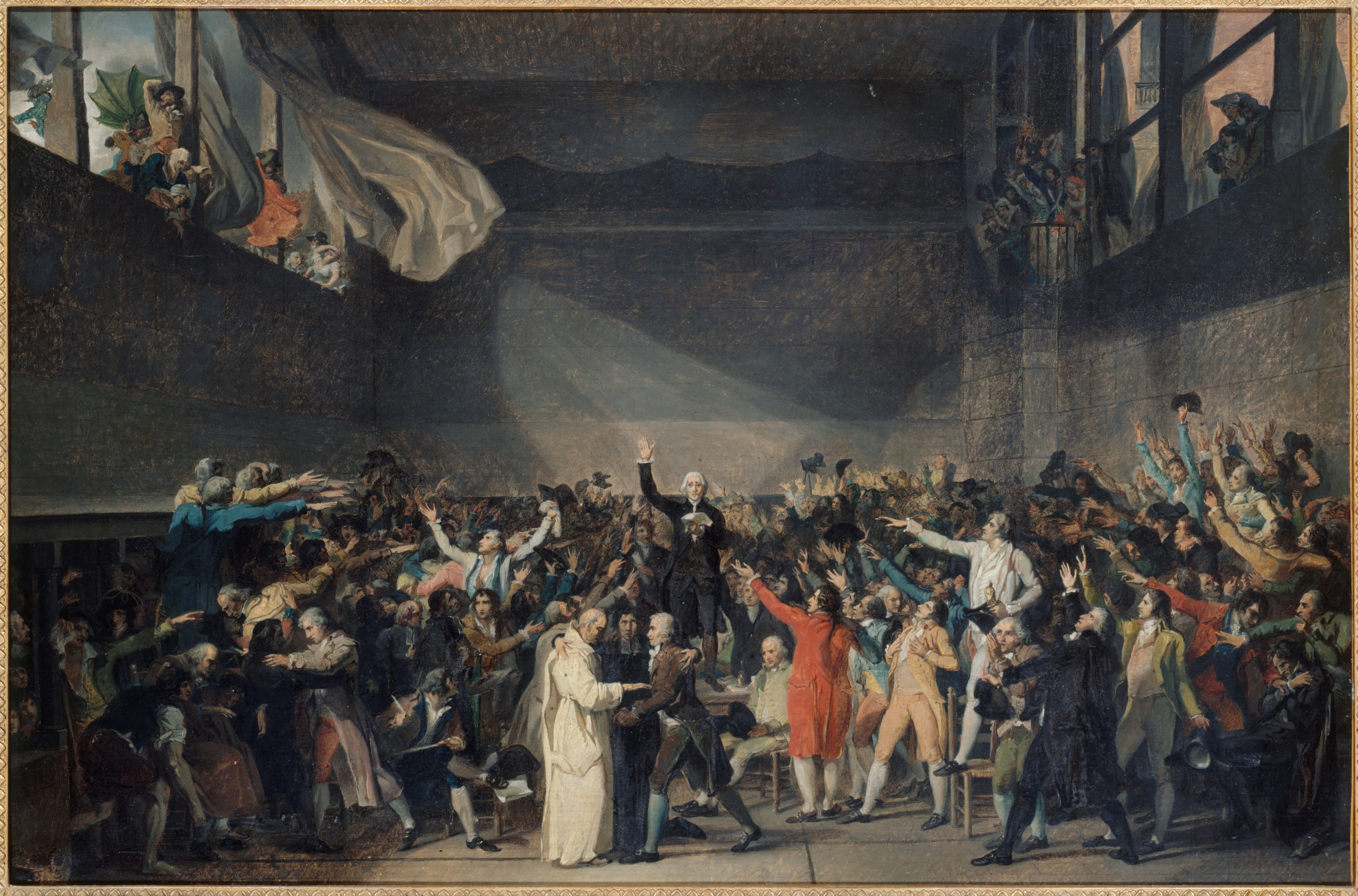
Locked out of their hall, nearly 600 deputies crowd into a tennis court and swear not to go home
look closer
A man stands above the crowd with the oath in one hand and the other arm up. This is Jean-Sylvain Bailly, an astronomer. Four years later he was guillotined on the Champ de Mars.
On the morning of the twentieth of June, 1789, the commoners of France arrived at their meeting hall in Versailles and found the doors locked and soldiers at them. Three days before, the deputies of the Third Estate had done something with no legal basis. They had declared themselves the National Assembly of France, the true voice of the nation, and invited the clergy and nobles to join them. The king answered by shutting their hall, giving out that it needed preparing for a royal session. The deputies did not believe him, and they were right to worry; the closed door looked like the first move toward dissolving them by force. In the rain, cold and half-panicked, they went looking for anywhere large enough to hold 600 men. A few streets away they found an indoor tennis court, an empty hall with a high ceiling and a stone floor. It was built for the racquet game the French called jeu de paume. There, standing on a table so the room could see him, the astronomer Jean-Sylvain Bailly, president of the new Assembly, read out an oath. The deputies swore not to separate, and to meet wherever circumstances demanded, until they had given France a written constitution. Nearly 600 men raised their right arms and shouted the words back. Exactly one refused. A deputy named Joseph Martin-Dauch said he could not swear to anything the king had not approved, and wrote the single word opponent beside his name. The room turned on him, some wanting him thrown out a window, and he was hustled out under guard, unharmed. David put him in the picture as well, down in the bottom right corner, sitting with his arms folded while the men around him reach for the oath. Jacques-Louis David, who would become the great painter of the Revolution and then of Napoleon, took the commission to record the day. His picture gives it the weight of scripture. Bailly stands high at the center with his arm up, and the deputies below strain toward him like iron filings toward a magnet. At the very front three clergymen hold on to one another: the Carthusian monk Dom Gerle in his white robe, the Protestant pastor Rabaut Saint-Étienne, and the priest Grégoire. Two churches making peace in the middle of a revolt. A storm had in fact broken over Versailles that afternoon, and David used it. The tall windows blow open, the curtains billow inward, and a shaft of stormy light falls on the men taking the oath. In the galleries, spectators lean in out of the wind to watch. The picture here is the oil sketch, a small canvas about a metre wide, and it is as far as the idea ever got in full colour. David was also given a canvas the size of a wall, over 6 metres of it, and began laying the figures in. He drew every deputy nude first so he could clothe them correctly later, the way he had been trained. Then the Revolution ate its own cast. Men sworn together in this room split into factions and sent each other to the guillotine. Bailly, the man on the table, was executed in 1793. It became impossible to hang a picture celebrating heroes who were killing each other, the money ran out, and David moved on. The big canvas is still at Versailles, the deputies drawn in outline and never dressed, four heads painted in and the rest bare canvas.