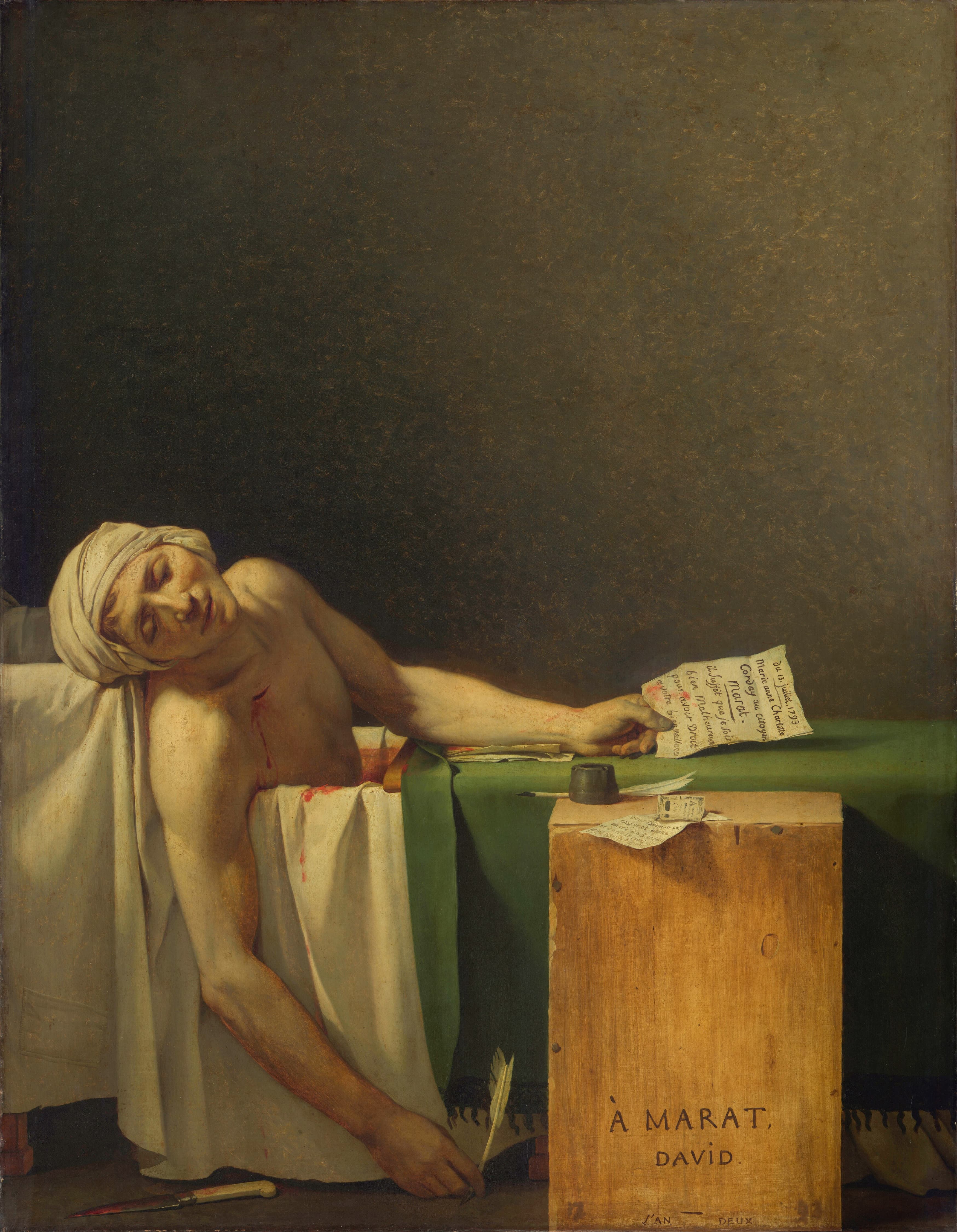
The Revolutionary Age · 13 July 1793
The Friend of the People
A knife bought that morning, a bath, and a martyr painted with the ugliness left out
look closer
Marat’s head has fallen back and his eyes are shut. The vinegar-soaked cloth is still wrapped round it. The disease that kept him in the bath left his skin scabbed and raw, and David painted it smooth.
Jean-Paul Marat spent his last hours where he spent most of them, in the bath. A skin disease had eaten at him for years. The only relief he found was to sit for hours in a copper tub of medicated water, a wooden board laid across it for a desk. That is where he wrote the newspaper that had made him the most feared man in Paris. It was called The Friend of the People, and from it Marat had called for heads by the thousand. On the evening of the thirteenth of July, 1793, a young woman from the provinces named Charlotte Corday talked her way to his door. She had been turned away that afternoon; she came back at seven, and this time she carried a note promising to name Girondin traitors hiding in Caen. Marat, who never could resist a list of enemies, had her let in. She was 24, and she had bought the knife that morning at a cutler’s stall in the Palais-Royal, a plain kitchen blade about 5 inches long. She stood by the tub and read him the names, and he wrote them down, and told her they would all go to the guillotine. Then she drew the knife from her dress and drove it once into his chest, under the collarbone, deep enough to open the great vessels above the heart. He called out to his fiancée, Simonne Evrard: help me, my dear friend. He was dead in minutes. Corday did not run. She was standing there when they seized her, and four days later she went to the guillotine herself, calm to the end. The executioner’s assistant slapped her severed head, and the crowd was so disgusted that the man was thrown in prison for it. Jacques-Louis David had visited Marat in that bath the day before the murder and found him working over his board. He was Marat’s friend, a deputy of the same faction, and the Convention asked him to make the death into an image the Revolution could pray to. He finished it that autumn and lied in every merciful direction. The real Marat was scabbed and swollen; David gave him the smooth pale skin and slack heavy arm of Christ taken down from the cross. He set the tub in a vast plain darkness, put a single wound and a thread of blood on the perfect chest, and made the murder look like an altarpiece. In one hand Marat still holds Corday’s note, the writing legible: it is enough that I am unhappy to have a right to your goodness. The lie she used to reach him is the paper he dies clutching. David added a second document the murder scene never contained. On the wooden crate Marat used as a desk he painted a banknote and a note in Marat’s hand: you will give this to that mother of five children whose husband died for his country. In his last moment, the picture insists, Marat was not writing out a death list but giving his own money to a war widow. On the face of the crate David signed the painting like a headstone, to Marat, and the year. He built the man a monument out of the packing box he wrote on. The tub itself outlived them all. It sat in a cellar, passed through the hands of collectors and a country priest, and ended up at the Musée Grévin, the Paris waxworks. An ordinary copper bath, and a country turned it into a shrine.