The Revolutionary Age · 20 May, 1800
The Fiery Steed
The general ordered himself painted calm on a rearing horse. He had crossed on a mule
look closer
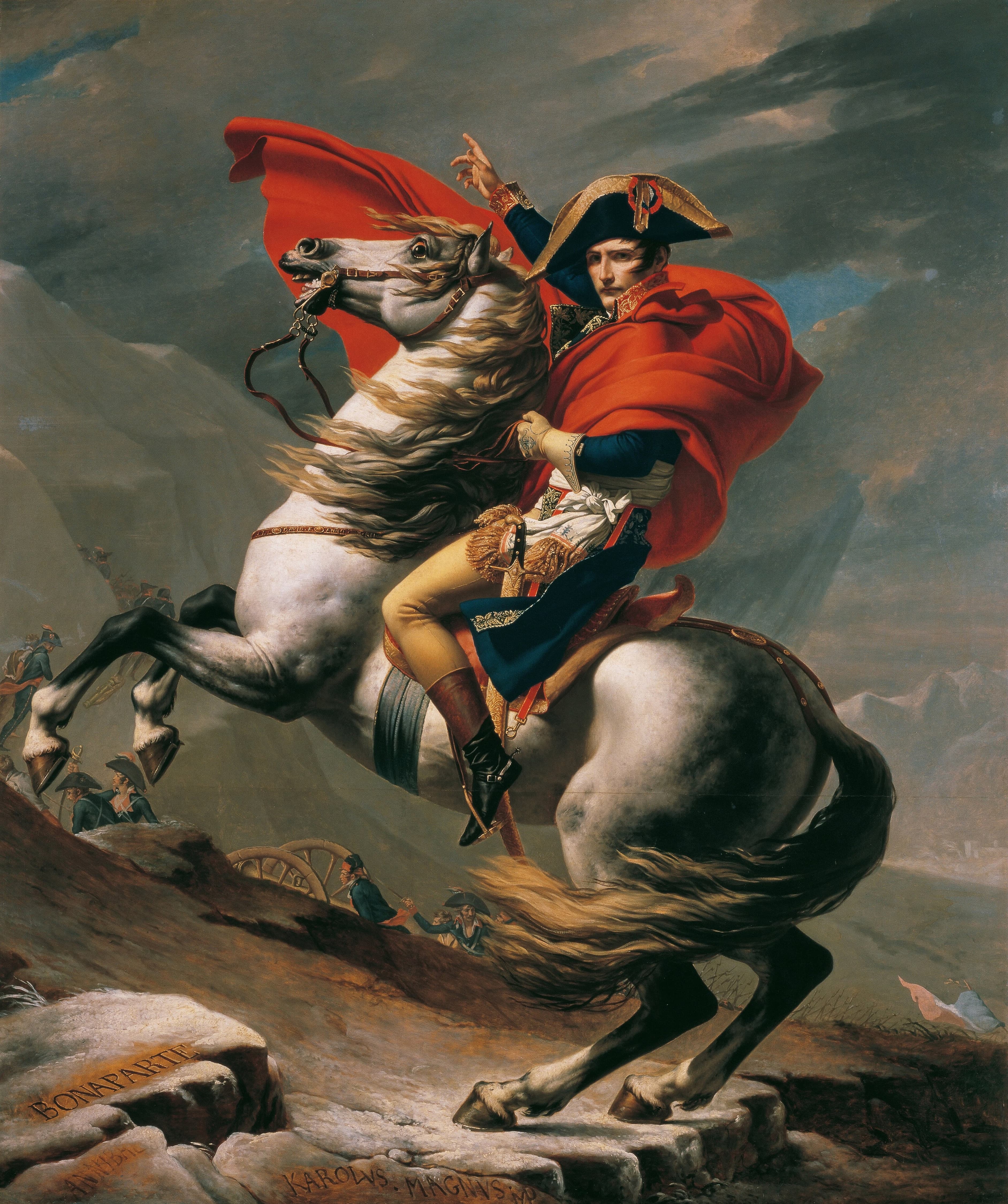
The face is far calmer than it should be on a man of 30 who had just risked everything on a mountain crossing. Napoleon refused to sit for the portrait. David worked from a bust of his head and from the uniform he wore at Marengo.
In the third week of May, 1800, a French army of some 40,000 men climbed the Great St Bernard Pass, still under snow. The top of it stands at 8,100 feet. They took the guns apart and dragged the barrels inside hollowed pine logs, a hundred men to a cannon, hauling them over the ice by hand. Napoleon crossed on the twentieth. He did not ride a rearing stallion. He rode a mule, wrapped in a grey coat. It was led by a young guide from the village of Bourg-Saint-Pierre, Pierre Nicolas Dorsaz, who did not know at first who he was walking beside. At the top Napoleon offered him a reward. Dorsaz asked for the mule, and got the mule, and then a house and a farm as well. The point of the crossing was speed. Three weeks later, on the plain of Marengo, the Austrians nearly beat him, and then, late in the day, did not. The picture was commissioned by Charles IV of Spain, for the royal palace in Madrid. Napoleon gave Jacques-Louis David one instruction. Calm, on a fiery horse. Calme sur un cheval fougueux. He would not sit for it. The great men of antiquity had their images without sitting, he said, and he asked what good sitting would do. So David worked from a bust of the head, from the uniform and bicorne Napoleon had worn at Marengo, and from his own son perched on a ladder to get the posture. The horse is invented. Two of Napoleon’s own horses stood as models, and what David built out of them is a storm with hooves. Everything in it argues upward. The cloak flies the wrong way for the wind that flattens the mane, because David needed the red to fill that corner of the sky. The gloved hand points to the summit the army has already passed. The face is far too calm for a man of 30 who had just risked everything on a mountain and a gamble. And along the rock at the bottom, cut as if by earlier travelers, are three names. BONAPARTE is the largest and the freshest. Below it, worn almost away, ANNIBAL and KAROLVS MAGNVS. Hannibal took elephants over the Alps against Rome. Charlemagne crossed to break the Lombards. David cut Bonaparte’s name into their stone and left the older letters weathered, so the new one would read as the last in a line. Napoleon liked it enough to order three more, for his château at Saint-Cloud, for the library at Les Invalides, and for the royal palace in Milan. A fifth stayed in David’s workshop until he died. They hang now at Malmaison, in Berlin, in Vienna, and twice at Versailles. The cloak is orange in the Malmaison picture and gold in the one at Vienna, and the horse changes color from version to version. Down in the lower corner of every one, small and dark under the horse’s belly, a file of real soldiers bends into the slope. They are dragging a gun carriage up the pass on foot, doing the thing the man above them is only pretending to do.