The Revolutionary Age · 2 December, 1804
The Crown He Lifted
The Pope came all the way to Paris to crown him. He took the crown and did it himself
look closer
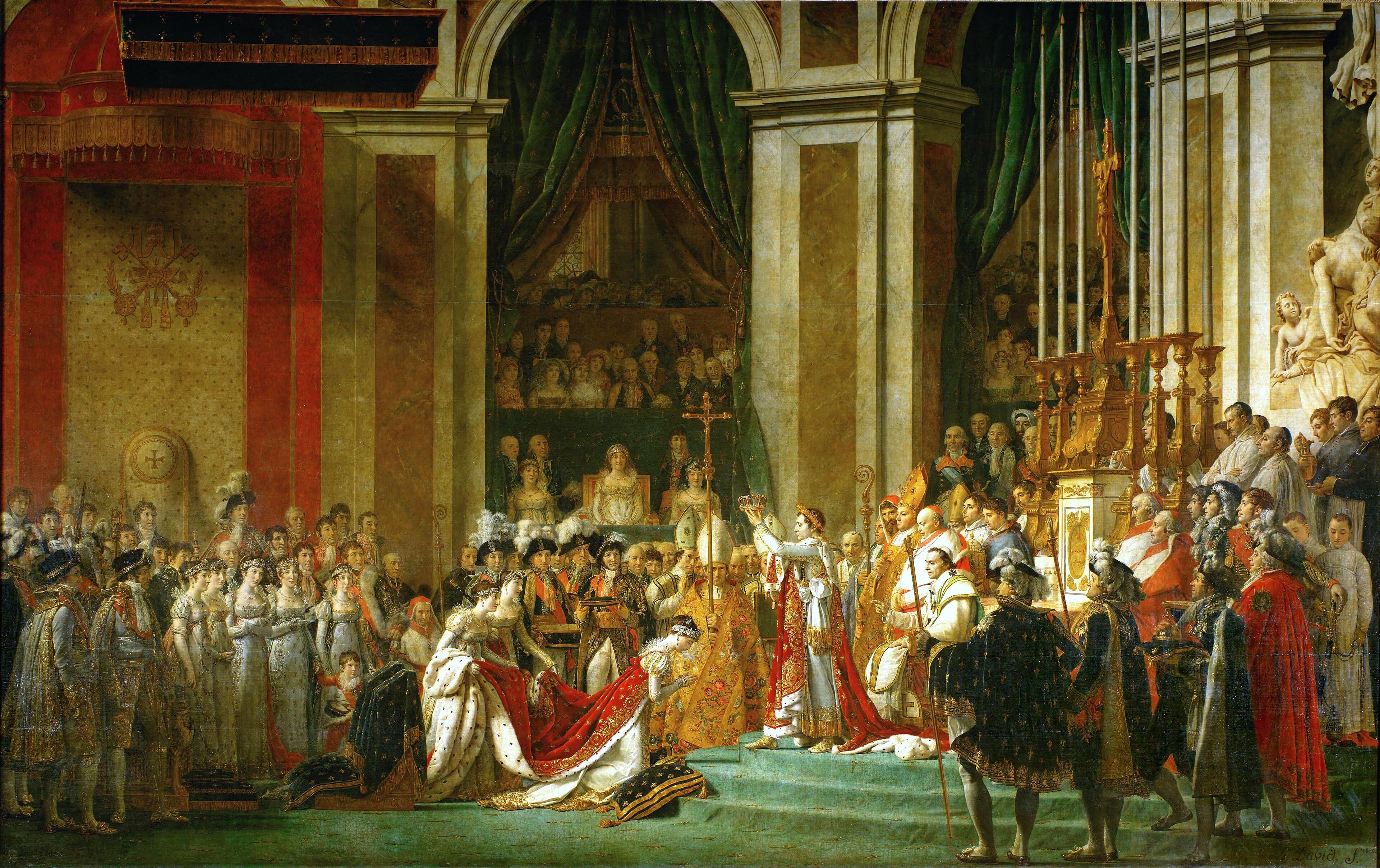
Napoleon already wears the gold laurel he had put on his own head instead of letting the Pope do it. David left that part out and painted him lifting the second crown, the one for his wife.
On the second of December, 1804, Notre-Dame was freezing and hung with borrowed splendor. The old Gothic front had been boarded over with a plaster arcade in the classical style, because Napoleon found the medieval church embarrassing, and braziers burned along the nave against a hard Paris winter. Pope Pius VII had come the whole way from Rome, over the Alps in a coach in the cold, on the understanding that he would crown the new emperor of the French. He anointed Napoleon’s head and hands with oil. Then, at the moment the crown should have passed from the Pope’s hands to Napoleon’s head, Napoleon took it himself, turned his back on the altar, and put it on. He had rehearsed the gesture. It said that the crown came from him, not from Rome, not from God, and everyone in the church understood it. Then he crowned his wife. Joséphine knelt on the carpet in white and diamonds, the women of his family carrying her train, and Napoleon lowered a second crown onto her hair. She was 41, four years older than the age she had given on her marriage certificate. She had wept and maneuvered for months to be crowned beside him, against the wishes of his whole family. The marriage produced no heir. Five years later he divorced her for an Austrian archduchess who could, and Joséphine kept the title of empress and the house at Malmaison and her roses until she died. Jacques-Louis David was there with a sketchbook. He began the canvas in December of 1805 and put the last touches to it in January of 1808. The finished canvas is 32 feet wide and lives in the Louvre. David chose the safer half-second. He left the self-crowning out and painted the emperor lifting the second crown over his kneeling wife, which reads as tenderness instead of theft. He edited freely. On the day, Pius VII sat with his hands in his lap while his own ceremony was taken away from him. In the painting he raises two fingers in blessing, because Napoleon looked at the sketch and said a pope brought all that way should at least be seen to bless something. The biggest lie is in the gallery above. In the center of the balcony, watching serenely, sits Letizia Bonaparte, the emperor’s mother, a Corsican woman who had raised eight children in genuine poverty and trusted none of this. She was not in the church that day. She had left Paris in protest over a family quarrel, refusing to attend, and Napoleon ordered David to seat her at the heart of the picture anyway, presiding over a coronation she had boycotted. Higher up, in the shadows of the same gallery, David painted a small row of onlookers, and among them, sketching, himself.