The Revolutionary Age · Winter, 1812
The Road Out of Russia
An army of 600,000 walks home through the snow and does not arrive
look closer
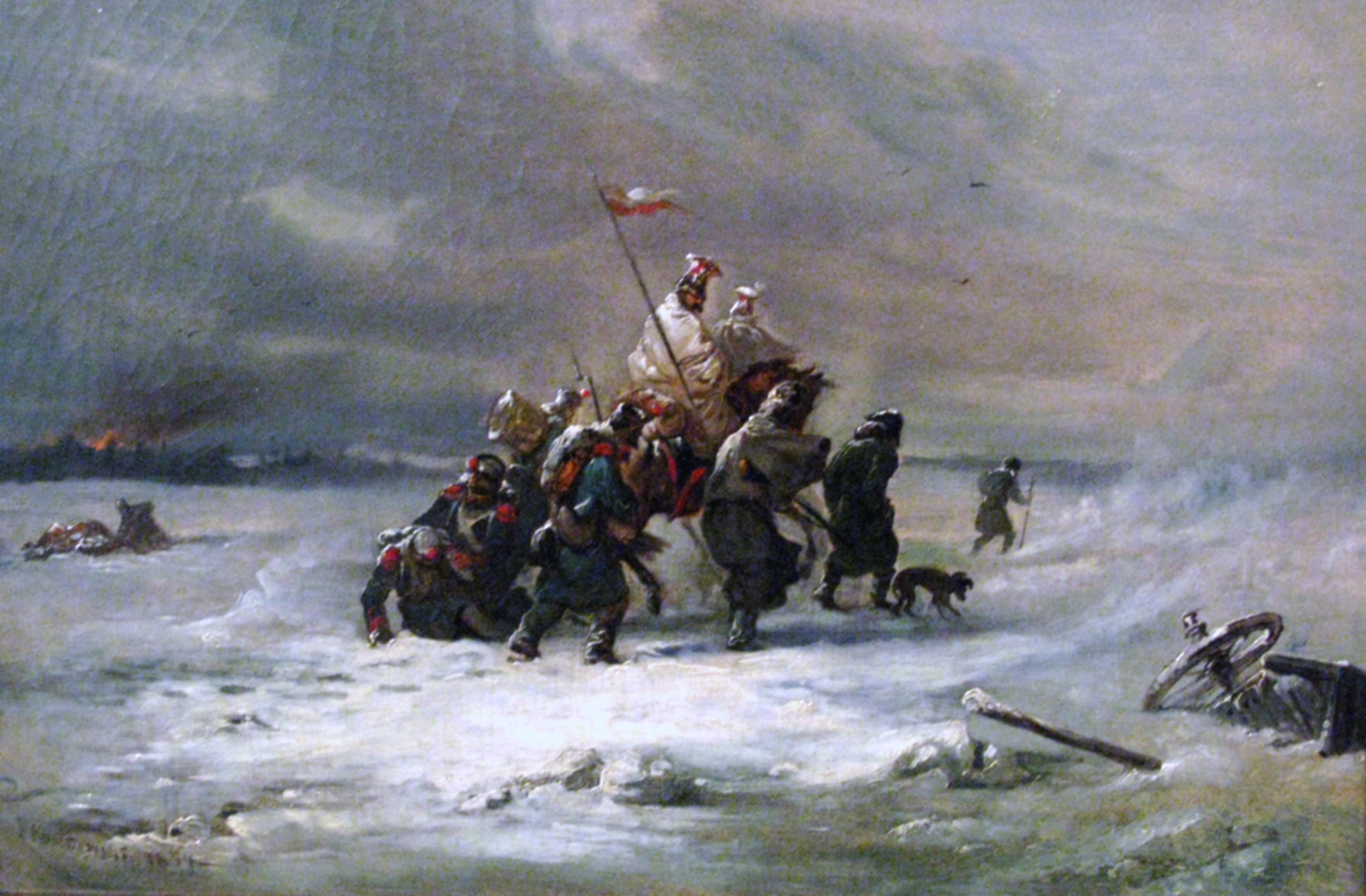
A red and white pennant rides over the column on a long lance. Those are the colors of Poland, and Kostrzewski was a Warsaw painter. Polish soldiers went east with Napoleon on a promise of getting their country back.
About 450,000 men crossed the Niemen with Napoleon in June of 1812. Reinforcements over the summer brought the invasion force to something above 600,000. He took Moscow in September and found it empty, and within a day it was on fire. The governor had ordered the city burned rather than let the French winter in it warm. Napoleon waited five weeks in the ashes for a surrender that never came, then turned around. The Grande Armée left Moscow on the nineteenth of October and walked back the way it had come, across country its own advance had already stripped bare of food. Then the cold came for it. The horses died first, by the thousand, and once the horses were gone the cavalry walked and the guns and the wounded were left where they stopped. Men froze standing up around fires that were too small. By Smolensk in early November most of the army was already gone. Then it got colder, and then they reached the river. At the Berezina, at the end of November, Russian armies were closing from three sides and the bridges were down. The bridge-builders under General Éblé, most of them Dutch, waded into water cold enough to kill a man in half an hour. Working in relays, they threw up two trestle bridges out of timber pulled from the town. Éblé died a month later at Königsberg, of what the water had done to him. The army crossed on the twenty-sixth through the twenty-ninth of November under fire. Éblé held back the order to burn the bridges as long as he dared, and when they went up tens of thousands of stragglers and camp followers were still on the far bank. The crossing cost 50,000 lives or more, soldiers and civilians together. In French, la Bérézina still means a catastrophe. On the fifth of December, at a place called Smorgoni, Napoleon handed the wreck to his brother-in-law Murat. He got into a sleigh and raced for Paris, ahead of the news. A general there had just tried to seize the government on a rumor that he was dead. Behind him the last of the army stumbled into Prussia over the following weeks. Of the central column, only a few thousand came out fit to fight. The thing he could not outrun was the Twenty-ninth Bulletin. It was his own dispatch, admitting the disaster and blaming the weather and the dead horses, and it closed with a sentence Paris read twice: the health of His Majesty has never been better. The painting is a Polish memory of it, made 42 years later. Franciszek Kostrzewski was a Warsaw painter, and he put a red and white pennant up over the column. Polish soldiers had marched east under Napoleon on the promise of their country back and got the snow instead. Two men at the head of the column still have horses. The rest are on foot with their heads down, a dog keeps pace at the edge, and off to the right a broken wheel stands up out of a drift. The picture is 35 by 54 centimeters, and it hangs in the National Museum in Warsaw.