The Revolutionary Age · April, 1822
The Island of Mastic
A rich Aegean island that grew resin for the sultan is emptied in a few weeks
look closer
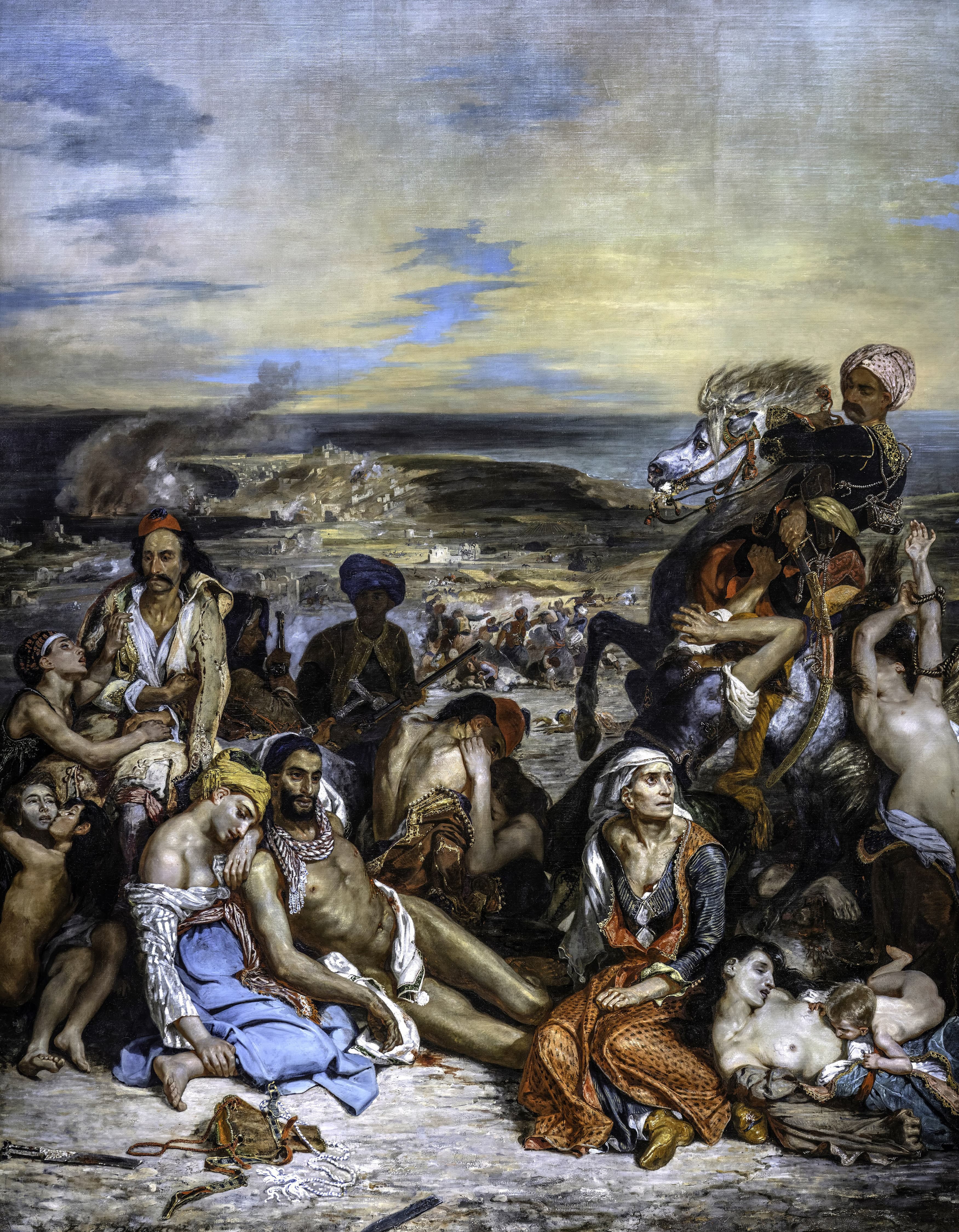
The old woman sits upright among the bodies with one hand open in her lap. She looks up and away from all of it. Nobody has ever settled what she sees.
Chios was the softest place in the Aegean to be Greek. The island grew mastic, the resin the Ottoman court chewed and made into liqueur. For that one crop the sultans had let Chios keep its bells, its schools and a light hand for more than 250 years. Its people did not want a war. When fighters from the neighboring island of Samos landed in March of 1822 to bring the Greek revolution to Chios, most of the islanders hung back, and it did them no good at all. An Ottoman fleet anchored off the town in late March. On the twelfth of April the order came to burn it, and troops came ashore to punish the whole island. What followed was not a battle. Of about 110,000 people on Chios, something like 25,000 were killed. Another 45,000 were sold into slavery, and the rest fled or were carried off. The markets of the eastern Mediterranean filled with Chiot women and children priced by the head. Villages that had made resin for the sultan were burned. Europe read about it in the newspapers, and the reading did something. There was already a fashion for ancient Greece among educated Westerners, all Homer and marble, and the massacre turned the fashion into a cause. Two years later Lord Byron, the most famous poet alive, died of fever at Missolonghi, where he had gone with his own money to fight for the Greeks. Eugène Delacroix was 26, with one Salon behind him, and he decided to put the massacre on a canvas 14 feet tall for the Paris Salon of 1824. He did not paint the killing. He painted the after: a hillside above the burning town strewn with Greek captives waiting to be murdered or shipped, and he refused them any heroism. There is no defiance in the picture, no last stand. An old woman sits upright and looks away over everyone’s head. A young man dying of his wounds lets a girl sleep against his shoulder. On the right, an Ottoman soldier on a rearing horse has a naked woman roped behind him. At the horse’s feet a baby still reaches for the breast of a mother who is already dead. Everyone is beautiful and nobody is saved. The way it was painted scandalized the professionals. Delacroix had laid the color on in small separate strokes, so that the light seems to move over the hillside instead of sitting still on it. Antoine-Jean Gros, the reigning master of the grand style, walked past it and called it the massacre of painting, and he meant the painting, not the Greeks. John Constable’s Hay Wain hung in the same Salon and took a gold medal from the king of France. Its broken, flickering greens went through Delacroix and a whole generation of French painters. The French state bought the Chios anyway, for 6,000 francs, and it is in the Louvre now, a room or two from the barricade Delacroix would paint six years later. The old woman is still looking up. Nobody has ever agreed on what she sees.