The Revolutionary Age · 25 June, 1848
The Stone Thrower
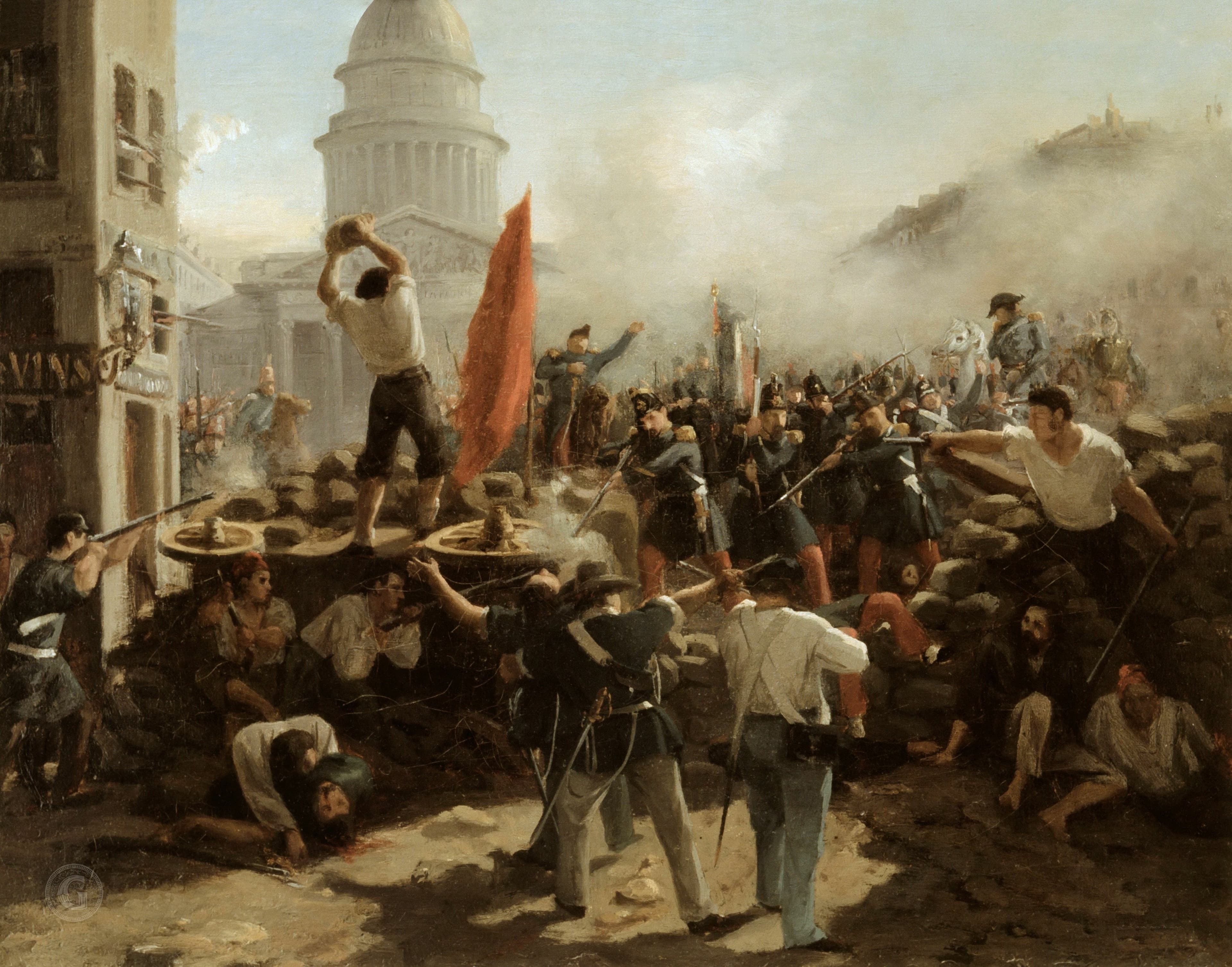
A man on a barricade lifts a paving stone as the army comes up the rue Soufflot
look closer
Two men crouch behind the barricade with muskets. Another lies face down in front of them. The barricade is the street itself, built from cart wheels turned on their sides and paving stones pried up by hand.
The new French Republic was four months old and already broke. February of 1848 had thrown out a king and set up the National Workshops, work and a small wage for any Paris man who had none, and by June 100,000 men depended on them. In the third week of June the government ordered the Workshops shut: young men could take the army, the rest could go home to the provinces or go hungry. The eastern half of Paris rose at once, and for four days the workers of the city fought the government that had just stopped feeding it. They built barricades again, hundreds of them, and this time the flag over the stones was a plain red one instead of the tricolor of the Republic. Red was the color the workers had made their own. The government gave the whole business to a single general, Louis-Eugène Cavaignac, with something close to dictatorial power. Cavaignac had a cold idea and used it. He pulled his troops back and let the insurgents finish their barricades undisturbed, so that when he attacked he could take a whole quarter at once instead of street by street. It worked. Over four days perhaps 10,000 people were killed or wounded. When it ended, the courts deported around 4,000 insurgents to Algeria, and the young republic had drowned its own left in the space of a week. One of the hardest fights was here, on the rue Soufflot, the short straight street that runs up to the Panthéon. On the twenty-fifth the army came up it against a barricade held by workers. The general commanding in that quarter, Édouard Damesme, had been shot through the thigh the day before, a few streets away on the rue de l’Estrapade. They took the leg off at the Val-de-Grâce, and he died of the wound five weeks later. Horace Vernet painted the moment the assault reached the stones. Vernet was the establishment’s battle painter, decorated, official, a man who worked for kings and then for this republic, and his sympathies were plainly with the soldiers coming up the street. But he was too good a painter to lie about who was interesting. The eye goes straight past the tidy bayonets to the insurgents on the barricade. At the top of the stones a man in a white shirt and dark trousers has both arms over his head, holding a paving block, in the half-second before he throws it. The red flag stands beside him. Behind them both is the dome of the Panthéon, pale in the powder smoke, the building where France buries the great men it decides to honor once they are safely dead. There is no name for the man with the stone. He was one of the workers who lost, and the losers of June left few records and no monuments. The winners wrote the histories and painted the pictures, and even this picture belongs to the other side. His weapon is a piece of the street itself. Paris was paved in squared blocks, each about the size a man can just lift over his head, and for a century every rising in the city began by prying them up. Vernet painted all of it on a canvas 36 by 46 centimeters, and it hangs in Berlin.