The Revolutionary Age · 20 September 1792
From This Place and This Day
A muddy artillery duel ends the age of kings anyway
look closer
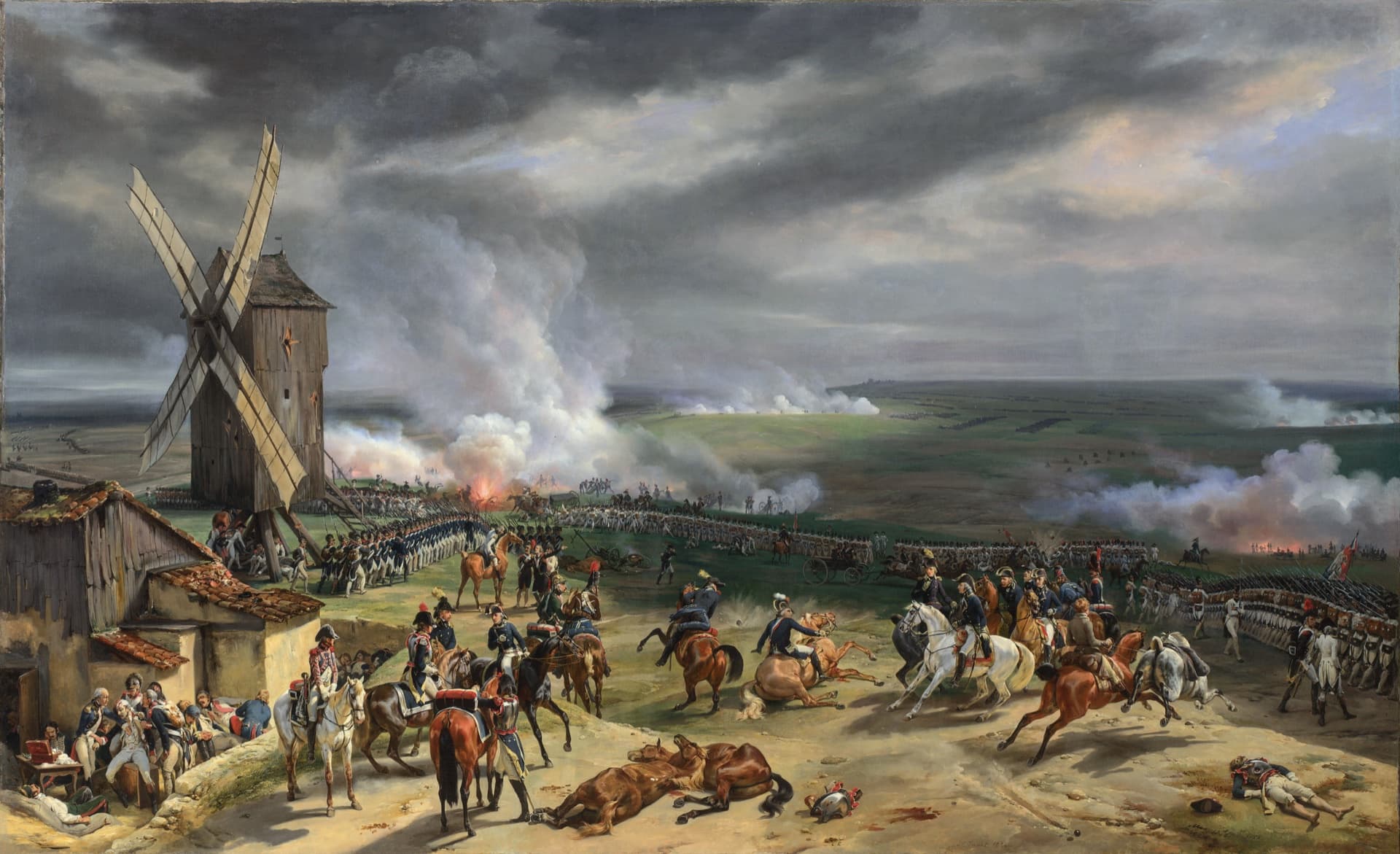
A windmill stands on the ridge with its sails stopped and a storm coming in behind it. This is the mill of Valmy. The French held this rise all day, and the battle took the mill's name.
The Prussian army that marched on Paris in the autumn of 1792 was the most respected in Europe, and it advertised. Its commander's manifesto promised the city vengeance and ruin if the royal family were touched. It was the most counterproductive document of the century. Paris answered by storming the Tuileries. The army that met the Prussians at Valmy on 20 September was something military science had no category for. It was half regulars and half volunteers who had been shopkeepers in July, and they sang while they stood. The battle itself was mostly weather and artillery. In fog and rain and mud, the French guns traded fire with the Prussian batteries across a shallow valley below the windmill of Valmy. The artillery was the one branch of the old royal army the Revolution had kept whole and professional. When the Prussian infantry started forward, an ammunition wagon blew up and put Kellermann on the ground. He got on another horse, raised his hat on the point of his sabre, and called out Vive la Nation. The line roared it back and did not break. The Duke of Brunswick looked through the rain at unbroken guns and unbroken shopkeepers and said the sentence that decided Europe: we do not fight here. Casualties on both sides together came to a few hundred. For what it settled, Valmy is the cheapest decisive battle in modern history. The invasion turned around and squelched home, dysentery commanding the rearguard. In Paris the National Convention had met that same day. On the 21st it abolished the monarchy. On the 22nd it declared the Republic, and the calendar restarted at Year One. Goethe was with the Prussian army that day, a civilian observer of 43. Demoralized officers asked him at the campfire for a word. He gave them the one the era kept: from this place and this day begins a new epoch in the history of the world, and you can say that you were there. He published the line 30 years afterwards, which is when most famous sentences get written. Vernet painted the mill and the mud in 1826 on a commission from the duke of Orléans. Orléans had a stake in the subject: at 18 he had been a lieutenant general of the Republic, and he had stood on that ridge himself. Four years after the canvas was delivered he became King Louis-Philippe, a monarch whose proudest credential was a battle fought to abolish monarchs, which is the Revolution's whole sense of humor in one commission. It is one of 4 battle scenes Vernet painted for Orléans, and it was damaged when a Paris crowd sacked the Palais-Royal in 1848. The painting hangs in the National Gallery in London: the mill at the left, the dead horses in the foreground, and the new epoch arriving as weather.