The Renaissance · 1533
Death at an Angle
Two young men, every instrument of knowledge, one smear on the floor
look closer
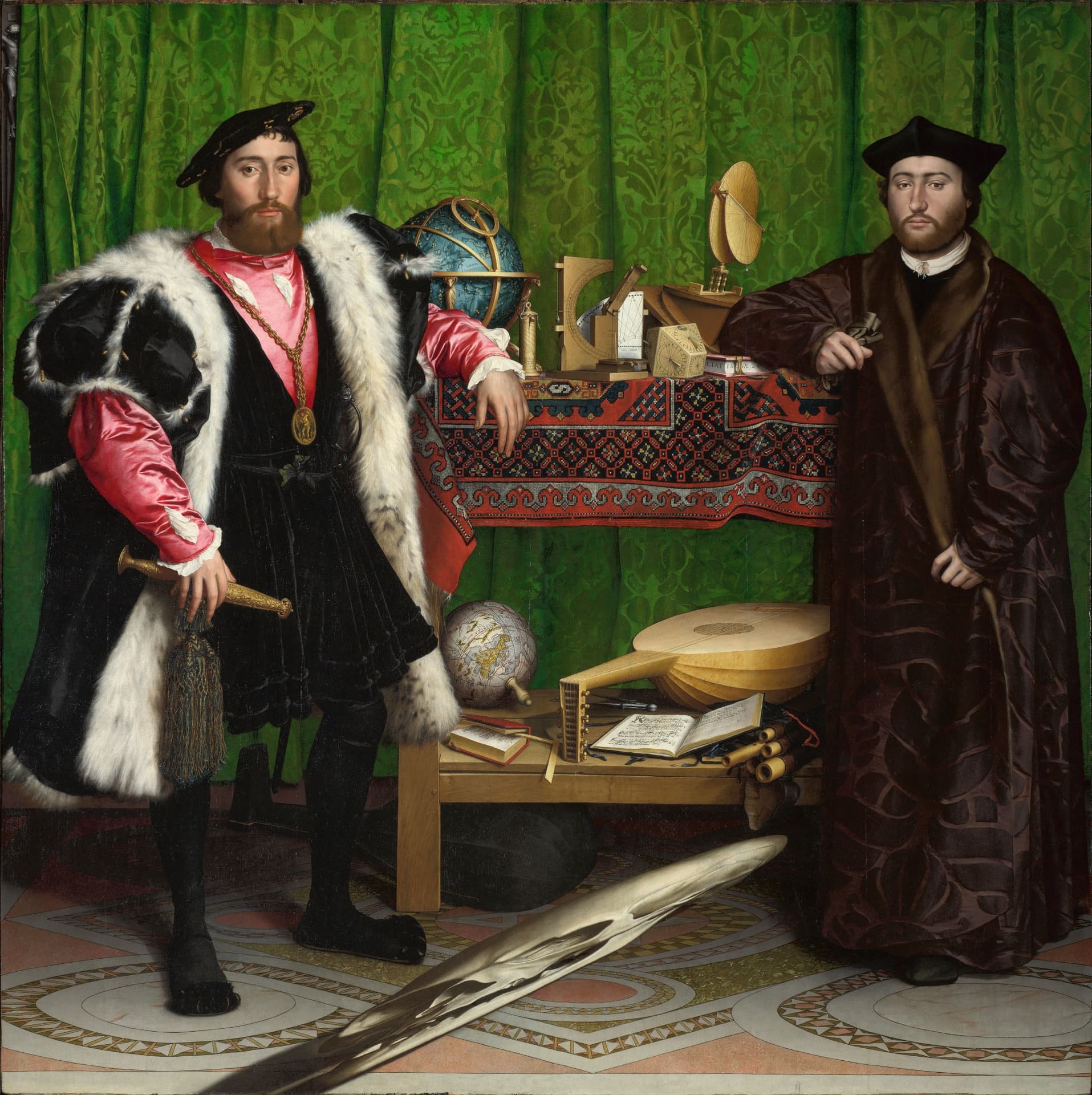
From straight on this is a grey smear lying across the tiled floor. Seen from one step to the right of the painting, it snaps into a human skull.
The man on the left is Jean de Dinteville, French ambassador to London, 29 years old, and having the worst posting of his life. It is the spring of 1533 and England is breaking from Rome while he watches. The king has secretly married Anne Boleyn, who is visibly pregnant. The new archbishop is about to annul the old marriage on his own authority. France is trying to keep one boot in each camp. His friend Georges de Selve, 25 and already a bishop, came to visit in April. Dinteville had Holbein, the best painter in England, put the two of them full length on one panel, surrounded by the whole equipment of their world. The equipment is the point, and it is out of tune. On the upper shelf sit the instruments of heaven: globes, sundials, and a torquetum, a brass device for locating a star. Several of them are set to readings that disagree with each other. The lower shelf holds the earthly instruments. There is a lute with one snapped string, the century's standard sign for broken harmony. Beside it a Lutheran hymnbook lies open, in a painting of two Catholic diplomats, at the two hymns least likely to offend anyone: a prayer to the Holy Ghost and the Ten Commandments. A textbook of merchants' arithmetic is propped open at the page beginning Division. Holbein has painted the entire crisis of Europe as a still life and dared the viewer to call it one. Across the floor, over a pavement copied from the Cosmati mosaic at Westminster Abbey, lies a long pale smear. Seen from one step to the painting's right, it becomes a human skull, drawn so exactly that opticians still argue about the tools Holbein used. From the front, where the two brilliant young men look out, death is unreadable; find the angle, and the ambassadors go vague while the skull comes sharp. Dinteville's motto was memento mori, remember death, and the badge on his cap holds a tiny silver skull. In the top left corner, half swallowed by the green curtain, hangs a silver crucifix: the one instrument in the picture nobody in it is using. Dinteville took the panel home to his château at Polisy that autumn and out of history for three and a half centuries. The National Gallery bought it in 1890. Visitors have been walking left to right past the two men who owned everything ever since, and watching what was waiting in the floor.