The Renaissance · 13 August 1521
The City on the Lake
The last day of the largest city in the Americas
look closer
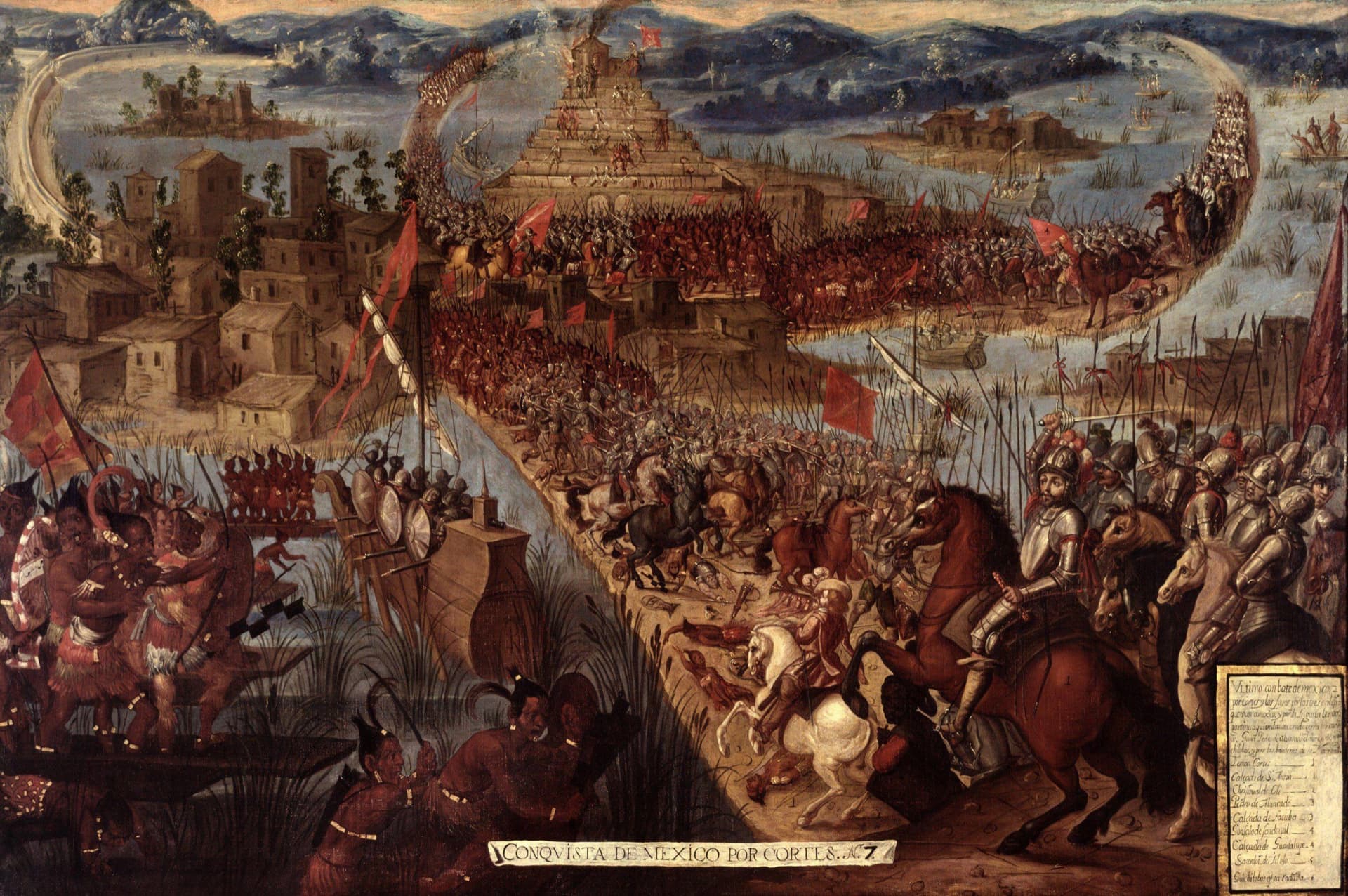
Smoke lifts off the temple at the top of the pyramid, and small figures fight their way up the stairway. Stone from this platform was carried off to build the cathedral that stands on the site now.
The Spaniards first walked the causeway into Tenochtitlan in 1519. The soldier Bernal Díaz wrote that some of them asked aloud whether it was a dream. A city of perhaps a quarter million people stood in the middle of a lake, larger than any city those men had seen at home. It grew its food on floating gardens and drank from a stone aqueduct running in from the springs at Chapultepec. Two years later they destroyed it house by house, and the strangest part of the story is how few of them there were. Cortés never commanded more than about 1,500 Spaniards. The army that took the city was tens of thousands of Tlaxcalans and other peoples the Aztecs had taxed and raided for a century. The conquest of Mexico was, in manpower, an Indian civil war with Spanish officers and Spanish steel. The siege of 1521 was an engineering solution to an amphibious problem. On the retreat the Spaniards still call the Noche Triste, the sad night, half of them drowned in the lake, weighed down by gold they would not let go. Cortés then had 13 small warships built inland, carried over the mountains in pieces, and launched on the water. The brigantines swept the war canoes, the causeways were cut, and the aqueduct from Chapultepec was broken at its source. What the guns could not do, thirst and hunger did. Behind them moved a third army. Smallpox had arrived with one sick soldier the year before, and it had already killed the emperor Cuitláhuac and, by some counts, two of every five people in the valley. On 13 August 1521, after a siege of 75 days, the last emperor was taken on the lake in a canoe. Cuauhtémoc had been trying to reach the mainland to keep the war going. He asked Cortés for the knife at his belt, to be killed as a king. He got three and a half more years as a hostage, then a hanging in the forest. The city was leveled, the temple platform quarried for a cathedral, the canals filled in. Over the next three centuries the lake itself was drained away. The one city the Spaniards had compared to enchantment is now the dry ground under Mexico City's traffic. The painting is one of a series made in Mexico itself 150 years later, for rich Spanish-descended families who wanted the founding story on their walls. Warships and war canoes, the causeway battles and the burning pyramid all happen at once, the way events are stacked in the older painted histories of the valley. In the corner a numbered key identifies the captains, like a school diagram of the end of a world.