The Renaissance · June 1520
Eighteen Days of Gold
Two young kings spend a year's treasury on a party
look closer
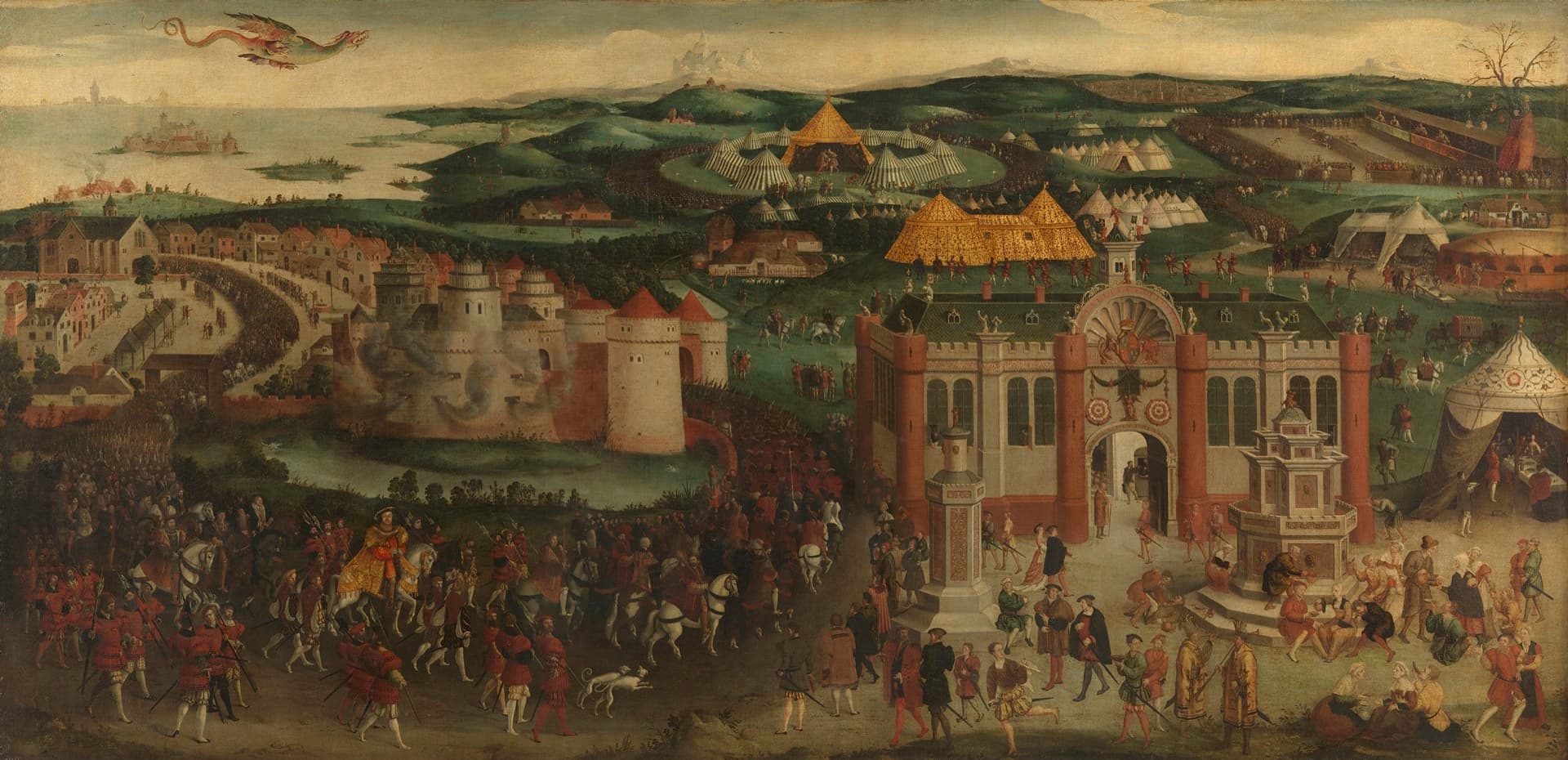
Henry VIII rides a white horse in cloth of gold. The painter made him larger than every man around him. The escort in red closes in on both sides of the road.
In June 1520, on a shallow valley between two castles near Calais, the kings of England and France met to become brothers. Henry VIII was 28; Francis I was 25; each had spies in the other's court and a new rival watching both, the 20-year-old Charles V, who had just added the empire to Spain. Neither king would set foot in the other's country, so Cardinal Wolsey, who produced the event, built a third kingdom between them. It held 5,000 people a side and 2,800 tents. For Henry there was a temporary palace at Guînes, timber and painted canvas made to look like brick, with real glass windows and gilded lions on the gates. Outside it stood two fountains running claret and spiced wine for anyone holding a cup, which by the second week was everyone. For 18 days the two courts jousted, wrestled, danced, and outdressed one another with a unity of purpose their diplomats never matched. The field took its name from the fabric both sides wore into bankruptcy: cloth woven with actual gold thread, tents of it, doublets of it, horse trappings of it. Each crown spent roughly a year's income. The one unplanned moment became the most famous. Henry was ahead on points in every arranged contest. He grabbed Francis by the collar and challenged him to wrestle, and Francis, trained in the Breton style, threw him flat on his back in front of both courts. The chroniclers, English ones especially, moved briskly on. On the final Sunday the two kings heard mass together in a chapel hung with gold tissue. Something shaped like a dragon sailed over the congregation. The accounts call it a firework or a kite, and it went into the painting too. As diplomacy it evaporated on contact. Within two years Henry had allied with Charles against France, and English armies were burning the country whose king he had sworn brotherhood with in a golden valley. The field produced no treaty that survived, only a display so total that no monarchy ever quite attempted it again, and a name that has meant gorgeous futility ever since. The panorama at Hampton Court was painted around 1545, 25 years later, and it holds the whole affair in one view. Henry rides in procession at the lower left, larger than his escort. The canvas palace stands at the right with both wine fountains running. The tent city goes back over the hills in gold and stripes, and the dragon crosses the sky above all of it. The painting takes the event at its own valuation, which is the correct way to paint a party.