The Machine Age · 1873
Eleven Men and a Rope
A student paints the Volga haulers as individuals and Russia argues for a decade
look closer
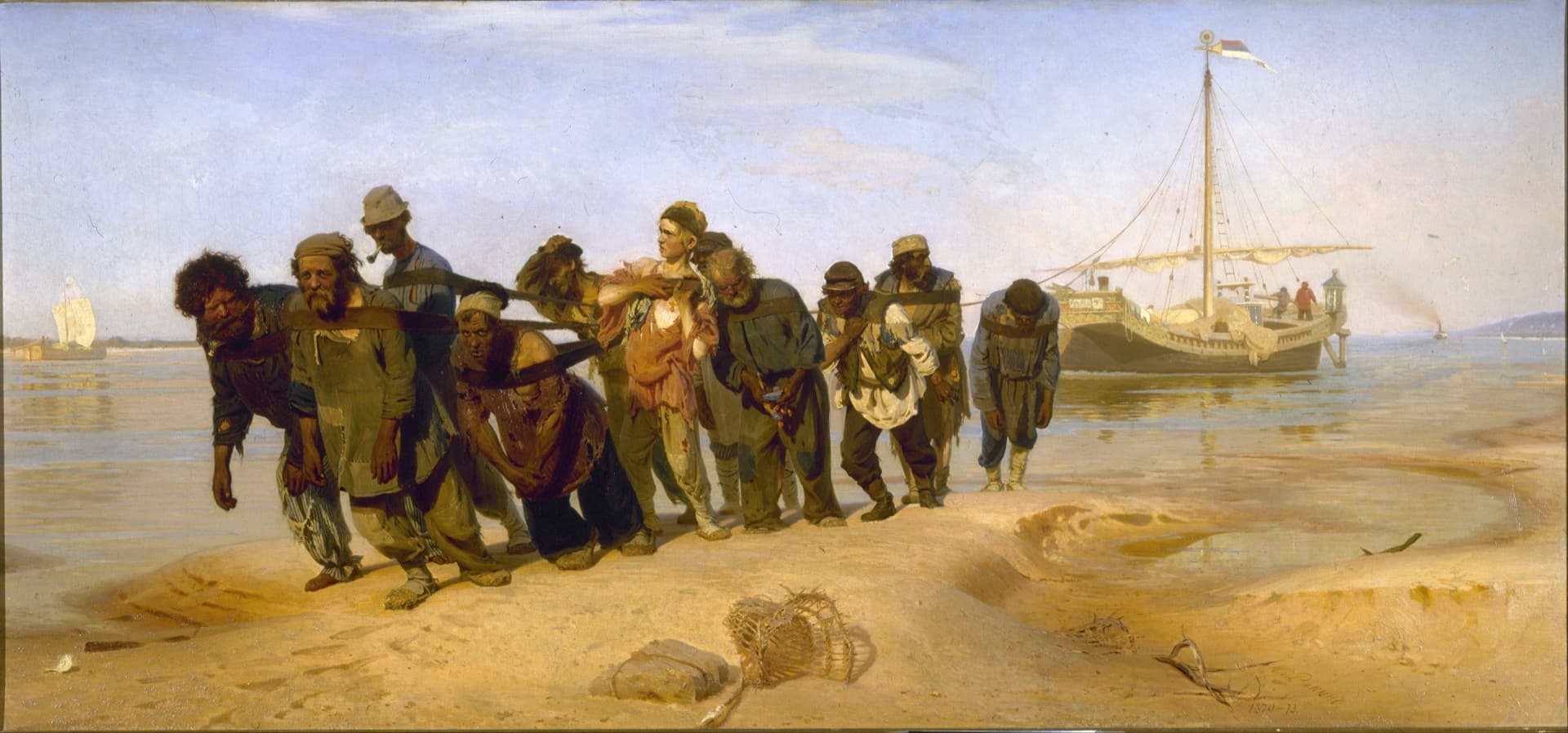
Kanin at the head of the line, a defrocked priest Repin knew by name and painted from life. Repin said the forehead belonged on a Greek philosopher.
Ilya Repin was 24 and still at the Academy when he saw them on the Neva. A gang of men in harness was dragging a barge upstream, past a bank of students and summer people with parasols. The contrast lodged. In 1870 he took his brother and the landscape painter Fyodor Vasilyev down the Volga. He spent two summers at Shiryaev Buerak, living near the burlak gangs, as the haulers were called. He sketched them, learned their names, and paid for portraits with tobacco. That is the fact that makes the painting what it is. He did not paint a mass. He painted 11 specific men, and you can tell them apart from the far side of a gallery. The leader in the front rank was a defrocked priest named Kanin, whose head Repin described with open reverence, a philosopher's forehead over a strap and a shirt that had stopped being a shirt. Behind him the gang sorts itself by exhaustion. One man packs a pipe as he walks. One sags almost to his knees. One at the back is barely upright, carried by the rope as much as pulling it. And in the middle, catching the light in a pink rag of a shirt, is the boy. Larka, the youngest in the gang, straightening up mid-step to shift his strap, the only figure in the line who is not accepting the arrangement, painted at the exact center of a canvas about acceptance. When it was shown in 1873 the establishment was embarrassed, and said so in the language of policy. A minister of transport complained that the picture advertised a practice already being replaced by steam tugs. That was true, and Repin had already put it in the painting. A steamer smokes on the horizon behind the men, coming up the river to put all 11 of them out of work. Dostoevsky had feared the picture would preach and wrote with relief that it did not; the haulers simply are there, and the viewer does the accusing. The Grand Duke Vladimir Alexandrovich bought it for 3,000 rubles and hung it in his billiard room, where he cheerfully explained it to guests. It went to the Vienna World's Fair the same year and came home a European reputation. Repin lived another 57 years, painted Ivan the Terrible and the October Manifesto and most of Russia's other permanent images, and never again needed anyone's permission. The barge is there at the far right, small, with a man in a red shirt idle on its deck. Repin gave the rest of the canvas to the rope.