The Renaissance · 2 May 1519
In the Arms of the King
Vasari gives the dying painter a king for a pillow
look closer
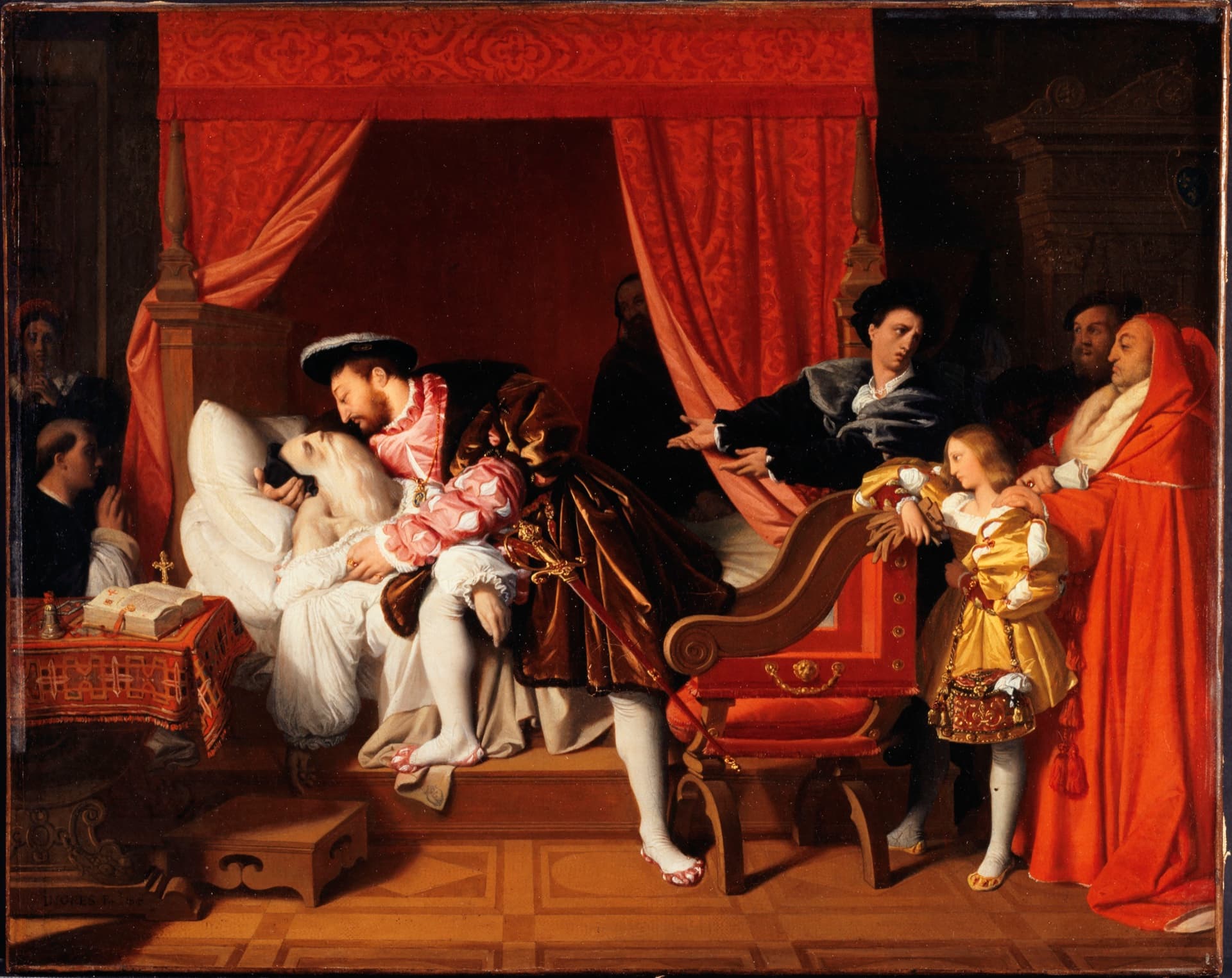
Francis I leans across the bed and takes Leonardo's head in his hands. The court records put the king at Saint-Germain-en-Laye, two days' ride away. Vasari put him here, and here he stays.
Leonardo spent his last three years in France because the king of France collected him. Francis I gave him a manor at Clos Lucé, a pension of a thousand crowns, and a title with room for everything: First Painter, Engineer and Architect to the King. No large commissions were expected. His right hand was partly paralyzed by then. He organized court festivals instead, and built a mechanical lion that walked the length of a hall and opened its chest to spill lilies at the king's feet. He kept three paintings in his rooms that he would not be parted from. One of them was the portrait of a Florentine silk merchant's wife. The king visited down a private lane, some say a tunnel, and talked with him for hours. He died at Clos Lucé on 2 May 1519, 67 years old, having tidied his affairs like a notary's son: will made, masses arranged, the manuscripts and paintings left to his companion Francesco Melzi. Vasari, writing 30 years later, gave the death its immortal staging. The king happens to enter. The old man raises himself in bed to apologize for having offended God and men by not working at his art as he should have. Then came the seizure, and the head of Leonardo going still in the arms of Francis. The court registers make trouble for the scene, placing the king's household at Saint-Germain-en-Laye, two days' ride away, the following morning. Registers can be signed in a king's absence; so can legends. What is certain is what the king kept. The paintings from the dead man's rooms passed into the royal collection. That is the entire reason a Florentine portrait called the Mona Lisa has spent five centuries in France, and hangs in the Louvre and not in Florence. Francis said, in a line reported secondhand years on, that no man had ever known as much as Leonardo. Kings' compliments are cheap, but he had backed this one with a pension. Ingres painted Vasari's version in 1818, exactly as literature and not as evidence. The king cradles the great head like a father, the pillow white, the room red. A courtier throws both arms wide to hold the room off, and a cardinal rests a hand on a page's shoulder. He was in Rome when he made it, working for the comte de Blacas, the French ambassador there, on a canvas 40 centimetres tall. France had just lost an empire and was shopping in its own past for scenes worth believing. This one has never gone out of stock.