The Machine Age · 21 August 1918
Led in Parties of Six
A gas barrage leaves a field of blinded men, and an old painter watches
look closer
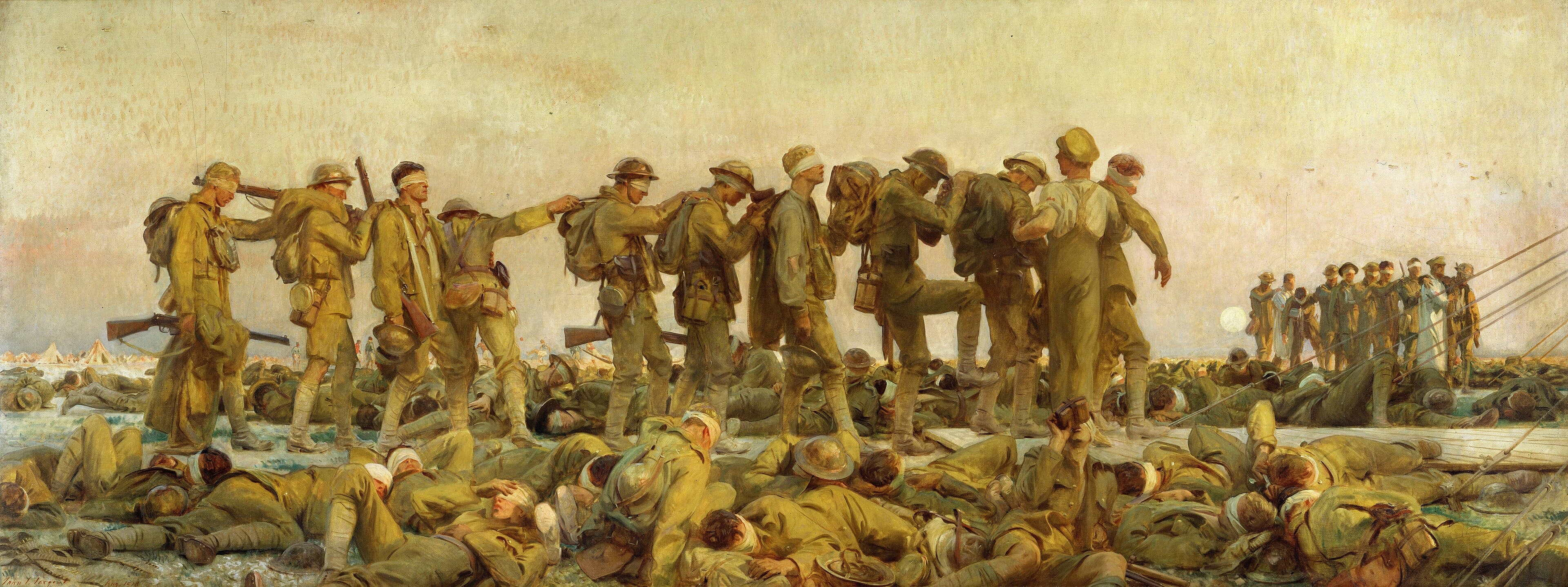
Each man rests a hand on the shoulder of the one ahead. Their eyes are wrapped in lint and their packs and canteens are still on. Sargent wrote that the gassed were led along in parties of about six, and he built the whole painting out of that line.
On the twenty-first of August, 1918, near a dressing station at Le Bac-du-Sud, on the road between Arras and Doullens, John Singer Sargent sat on the grass and watched blinded men come in. He was 62, the most sought-after portrait painter of his age, sent to the Western Front by a British committee that wanted a great picture of the war for a hall of remembrance. A German barrage had put mustard gas over two brigades of British infantry, and the gas did what it does slowly. Hours after a man breathed it or got it on his skin, his eyes swelled shut and blistered. He went blind, usually for days, sometimes for good. The gas rarely killed. It filled the field with men who could walk but could not see. Sargent wrote down what he saw. The gassed cases kept coming in, he noted, led along in parties of about six, each man’s hand on the shoulder of the man in front, guided by an orderly who could see. They sat and lay on the ground in their hundreds, eyes covered with a strip of lint. That single arrangement, the file of blind soldiers roped together by touch, is the whole of the painting he built from it. The finished canvas is enormous, 7.5 feet high and 20 feet long. It puts the viewer where he sat: a low golden evening, two files of bandaged men shuffling forward across ground carpeted with the men already down. He painted it back in London and finished it in March 1919, and he did one thing that the eyewitness in him could not resist. Far back on the skyline, small enough to miss, a group of unhurt soldiers is playing football in blue and red shirts. The war went on around the gassed field exactly like that, a routine horror with a match beside it, and Sargent put the match in. He arranged the standing men in a shallow frieze across the front of the canvas. Several of them lift a foot high to step over a guy-rope or a body they cannot see, and the raised knees run down the line like a slow march. The Royal Academy voted it the picture of the year in 1919. Not everyone was grateful for it. Virginia Woolf attacked its patriotism in print, and E. M. Forster thought it too heroic. Both of them were looking at a beautiful thing made out of a filthy one. The argument has never quite closed. Sargent went back to portraits and died six years later, in his sleep, in London. The painting hangs in the Imperial War Museum, 20 feet of low sun and bandaged eyes, and the football game is still going on behind the files, where almost nobody looks.