The Machine Age · 1920
The Colossus and the Flag
A painter who cannot walk sends a giant striding across the revolution
look closer
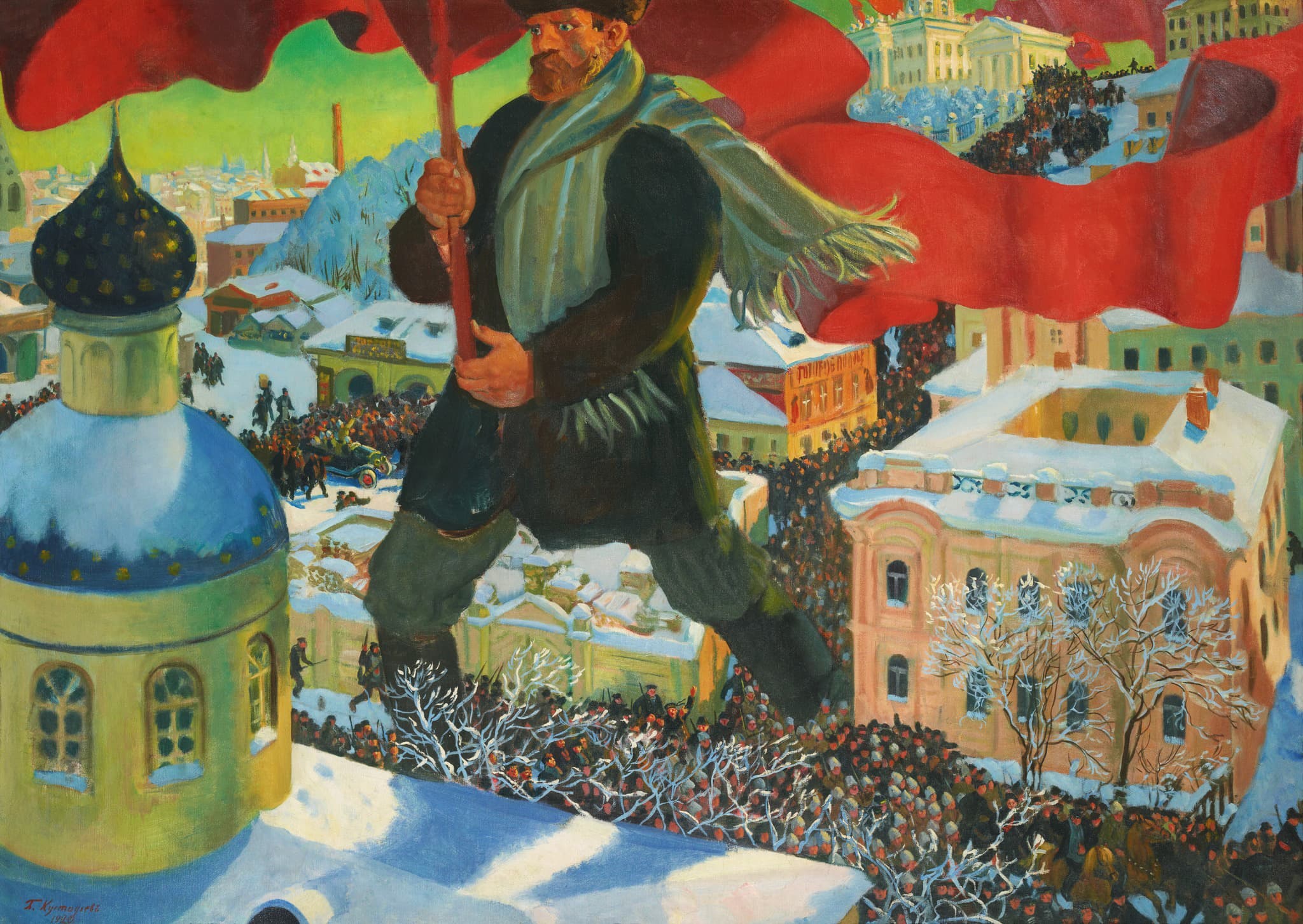
A red-bearded giant in a fur cap and a fringed green scarf stands against a green sky. One fist is closed high on the red pole. Kustodiev had been paralyzed from the waist down since 1916, and he painted this lying on his back.
By 1920 Boris Kustodiev had not walked in years. Tuberculosis of the spine had put him in a wheelchair. He spent a year in a private Swiss clinic, and in 1916 he lost the use of his legs for good. He lived in Petrograd, the city that had been Saint Petersburg, through the February revolution that took the tsar and the October one that brought the Bolsheviks. He saw almost none of it in the street. He watched the crowds and the red flags from his window, then had the canvas brought to him and painted lying back, unable to stand in front of his own work. What he painted that year was a giant. A huge peasant in a fur cap and a long green scarf strides across a snowbound Russian town, taller than the churches. Both his hands are closed on the staff of a red flag so long it becomes the entire sky. Between his boots the real streets run small and dark, packed with a crowd flowing along the walls of yellow houses like water finding a channel. The flag streams out behind and above everything, over the rooftops, brushing past the gold-studded blue dome of an Orthodox church at the edge of the town. The colossus does not look down. He looks straight ahead, out past the frame, and keeps walking. The strange thing is who made it and how he felt. Kustodiev was not a fighter or a firebrand. He was the great painter of fat merchants and country fairs, of women drinking tea on summer balconies, of the plump comfortable Russia the revolution was busy destroying. He went on painting those sunlit scenes from his wheelchair to the end. The Bolshevik is his one thunderclap. Historians still argue over what he meant by the giant. He is either a hero carrying the future or a blind force too big to reason with, crushing the small bright city under its feet. The picture answers both ways at once. He painted it in the middle of a civil war that would kill millions, with a famine on the way. It went to the Tretyakov Gallery in Moscow, where it stays, 101 by 140 centimeters of red. Kustodiev lived seven more years and died in 1927, at 49, in the chair, painting the fairs and the balconies to the last. The giant walks out past the edge of the canvas, toward something the painter who could not stand never named.