The Machine Age · 30 November 1853
The Last Battle Under Sail
Explosive shells end four thousand years of wooden war
look closer
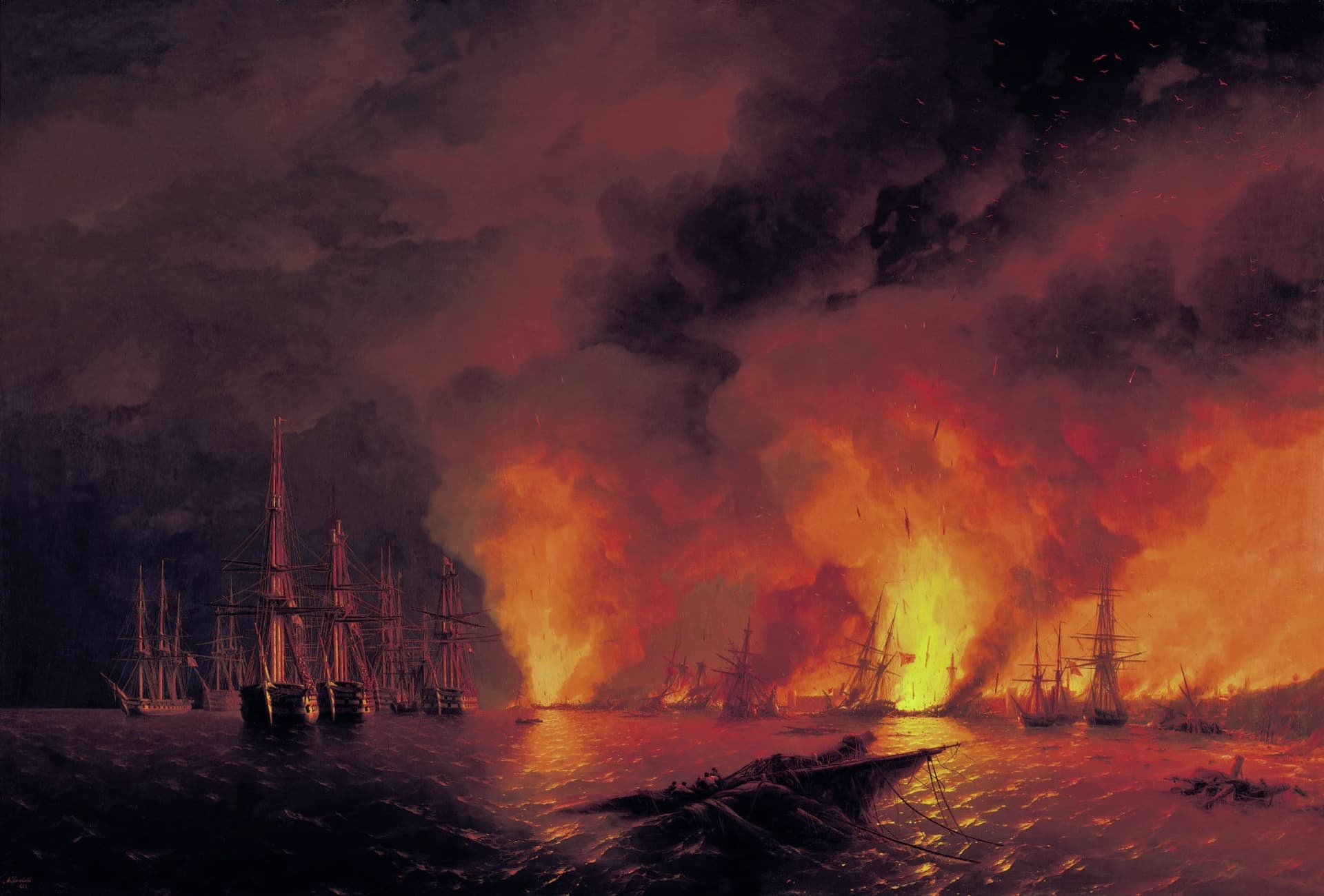
Ottoman warships burn down to the waterline with their red flags still up on the masts. Embers drop through the smoke. Sinop was the first sea battle fought with explosive shells.
On the last day of November 1853, Admiral Nakhimov brought 6 Russian ships of the line into the harbor of Sinop, on the Turkish Black Sea coast. They came in through the rain squalls and anchored opposite the Ottoman frigate squadron, which was sheltering under the town's batteries. What followed was called a battle for diplomatic reasons. The Russian line carried something the wooden world had not yet taken in: Paixhans guns, firing explosive shells instead of solid shot. In a little over an hour the Ottoman squadron did not sink so much as burn to the waterline where it lay. The Russians destroyed 7 frigates and 3 corvettes and then silenced the shore batteries; the burning hulls went up one after another and set the town alight, with nobody left to fight it. Of the 4,200 Ottoman sailors present, about 2,700 were killed, and the paddle frigate Taif outran the Russian steamers to carry the news to Istanbul. The Russians lost 37 men and no ships, and the wounded Ottoman commander, Vice-Admiral Osman Pasha, was taken prisoner. The completeness was the catastrophe. In London and Paris the newspapers ran the engagement as the massacre of Sinope: proof that Russia would swallow the failing Ottoman world unless stopped. Britain and France declared war within 4 months, and the age took the name of the peninsula where their armies landed: the Crimea. The Light Brigade elsewhere in this museum charged in the same war. The other consequence ran deeper than any front. Explosive shells against oak settled an argument navies had been avoiding. Within 6 years France launched the first ironclad and Britain answered with an iron one. The fleets that had fought from Lepanto to Trafalgar in wooden walls were out of date in a decade. Sinop was the last great fleet action of the age of sail, and both facts, the last and the reason it was the last, are in the flames. Aivazovsky, the Black Sea's own painter, put two canvases on the battle within the year, the daylight action and this one, the night after. He painted the harbor as a furnace under a smoke sky, with the Russian line dark and orderly at the left. In the foreground a broken spar carries survivors, because he never painted a sea without insisting someone was in it. Nakhimov had less than two years left; a sharpshooter killed him on the ramparts of Sevastopol defending the base his victory had made a target. The war his hour at Sinop ignited cost three quarters of a million lives and modernized every navy on earth, which is a heavy bill for the tidiest victory in Russian naval history.