The Machine Age · 1855
The Last of England
A painter poses himself for the leaving he almost made
look closer
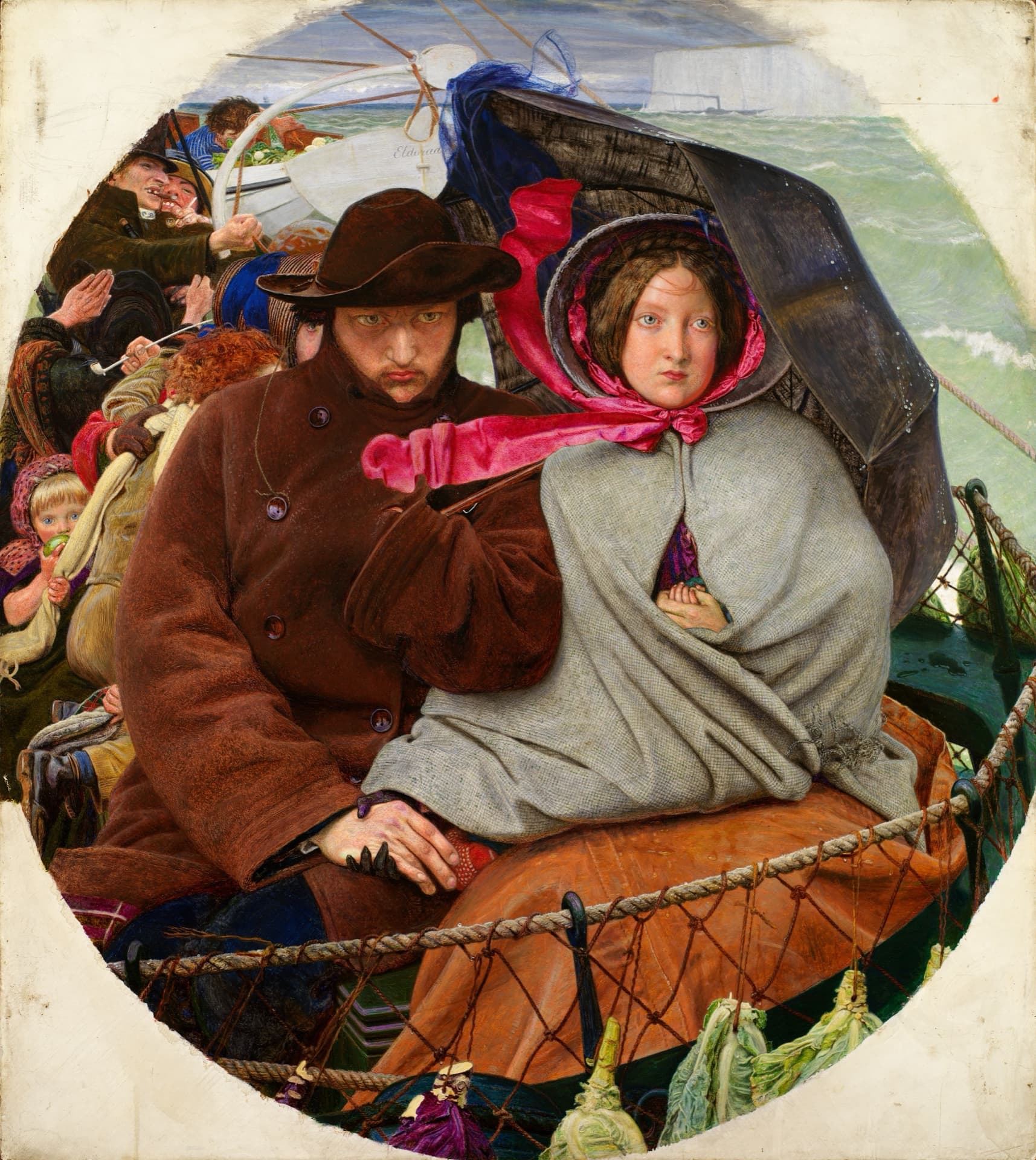
His bare hand closed over her black glove, the knuckles gone purple with cold. Brown painted the flesh outdoors on dull winter days on purpose, to get exactly that color.
In 1852 about 370,000 people left Britain, the largest exodus in its history to that point. They were Irish families still running from the famine's shadow, laborers priced out of everything, and, newly, the middle classes, because Australian gold had made leaving look like arithmetic. That summer Ford Madox Brown stood on the dock to see off his friend Thomas Woolner. Woolner was a sculptor of the Pre-Raphaelite circle who had given up on English patrons and shipped out for the Melbourne diggings. Brown was 31, broke, unfashionable, and privately weighing India for himself. The painting he began that year is the emigration statistic with faces. A young couple sit on the open stern of a packet boat named, with the century's own irony, Eldorado. The white cliffs shrink behind them, and cabbages for the voyage are netted along the rail. He posed himself and his wife Emma for the pair, and painted outdoors through two winters. He worked on days, he noted, when the cold made the flesh look right: the particular purple of hands that have stopped complaining about it. Everything in the round panel is organized around two small warmths. The first is the husband's bare hand gripping his wife's gloved one on his knee. The second, almost hidden in her cloak, is the tiny fingers of a baby holding her other hand. The baby is the third passenger, and the picture shows it only to viewers who look the way parents watch. The man's face is set at the exact temperature between anger and grief that has no English name; the wife watches the country go with the steadier face of the two. Brown wrote that he had chosen educated emigrants deliberately, people bound to England by every tie except the ability to live in it. Woolner, the man the picture saw off, found no gold, came home within two years, and rose into the Royal Academy after all. That is the joke history played on the painting, and it costs the picture nothing: the couple on the canvas are not Woolner. They are the ones who did not come back. Brown himself stayed, stayed poor longer than he deserved, and became the painter Victorian Britain trusted with its work and its leavings. The panel, corners left bare around the oval with the artist's color trials still on them, hangs in Birmingham, in the industrial city that manufactured many of the reasons for the voyage.