The Renaissance · 1508
On His Back
A sculptor who hates painting is ordered up a ladder for four years
look closer
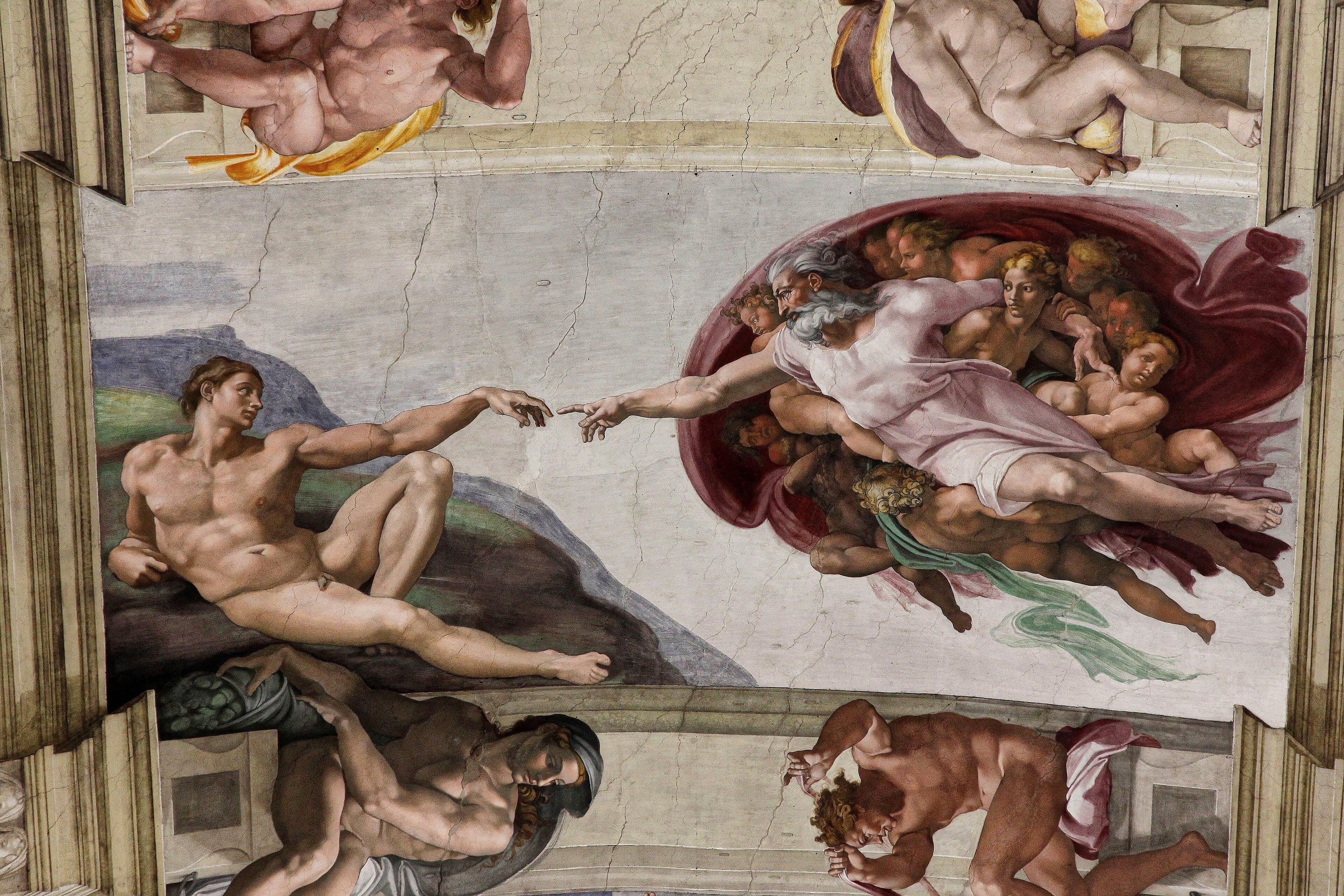
Adam’s hand and God’s stop short of each other. Michelangelo left a finger’s width of plaster between the fingertips, and that gap is the subject of the panel.
In the spring of 1508 Pope Julius II ordered Michelangelo Buonarroti to paint the ceiling of his uncle’s chapel, and Michelangelo did everything he could to refuse. He was 33. He thought of himself as a sculptor and said so at every chance. He suspected the whole commission was a trap laid by rivals who wanted him to fail at a thing he had never done. Julius was not a pope you refused. Contemporaries called him il papa terribile, the terrible pope, a man who led armies in armor and rebuilt Rome by force of temper. Michelangelo took the job, then fired the assistants brought from Florence and did nearly all of it himself. He did not lie on his back, whatever the story says. He built a wooden scaffold that arched below the vault and stood on it, head tipped back, arm above him, for the better part of four years. The posture wrecked him. He wrote a poem to a friend, Giovanni da Pistoia. His beard pointed at heaven, he complained, his skin stretched long in front and bunched behind, and paint dripped steadily onto his face. In the margin he sketched a cartoon of himself, bent like a Syrian bow. The plaster fought him too. Early on it grew mold, and he had to be taught a new recipe that would take the Roman damp. What he put up there is more than 300 figures across 500 square meters: the making of the world, the flood, nine scenes from Genesis ringed with prophets and sibyls and nudes. The one everyone knows is the creation of Adam. God comes in from the right, borne on a red cloak crowded with figures, his arm flung out; Adam reclines on the earth at the left, just waking, lifting a slack hand toward him. Their fingers do not touch. Michelangelo left a gap of bare plaster between them, a hair of nothing, and that gap is the whole subject. Some anatomists have pointed out that the shape of the cloak billowing around God matches a cross-section of the human brain. It may be a coincidence and it may not. Michelangelo dissected corpses by candlelight for years and knew exactly what a brain looked like. The ceiling was unveiled at the end of 1512. Julius lived only a few months longer. Michelangelo, who had begged not to do it, spent the rest of his long life being asked to do it again. The pigment he laid into wet plaster is still up there: the waking man, and the finger’s width of distance he refused to close.