The Renaissance · 1511
The Room of Thinkers
A young painter fills a pope’s library with every philosopher at once
look closer
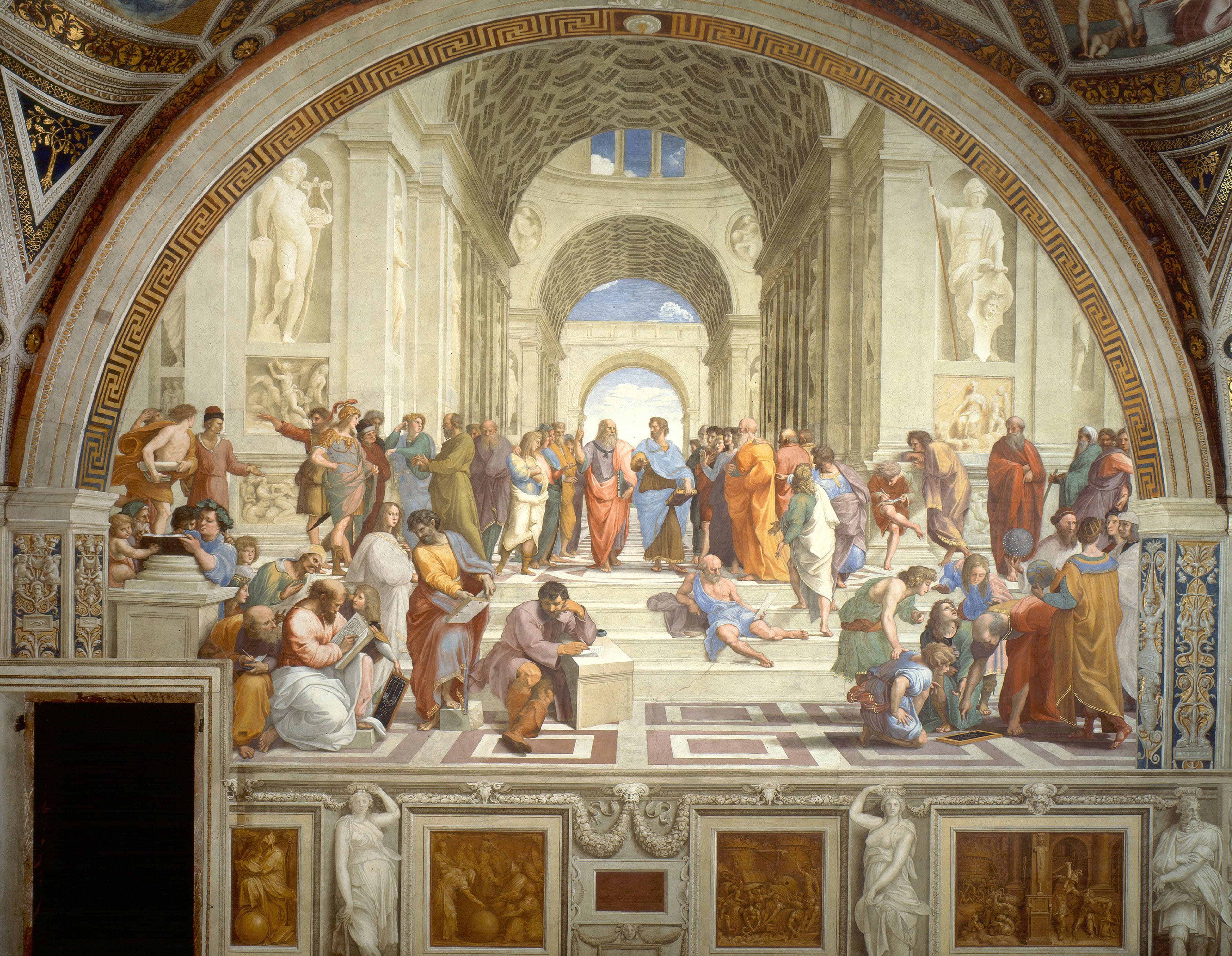
Two men come forward under the arch. Plato points one finger up for the world of ideas, and Aristotle holds his hand out flat over the floor. Raphael painted Plato with the face of Leonardo da Vinci.
Raffaello Sanzio was not yet 30 when he got the walls of the pope’s private library in the Vatican and license to paint whatever suited a place of books. He is remembered as Raphael, and on one wall he assembled the entire ancient mind in a single marble hall. More than 50 philosophers, mathematicians and astronomers stand and argue under a vault that echoes the new Saint Peter’s then rising a few hundred meters away. It has been called The School of Athens ever since, though nobody in the picture ever met. He put the two who mattered most dead center, under the last arch, small against the sky. Plato, old and white-bearded, points one finger straight up, toward the world of ideas he believed was the only real one. Beside him Aristotle, younger, holds his hand out flat and low, palm to the earth, insisting the truth is down here where you can measure it. The whole floor plan bends around that one disagreement, a raised hand and a lowered one. Raphael gave Plato the face of Leonardo da Vinci, then in his fifties and the most admired living artist, a private joke that only the court would catch. The joke goes deeper. Slumped alone on the front steps, elbow on a block of stone, brooding in a stonecutter’s tunic, sits a single glowering figure who belongs to no school and matches no ancient description. He was added late, after the rest was done, painted in the heavier, more muscular manner of the ceiling next door, and he wears the face of Michelangelo. Raphael had crept into the Sistine Chapel and seen what the older man was doing up his ladder. He answered it by planting Michelangelo in his own fresco as a loner too absorbed to talk to anyone. Down at the lower left another group crowds around a bald man writing in a book, thought to be Pythagoras. On the right a bent figure draws with a compass, and he has the features of the architect Bramante. Raphael signed the thing by walking into it. At the far right edge, half-turned out of a knot of astronomers, a young man in a dark cap looks out of the fresco, calm, turned away from every argument in the room. That is Raphael himself, standing among the geniuses he loved, aged 28. He finished the room in 1511 and died nine years later on his own birthday. The philosophers keep arguing on the wall of a working papal office, the finger up and the hand down, no closer to agreeing than the day he left them.