The Renaissance · 18 April 1521
Here I Stand
A monk facing an emperor refuses to take back a single word
look closer
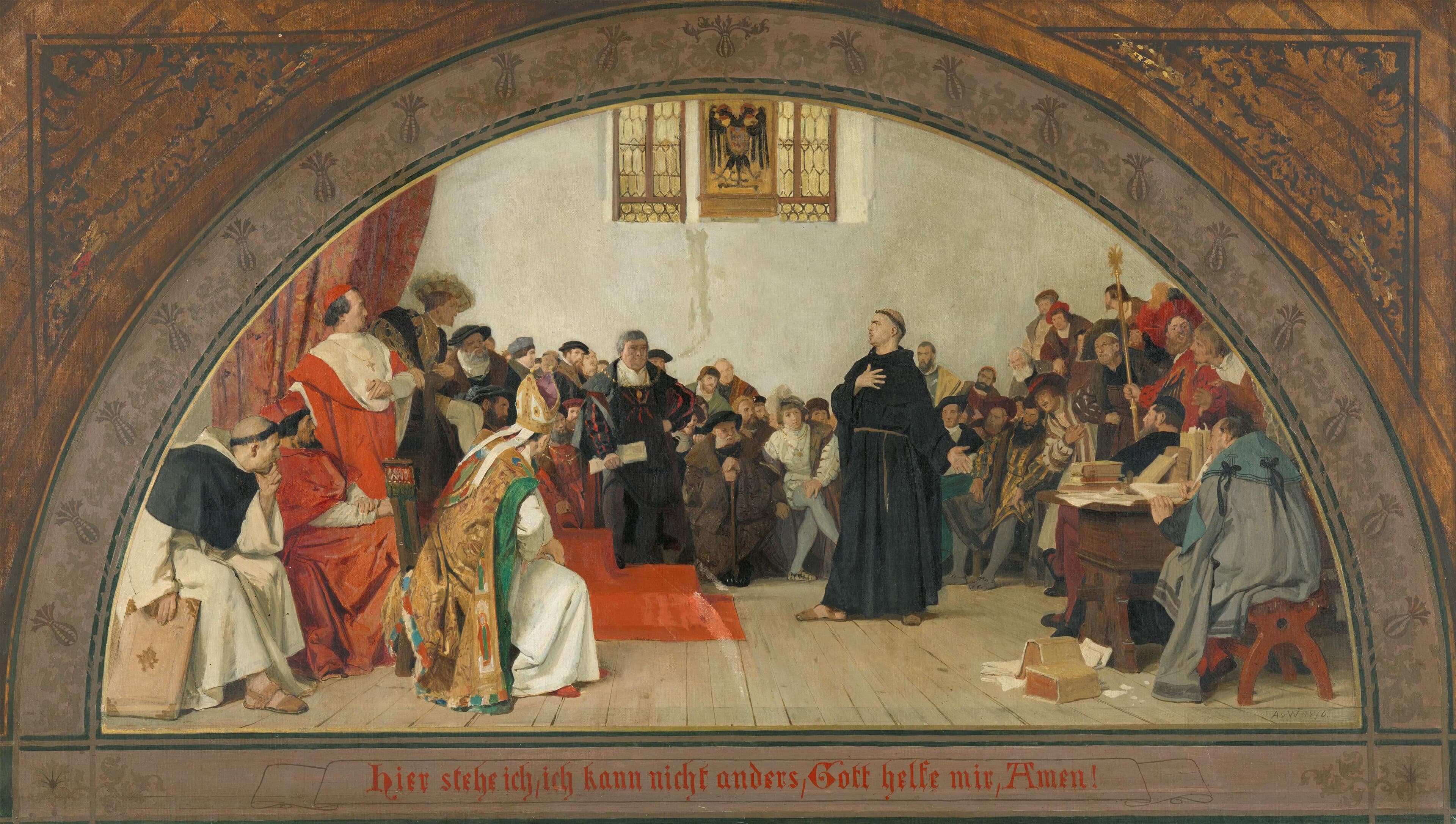
Luther stands on the open floor in a black habit with one hand flat on his chest. He will not take back a word. He was 37, and within weeks the Edict of Worms would make him an outlaw any man could kill without penalty.
On 18 April 1521 a monk stood in a crowded hall in the town of Worms and was ordered to disown his own books. In front of him sat Charles V, ruler of an empire that ran from Spain to the edge of Hungary, 21 years old, master of more land than any European since Charlemagne. The monk was Martin Luther, a professor of theology from Wittenberg, and his writings were stacked on a table so he could see them. The question put to him was simple. Would he recant what he had written, yes or no. He had asked for a day to think, which he got, and came back the next evening. He would not recant, he said, unless he could be convinced by scripture or plain reason, because to act against conscience was neither safe nor honest. The transcripts record him ending, God help me. Amen. The famous line, here I stand, I can do no other, does not appear in the earliest accounts; a note-taker seems to have added it soon after, and it stuck because it fit the man. Charles was unmoved. Within weeks he signed the Edict of Worms declaring Luther an outlaw whom anyone might kill without penalty. On the road home Luther was seized by masked riders, his own protector’s men, and hidden in a castle for the best part of a year. What kept him alive was a machine. In the autumn of 1517 he had written 95 arguments against the selling of pardons for sin. Printers copied them, and within weeks they were being read across the German lands, then translated and read further. A single monk’s complaint had become, by the time he reached Worms, a movement no emperor could recall, because you cannot un-print a thing once the presses have it. The German scripture he translated in that castle sold out its first run almost at once. The scene here was painted more than three centuries later by Anton von Werner, a German history painter. He shaped it to the arch of the school hall in Kiel he was decorating. That mural was 3.5 meters high and 7 across. It burned in an air raid in 1944. Von Werner built the faces from old engravings. The churchmen bank along the left, the archbishop of Mainz in a gold cope with his back turned, and Luther stands alone on the bare boards with one hand on his chest. The double-headed eagle of the empire hangs in the window above them all. Along the very bottom, added like a banner, runs the sentence Luther probably never quite said: here I stand, I can do no other, God help me, Amen. The eagle is still an empire. The monk in the middle of the room has already won and does not know it yet.