The Renaissance · 1543
The Book That Moved the Earth
A cathedral canon publishes the sun at the center as he lies dying
look closer
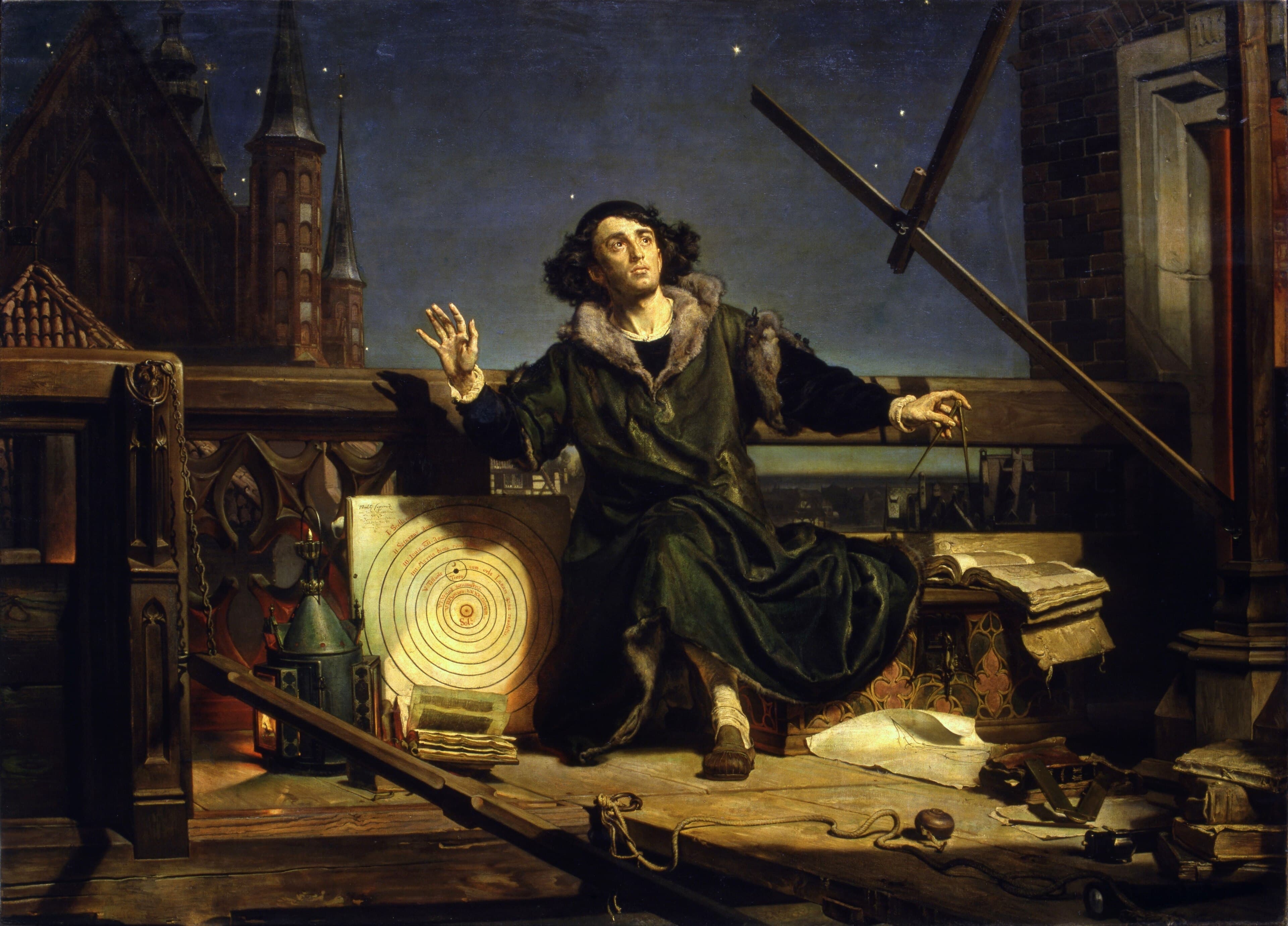
Copernicus tips his head back and stares up. His left hand is open and empty at shoulder height. Matejko painted him after the discovery rather than during it, and he looks at what he has done.
For most of his life Nicolaus Copernicus kept the biggest idea in Europe in a drawer. He was a church canon at Frombork on the cold Baltic coast of Poland, a lawyer and doctor and administrator who did his astronomy on the side, from a tower in the cathedral wall. Somewhere around 1510 he had worked out that the numbers came out simpler with the sun at the center instead of the Earth. The Earth became just one more planet swinging around it, turning once a day. He wrote it up. Then, for roughly 30 years, he mostly declined to publish, wary of ridicule and of the Church. A young Lutheran mathematician named Rheticus finally pried it loose. He traveled all the way to Frombork, stayed two years, and talked the old man into letting the manuscript go to a printer in Nuremberg. It came off the press in 1543 as De revolutionibus orbium coelestium, on the revolutions of the heavenly spheres. It was dedicated to the pope: six books of geometry that took the ground out from under the human race. Someone, an editor named Osiander, slipped an unsigned note into the front claiming the whole thing was only a calculating trick and need not be believed. He did it without permission. Rheticus was furious and scratched the note out of his own copy in red. Copernicus did not live to fight about it. The story, half legend, is that his fellow clergy laid the first printed copy in his hands on the day he died, in the spring of 1543. In the story he woke enough to see it, and then was gone. Whether he truly saw it, nobody can prove. What is certain is that he died just as the book appeared and never had to answer for it. It would sit on the Church’s list of forbidden books decades later, long after he was dust. The Polish painter Jan Matejko began the canvas in 1871, for the 400th anniversary of Copernicus’s birth, and called it Conversation with God. Poles bought it afterward by public subscription for the great hall of the university in Kraków. He set Copernicus outdoors on a stone terrace at night, alone, instruments scattered around him, the spires of Frombork cathedral black against the stars. Propped on the boards at his feet, lit as if from inside, stands his own diagram of the new heavens: neat rings of orbit around a small circle lettered Sol. He is not calculating. He has stopped, thrown his head back, and is staring straight up at the thing he has just moved. He was a churchman who rearranged the heavens, then slipped out of the argument by dying at the exact moment his book came alive.