The Renaissance · 24 August 1572
The Morning Bell of Paris
A wedding fills the city with Protestants, then a bell rings at dawn
look closer
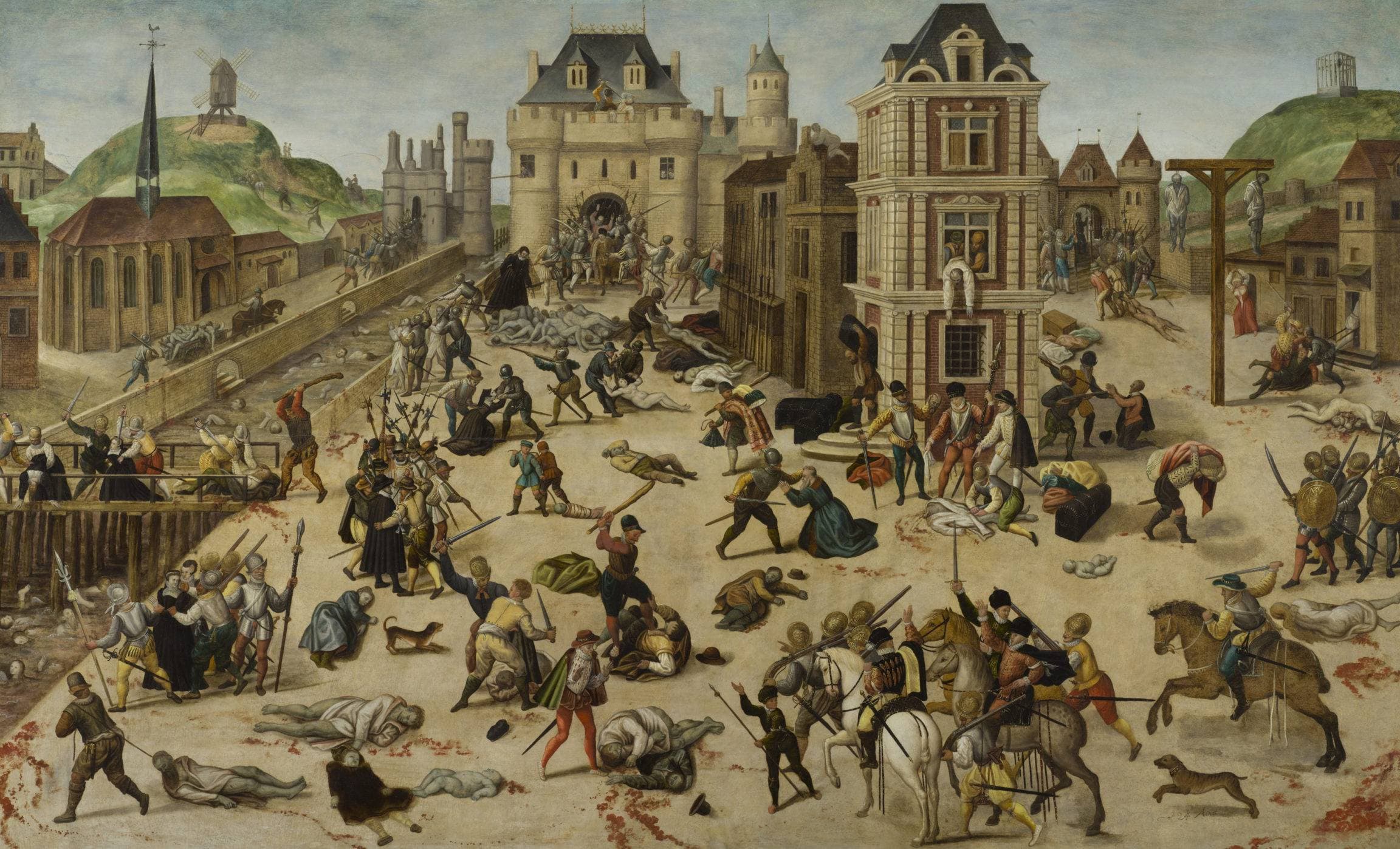
Two men push a body in a white shirt head first over a window ledge. This is Gaspard de Coligny, the admiral of France. They killed him in his bedroom upstairs, and the crowd below took the head and the hands.
On 24 August 1572, before daylight, a church bell rang in Paris and the killing began. Six days earlier the city had hosted a wedding meant to knit France back together. Marguerite de Valois, sister of the Catholic king, had married Henri of Navarre, leader of the Protestant Huguenots. Thousands of prominent Protestants were in town to celebrate. Among them was Admiral Gaspard de Coligny, the most powerful Huguenot in the kingdom and a man the king had begun to trust. Two days before the bell, someone shot Coligny in the street from a window. The gun wounded him but did not kill him. What the wound did was panic the court into finishing the job on everyone. In the dark of St Bartholomew’s Day, soldiers under Henri, Duke of Guise, broke into Coligny’s lodging and killed him in his bedroom. Guise, waiting below, called up to ask if it was done, and ordered the body thrown out of the window into the street. The crowd took it from there, cutting off the head and the hands and dragging what was left through Paris. That was the signal, more or less, and the rest of the city followed. Neighbors killed neighbors they had known for years. Roughly 3,000 people died in Paris in a few days, and thousands more as the violence spread to other towns through the autumn. François Dubois was a Protestant from Amiens who got out of France alive, and years afterward he laid the whole morning across one panel for a fellow refugee, a banker from Lyon. Whether he saw any of it himself is unknown. What he painted is the entire massacre at once, a city square strewn with the dead and the dying while the well-dressed do the killing. On the corner of a fine stone house, Coligny appears twice, once being tipped from an upper window in a white shirt, once as the headless body on the ground below. Off to the left a cart is loaded with corpses beside a church, and on the green hill behind it riders run people down. On the right, men stagger away under looted chests, because a massacre is also a robbery. Dubois signed nothing sentimental into it. He painted the plunder and the small casual murders in the same even daylight as the great crime, dogs sniffing at the bodies, hats knocked into the dirt. At the back, tradition says, the queen mother Catherine de’ Medici comes out to inspect the results. It is the only painting by Dubois that survives. He spent the rest of his life in Geneva and died there on 24 August 1584, 12 years to the day after the bell, and the panel hangs now in Lausanne.