Ancient Rome · 2 September, 31 BC
Sixty Ships Turned Home
A queen hoists sail mid-battle and an empire follows her out
look closer
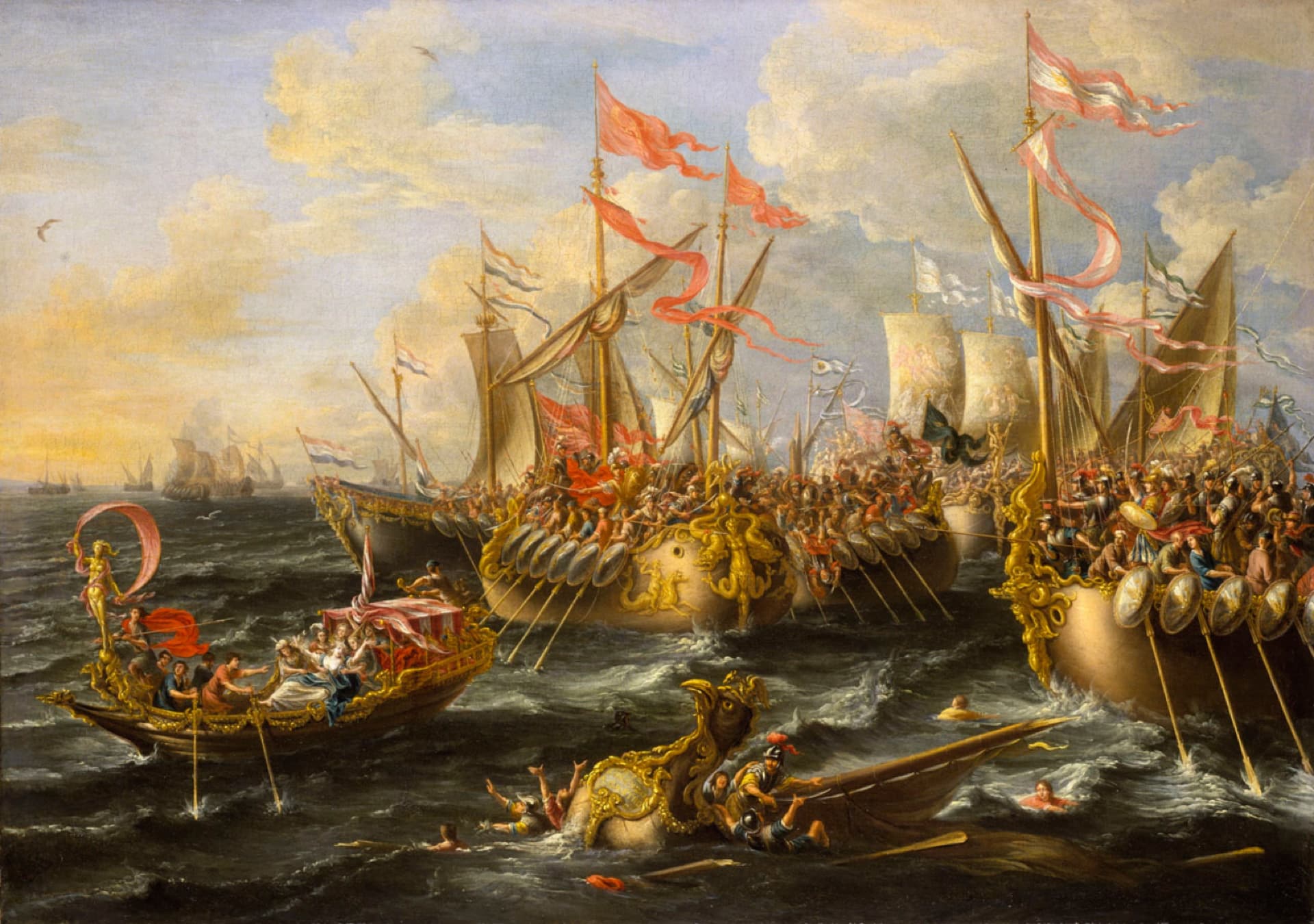
Cleopatra reclining under the striped awning while the rowers pull and a man in red points the way out. The gilt figurehead on the prow is already turned away from the fighting.
The last war of the Roman Republic was declared against a foreign queen, because that was easier to sell. Antony held the East with Cleopatra's fleet and Cleopatra's money. Octavian held Italy. He had also seized Antony's will from the Vestal Virgins and read it to the Senate: money left to Cleopatra's children, and instructions that Antony be buried beside her in Alexandria. Rome could forgive a civil war, but not an address. By the summer of 31 BC Antony's grand fleet sat blockaded inside the Ambracian Gulf, on the west coast of Greece. Octavian's admiral Agrippa picked off the supply ports, and malaria worked through the rowing benches. Antony burned the ships he could no longer crew. On 2 September he came out to fight, or to leave; historians have argued about which ever since, because his captains had stowed the sails aboard, and you carry sails to run, not to battle. For hours the heavy quinqueremes ground against Agrippa's lighter line. Early in the afternoon the wind came round. Cleopatra's 60 ships had been waiting in the rear with the war treasury in their holds. They raised sails, went through the middle of the fight, and out to sea. Antony left his flagship, boarded a faster ship, and followed with a few dozen more. Plutarch spent one furious sentence on it: he was dragged along after the woman as if he had grown into her flesh. The fleet he abandoned fought on into the evening without knowing it was leaderless, then surrendered or burned. The 19 legions on shore waited a week for orders and went over in a body. A year later Octavian took Alexandria. Antony and Cleopatra managed their exits by sword and, the story says, by snake. Egypt became a province, and within four years the man who had been Octavian was Augustus. On the headland above the battle he built a Victory City, Nicopolis, with a monument faced in the bronze rams of captured warships. The rams are gone, but archaeologists still count the empty sockets. Lorenzo A. Castro painted the battle in 1672 with the only navy he knew: baroque galleys with gilded sterns, streaming pennants, an admiral's barge got up like a floating throne room. In his left foreground Cleopatra is already going, under a red canopy behind a gilt figurehead that trails a pink streamer, her prow turned out of the fight. In the center of the canvas, sailors go into the water off a capsized gilded hull. The canvas hangs in the National Maritime Museum at Greenwich among the fleet actions, where it is the oldest war in the room.