Feudal Japan · Spring, 1592
The Army That Crossed the Sea
Having taken Japan, Hideyoshi ships an army at Korea and aims past it at China
look closer
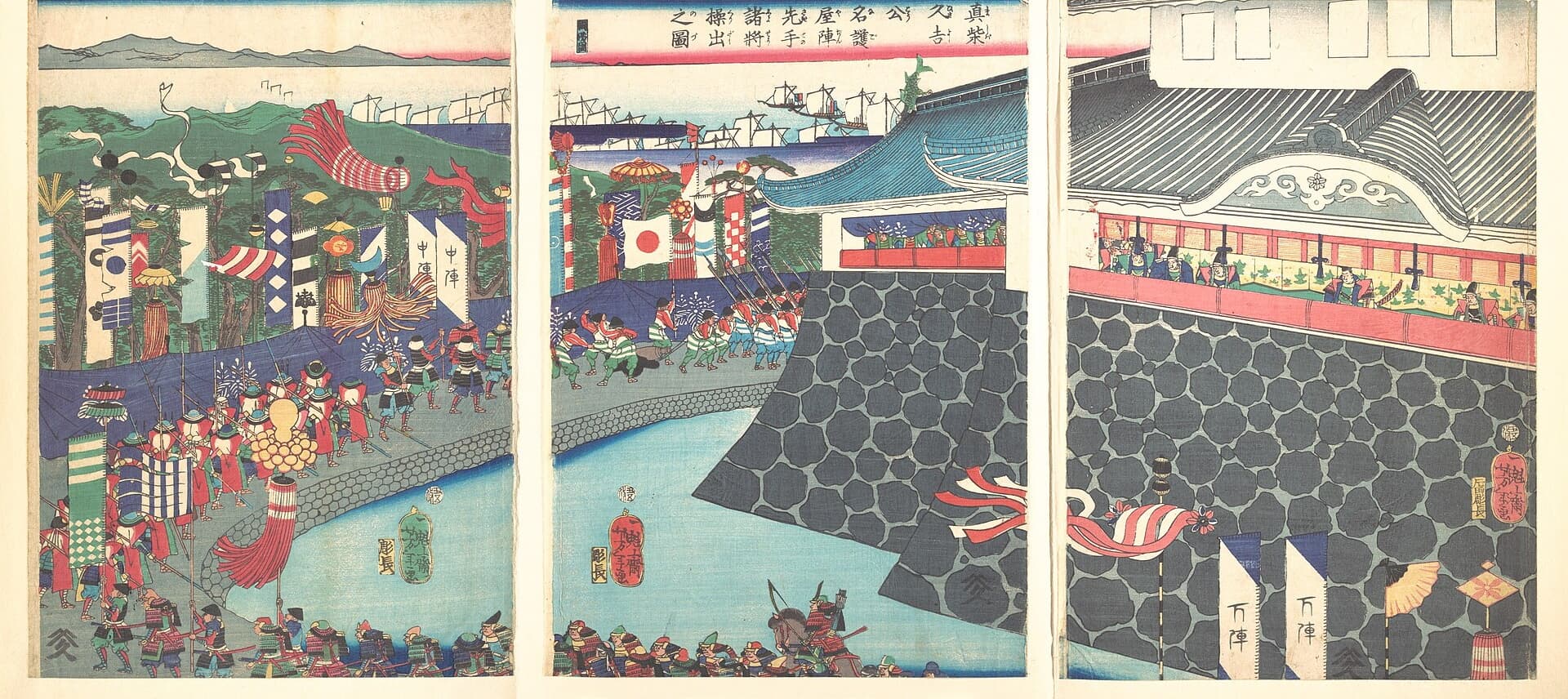
Soldiers in red and green file along the wall with their lances up. A red sun-disc banner and a striped standard are raised over their heads. About 160,000 men crossed to Korea in the first months of the invasion.
In the spring of 1592 Toyotomi Hideyoshi, master of a Japan he has just finished uniting, gathers an army of roughly 160,000 men and points it across the water at Korea. The plan is to march through Korea and conquer Ming China beyond it. He builds a new fortress town at Nagoya, on the northwest tip of Kyushu, as the staging camp, and from there the divisions cross to the mainland. On the 13th day of the fourth month the first of them, under Konishi Yukinaga, land at Busan. They are among the most experienced soldiers on earth, hardened by a century of civil war and armed with the matchlocks that had won Nagashino. They move north at frightening speed, taking Seoul in under three weeks and Pyongyang by summer. Then the sea turned on them. The Korean admiral Yi Sun-sin commanded a fleet that included the armored geobukseon, the so-called turtle ships. He began sinking the Japanese supply convoys one squadron at a time, and off Hansan Island he destroyed a fleet in a single day. An army that had raced up the peninsula found the sea road behind it cut. Ming China sent troops down from the north, Korean guerrillas rose in the countryside, and the swift conquest congealed into a grinding war of sieges and hunger and winter that neither side could win. A second invasion in 1597 went no better, and the whole enterprise ended not in victory or defeat but in a death. Hideyoshi died in 1598, at Fushimi, and his council ordered the armies home. Nothing had been gained, Korea was wrecked, and Japan had spent six years and tens of thousands of lives on it. Hideyoshi ran the invasion of the continent from his camp at Nagoya and never set foot on the mainland. The print is by Tsukioka Yoshitoshi, made in the nineteenth century, and it shows the army leaving. Hideyoshi’s castle rises at the right behind a long stone wall lined with watching officers, banners and lances fill the courtyards, and ranks of soldiers file out along the water below the wall. Yoshitoshi has to disguise his subject a little, since printing the real Hideyoshi was restricted in his day, so the name on the sheet is Mashiba Hisayoshi, 2 characters off from Hashiba Hideyoshi. What he does not disguise is the scale of it: rank on rank on rank, a whole country’s army walking out past the stonework toward the boats.