Medieval Europe · 30 March 1282
The Bell for Vespers
An insult at a church door on Easter Monday empties an island of its rulers
look closer
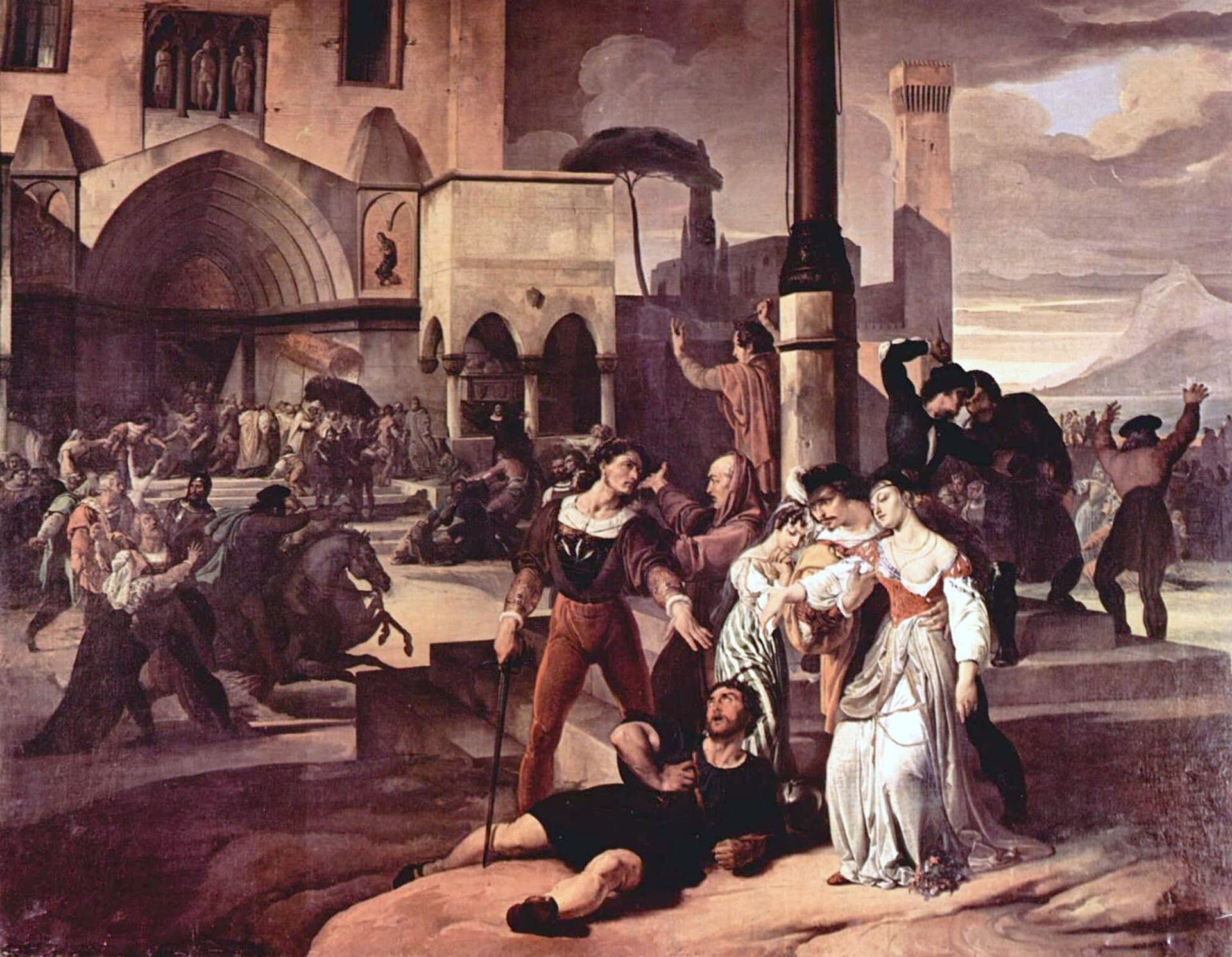
A French soldier plants his feet and puts a hand out toward the women at the right. This is Drouet, and the lily stitched on his chest marks him as French. He holds his sword down in the other hand, with the point at the ground.
The bell rang for the evening prayer and the killing started with it. It was Easter Monday, the thirtieth of March 1282, outside the church of the Holy Spirit on the edge of Palermo. Sicilians had gathered there in the cool of the evening for the service called vespers. Sicily had been ruled for 16 years by Charles of Anjou, a French prince the pope had installed as king, and his soldiers and tax men were resented in every town on the island. As the crowd waited, a party of them came among the women, half drunk, and a sergeant named Drouet took hold of a married woman on the pretext of searching her for weapons. Her husband put a knife in him on the spot. It was the last thing Drouet did. What might have stayed a brawl became a slaughter because the whole island was waiting for a spark. The Sicilians around the church fell on the Frenchmen and cut them down, and as the vesper bells of Palermo went on ringing the rising ran through the city. The mob hunted the French through the streets and into the churches and killed them, and by a chronicler’s report even dragged Sicilian women thought to be carrying French children out to die. The password, the story goes, was ciciri, the Sicilian word for chickpeas, which a French mouth could not get right. Anyone who failed was killed. Within six weeks more than 3,000 French were dead across the island, and Charles of Anjou had lost Sicily in a single Easter week. The island did not go back. Having thrown out one foreign king, the Sicilians offered the crown to another, Peter of Aragon, whose wife had a claim. The war that followed dragged Aragon, France, and the papacy through 20 years of fighting over the wreckage. Sicily stayed with Aragon and its Spanish successors for centuries afterward. More than five centuries later the affair handed the Italian movement for unification a ready-made national legend. It was the day the people of one island rose in an evening and threw their masters into the sea. It also gave Giuseppe Verdi the plot for a grand opera, which he wrote for Paris, of all cities, in 1855. Francesco Hayez painted the moment the insult catches fire, around 1822, and painted it as theater. Drouet stands in a dark doublet with a French lily stitched on his chest, one hand out toward a bride in white. Her head falls back and her family closes around her. A man lies at Drouet’s feet, propped on an elbow, looking up. Behind them the rising boils up the church steps, a horse plunging in the middle of it. A tower and a bare mountain stand off to the right under a heavy sky. This was the first of the several versions Hayez made of the scene, painted in his studio at the Brera in Milan for the marchesa Visconti d’Aragona. Hayez was a northerner painting a southern story for his own political century. The Italy he was addressing was still cut into pieces, half of it under foreign rule, and it would have known exactly which occupier he meant.