Medieval Europe · 3 October 1226
The Wounds on the Mountain
A friar fasting on a peak comes down marked with the five wounds of Christ
look closer
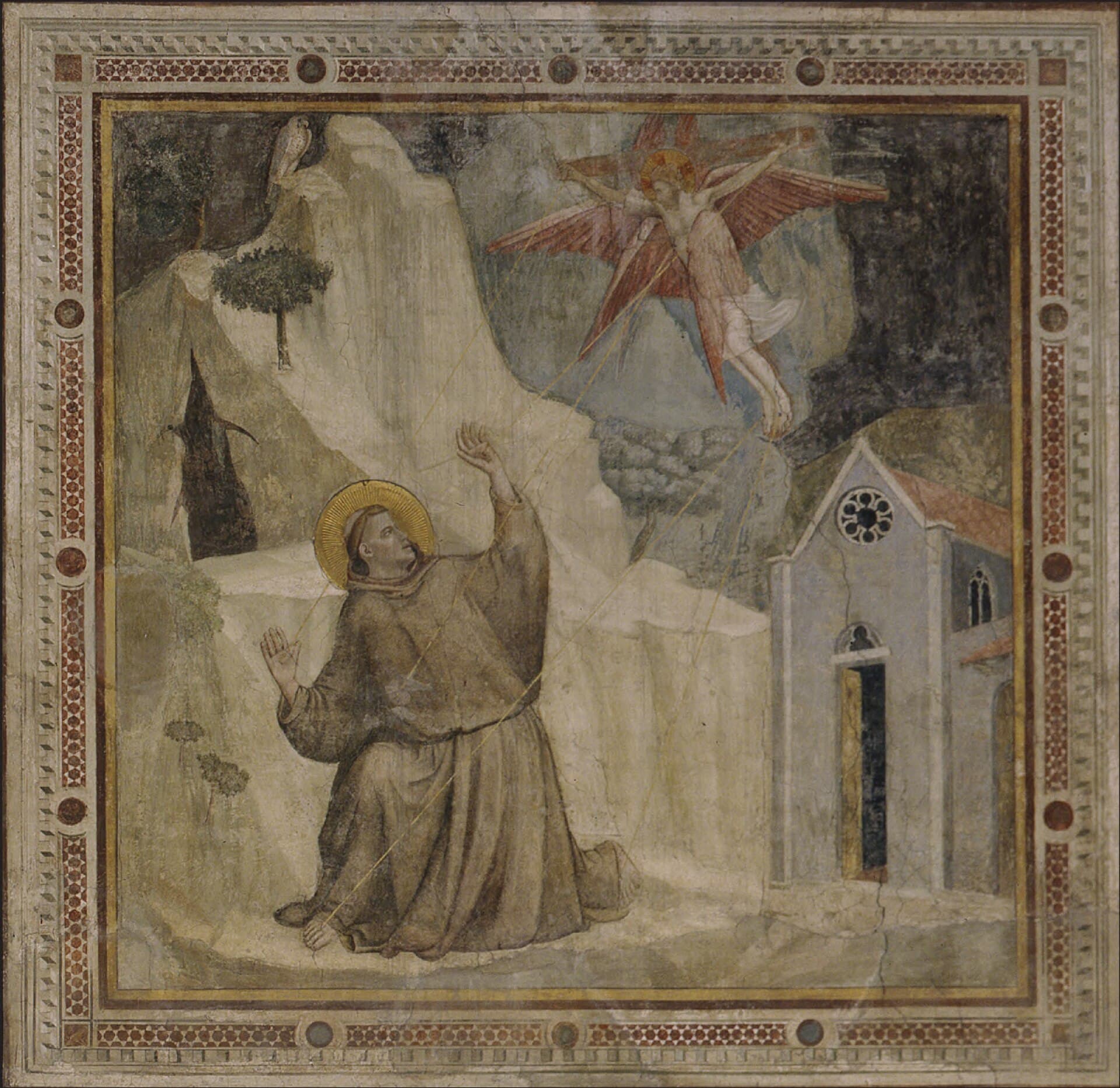
Francis tips his head back with both hands open, and thin gold lines run down across the bare rock to meet them. He was 42, going blind, and had two years to live.
He had gone up the mountain to fast. In September 1224, Francis of Assisi climbed La Verna, a rock in the Tuscan Apennines given to him by a lord who admired him. He kept a hard 40-day fast toward the feast of Saint Michael, praying in a hut apart from the few brothers who had come with him. He was 42 and going blind and had perhaps two years to live. On or about the fourteenth, the feast of the Exaltation of the Cross, his companions later said, he had a vision at dawn. A six-winged seraph came to him with the figure of a crucified man between its wings. When it faded there were wounds in his hands and feet and side, the marks of the nails and the lance, and he carried and hid them for the rest of his life. It is the first case of the stigmata the Church records, the wounds of the cross turning up on a living body. What is strange is how ordinary the man underneath it was. Francis was a cloth merchant’s son from Assisi. He had gone to war as a young man, been captured, and come home changed. Then he gave everything away. He stripped off his clothes in the town square, in front of his furious father and the bishop, to say he would take nothing more from him. He preached to anyone, walked barefoot, and kept no money. He took the whole created world for family. He is supposed to have preached to a field of birds, and to have struck a bargain with a wolf that had been eating the people of Gubbio. The order he founded to live that way had already grown into thousands in his own lifetime. It had begun to argue about whether so much poverty was practical, and that argument outlived him by a century. He came down from La Verna and did not last long. Nearly blind, in constant pain, he dictated a hymn to the sun and to what he called Brother Fire and Sister Water, and near the end added a verse welcoming Sister Death. He died on the evening of the third of October 1226, on the bare ground by his own wish, 44 years old. Two years later the pope made him a saint, faster than almost anyone before or since. Giotto painted this over the door of the Bardi family’s chapel in Santa Croce in Florence, around 1320, a full century after the vision on the mountain. Giotto is the hinge where painting turns back toward the solid world. His figures have real weight and real ground to kneel on, after ages of flat gold. Here he sets Francis alone on the rock, arms up, gold threads running from the winged figure’s wounds to his own. The winged figure is not an angel. It is a man with six wings, hanging with his arms out, come down to hand Francis his own pain. Down at the right Giotto put a plain church with a rose window, a real building among the symbols. The chapel was plastered over in the 16th century on the orders of Duke Cosimo the First, and Florence did not see this wall again until restorers took the plaster off in the 1800s.