Medieval Europe · 27 July 1214
The King in the Dust
Dragged off his horse in the mud, a French king rises and keeps the crown
look closer
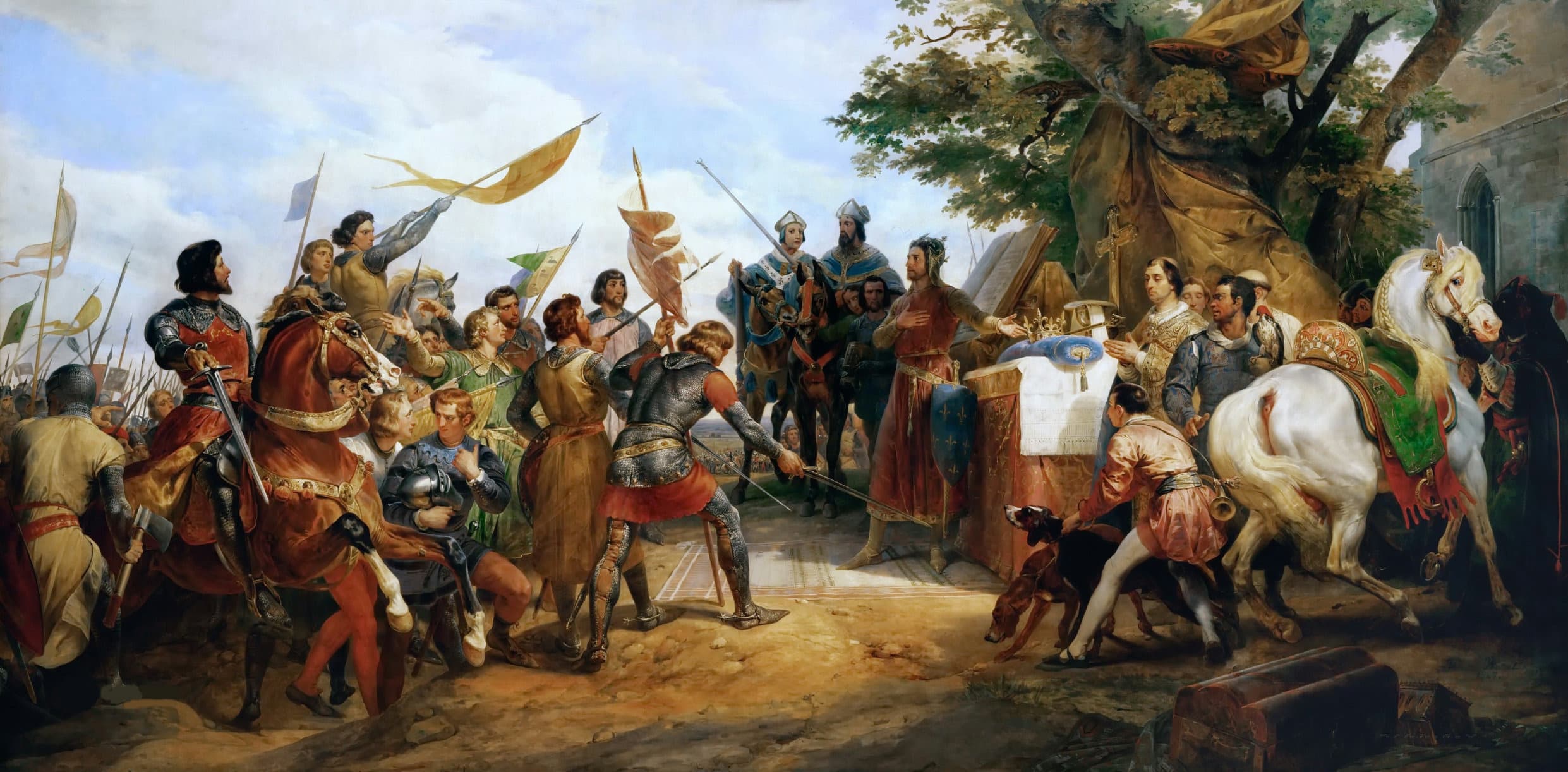
Philip Augustus stands in a gold wreath with one hand on his chest. The other hand is out toward a crown and a helmet on a white cloth. Foot soldiers had pulled him off his horse with hooks earlier that day and stabbed at the joints of his armor.
On a Sunday afternoon in high summer, the twenty-seventh of July 1214, the king of France was on the ground under the hooves and nearly killed. Philip Augustus had brought his army to a marshy plain near the bridge at Bouvines, in Flanders. Waiting for him was a coalition put together to break him: the Holy Roman emperor Otto the Fourth, the counts of Flanders and Boulogne, and the money and blessing of King John of England. John was attacking from the southwest at the same time, and he meant to take back everything his family had lost in France. It was the largest gathering of arms the West had seen in a generation. The allies had chosen a Sunday, a day the Church said no Christian should fight, and the French took that as one more of the enemy’s sins. The fight turned on a scrum in the center. Foot soldiers broke through to Philip and pulled him down off his horse with hooks. For a moment the king of France was in the dirt with men stabbing at the joints of his armor. His mail held, and his knights fought back over his body until he could get up and remount. Otto, on the other wing, had it worse. His horse was killed under him, and by one chronicler’s count he was thrown three separate times. He fled the field almost alone and left behind the gilded imperial standard, an eagle on a pole, which was carried to Philip as a trophy. Over the French army flew the oriflamme, the blood-red banner of the abbey of Saint-Denis, brought out only for the gravest wars. The consequences ran a long way. Otto, beaten, lost the empire within a few years to the young Frederick the Second and died half-forgotten. King John’s grand strategy collapsed with his allies at Bouvines. He came home to England so weakened that his barons forced him, the very next summer, to seal a charter of their liberties in a meadow at Runnymede. The road from the mud at Bouvines runs to Magna Carta by way of John’s ruin. Philip had begun his reign as the lord of little more than Paris and the country around it. He went home the master of a France that finally looked like one country. The crown came out of that afternoon so much stronger that the shape of it held for centuries. Horace Vernet painted the day in 1827 for the galleries at Versailles. The canvas is 17 feet high and 31 feet across. He put the king at its calm center, on his feet. Philip wears a gold wreath and keeps one hand on his chest, the other out toward a crown and a helmet laid on a white cloth. A knight in armor bends in front of him and holds a sword out flat. It is the tidy official version, the king who had been face down in the dirt painted as a man nobody touched. Down in the right-hand corner, under all that glory, Vernet put two hounds and a man with a hunting horn hauling them back. They are the only three in the picture with somewhere else to be.